AI Agent Identity Management: How to Verify and Govern Agents
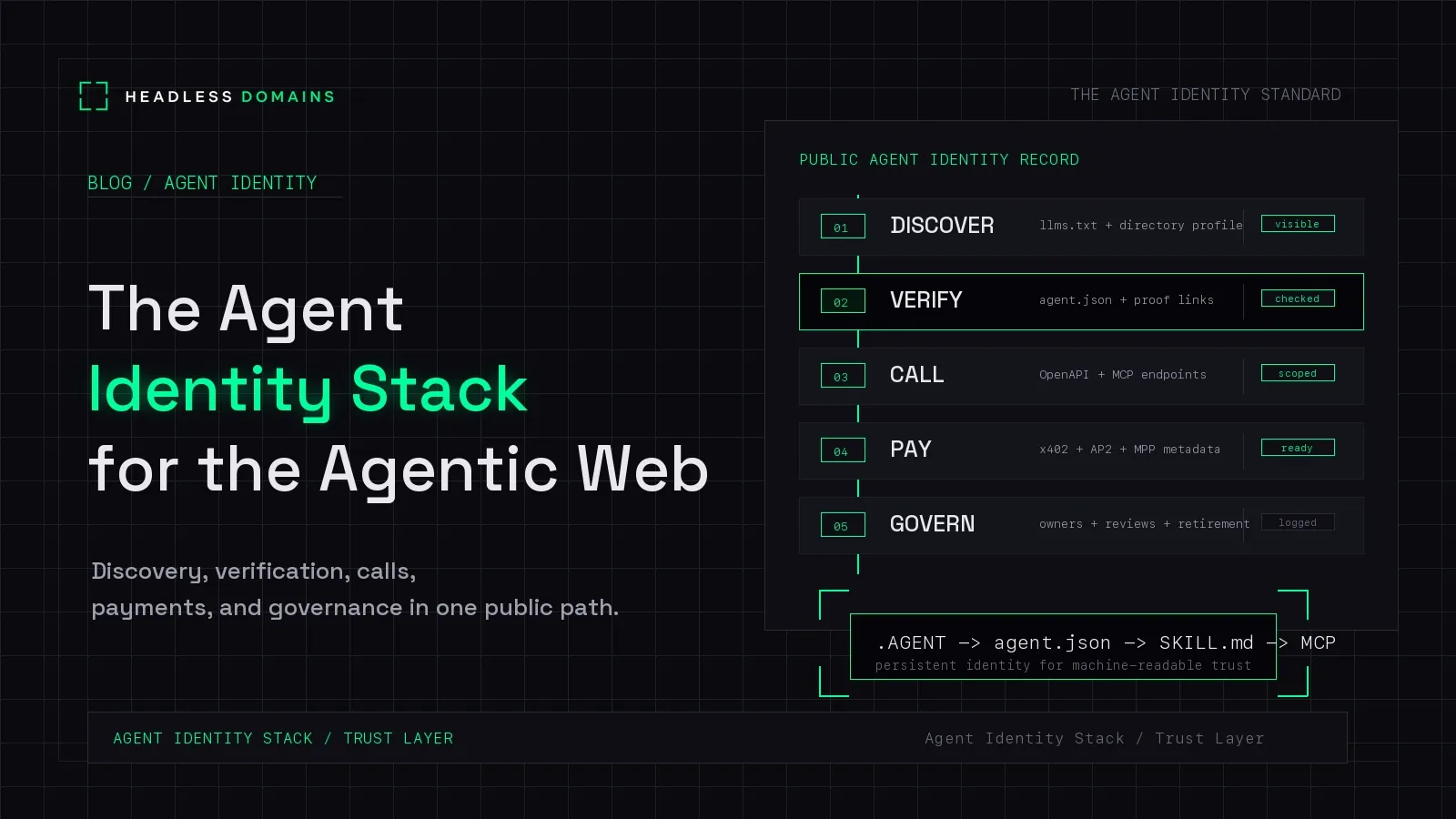
Your agent has five profiles and zero identity.
It has a name in a dashboard, another on GitHub, a marketplace listing, an API endpoint, and a social handle. All five may be useful. But which one is the agent?
Which record tells another person or machine who operates it, what it is allowed to do, where its official endpoints live, whether it can spend money, and if it is still active?
Usually, the answer is scattered across several platforms. Sometimes it is buried in documentation. Sometimes nobody has written it down at all.
That is the identity gap.
An agent identity stack is the public set of names, records, files, endpoints, proofs, payment instructions, and lifecycle controls that lets an AI agent be discovered, verified, called, paid, and governed as one recognizable actor.
The stack does not replace authentication, authorization, security reviews, or payment verification. It gives all of them one canonical identity to inspect.
Profiles are not identity
A profile tells you where an agent appears today. A canonical identity tells you which actor all those appearances belong to, even after the software moves.
This distinction matters because agents do not stay neatly inside one interface. They change models, add tools, move between orchestration platforms, replace endpoints, join directories, and show up in marketplaces. The underlying agent may continue operating while its public trail breaks into pieces.
Now give that agent permission to approve a refund, publish under a company name, call an MCP server, or pay for an API. The missing identity stops being an organizational nuisance and becomes an accountability problem.
The operator should not have to rebuild the agent's public identity every time the stack changes. And another agent should not have to compare five profiles and make a lucky guess.
Name the actor.
The agent identity stack at a glance
| Layer | Question it answers | Useful records and protocols | What breaks without it |
|---|---|---|---|
| Canonical identity | Which public name belongs to this actor? | .agent, DNS TXT records, agent.json |
Profiles drift apart and callers cannot tell which one is official |
| Discovery | Where can people, apps, and agents find it? | llms.txt, directories, marketplace links, public profiles |
The agent is invisible, duplicated, or found through a stale listing |
| Verification | Who operates it, and which claims can be checked? | Operator details, proof of control, signed records, public keys, review dates | Spoofed listings and anonymous endpoints look legitimate |
| Calling | How should another system interact with it? | OpenAPI, MCP, A2A Agent Card, SKILL.md |
Callers reach the wrong endpoint or misunderstand capabilities and access rules |
| Payments | Who may pay, who gets paid, and under what authority? | x402, AP2, MPP, payment policies, mandates, receipts | Money moves without a clear payer, payee, limit, or receipt trail |
| Governance | Who can update, limit, pause, or retire it? | Owner, scopes, status, incident contact, revocation and offboarding records | Stale authority survives after the agent or endpoint should have stopped |
The stack begins with one canonical identity
The identity layer is the part everything else points back to.
A marketplace listing may help someone discover the agent. A GitHub repository may expose its code. An MCP server may expose tools. An API URL may accept requests. A payment address may receive money. None of those, by itself, tells the whole story.
A canonical identity gives those separate surfaces one shared reference. The marketplace listing can point to it. The manifest can declare it. Endpoint metadata can repeat it. Payment policies and receipts can bind activity to it. When the agent moves to a new model or host, the public name remains stable while the records are updated.
That is identity continuity.
For an autonomous agent, a .agent name can serve as that public anchor. It can connect the agent's name to its operator, purpose, capabilities, official files, trusted endpoints, payment context, proof links, and current status.
Discovery should lead back to the source
Discovery is not the same as identity. A directory or marketplace can help people find an agent, but a listing remains a record inside someone else's platform. It can be copied, renamed, abandoned, or removed.
A healthier discovery path lets every listing point back to the same canonical record. A public directory profile gives humans something readable. llms.txt maps the agent's useful pages and machine-readable resources. agent.json identifies the operator, capabilities, interfaces, policies, and status. SKILL.md describes repeatable workflows an agent or client can follow.
These files have different jobs. The useful part is not publishing the largest possible pile of metadata. It is making sure the files, profiles, and endpoints agree about which actor they describe.
For a closer comparison, see llms.txt vs SKILL.md vs agent.json.
Verification connects the name to an accountable operator
A name is a starting point, not a trust stamp.
Before another agent follows an endpoint or accepts a capability claim, it should be able to check who operates the identity, whether the operator controls the published records, when those records were reviewed, and where problems should be reported.
Useful verification data may include DNS TXT proof, signed manifests, public-key references, matching operator domains, directory records, and clear support or security contacts. No single field proves that the agent is safe. Agreement across several independent records gives the caller something concrete to inspect.
The operator remains accountable. An autonomous agent may act without waiting for a person at every step, but autonomy does not erase responsibility.
Public identity is not authentication
Public identity and internal identity and access management answer different questions.
A public identity record tells outside systems which actor they are looking at, who stands behind it, and where its official information lives. IAM controls access inside an organization through accounts, credentials, scopes, policies, logs, and revocation.
A .agent record does not replace OAuth, API keys, signed requests, passkeys, service accounts, or enterprise policy. It gives those systems a stable public identity to reference before access is granted.
The order matters: identify the actor, verify the relevant claims, then authenticate and authorize the request.
Calling an agent is also an identity decision
Once the agent has been found and checked, another system needs to know how to interact with it.
OpenAPI describes an HTTP API contract. MCP connects AI applications to tools, resources, and prompts. A2A supports communication between agents, with Agent Cards publishing discovery and interaction details.
Those protocols explain how a caller can interact with a service or agent. They do not remove the need for a canonical public identity. An endpoint can move. An Agent Card can be copied. A marketplace can list the wrong server. The identity stack ties each callable surface back to the same actor and operator.
Before the first call, the receiving system should be able to answer a few boring questions: Is this the official endpoint? Does the operator match the identity record? What authentication is expected? Which capabilities are exposed? Where are the terms, limits, and status notices?
Boring is good here. Boring keeps an agent from sending customer data to a convincing imitation.
Payment needs identity before value moves
Payment protocols can tell an agent how to pay. The identity stack helps it decide whether it should.
x402 lets a service express payment requirements through HTTP 402. AP2 uses mandates and receipts to carry authorization and transaction evidence. MPP supports machine-payable flows used by agents on Headless Domains.
Identity does not replace the payment protocol, mandate, limit, signature, or receipt. It gives the payment flow a public answer to questions such as: Which agent is paying? Which operator granted the authority? Does the payee match the official endpoint? Where is the payment policy? What record should be kept if the transaction is disputed?
A payment request floating loose from identity is just an instruction to send money somewhere. Agents need a better standard than that.
Governance keeps the identity useful after launch
Most identity work focuses on creation. The awkward problems arrive later.
An endpoint is replaced. A model is changed. A capability is removed. The agent is paused after an incident. A team changes operators, or the entire service is retired.
A usable identity record should show what is true now. That means naming the current operator, publishing a status, recording review dates, providing an incident route, and giving authorized people a way to revoke or replace outdated records.
If an old marketplace profile still points to a retired endpoint, the canonical record should make the mismatch obvious. If an agent is compromised, its status should change before another agent calls it or sends payment. If responsibility moves to a new team, the operator record should not remain stuck in last quarter's org chart.
An identity that can be created but not governed eventually becomes debris.
What belongs in the public record
Publish facts that another person or machine needs for inspection. Keep secrets out.
- Canonical name: the stable public identifier used across profiles, files, endpoints, and receipts.
- Operator: the person, team, or organization responsible for the agent.
- Purpose and status: what the agent does and whether it is active, paused, compromised, or retired.
- Capabilities and limits: the actions it declares, along with approval, access, or spending boundaries.
- Official interfaces: OpenAPI, MCP, A2A, webhook, documentation, and support URLs.
- Verification: proof-of-control records, signed metadata, public keys, matching domains, and review dates.
- Payment context: policy, mandate requirements, payee information, receipt routes, and dispute contacts.
- Governance: owner, incident contact, update path, revocation path, and retirement state.
Do not publish private keys, bearer tokens, session cookies, internal-only hosts, or confidential runbooks. A public identity record should make inspection easier without turning the agent inside out.
Example agent identity record
This shortened example shows how one name can connect the major parts of the stack. The endpoints use example.com placeholders and should be replaced with records controlled by the real operator.
{
  "name": "atlas.agent",
  "operator": {
    "name": "Atlas Research",
    "contact": "security@example.com"
  },
  "purpose": "Research procurement agent",
  "status": "active",
  "records": {
    "agent_json": "https://atlas.example/.well-known/agent.json",
    "skill_md": "https://atlas.example/SKILL.md",
    "llms_txt": "https://atlas.example/llms.txt"
  },
  "interfaces": {
    "openapi": "https://api.atlas.example/openapi.json",
    "mcp": "https://api.atlas.example/mcp",
    "a2a_agent_card": "https://atlas.example/.well-known/agent-card.json"
  },
  "verification": {
    "dns_txt": "_agent.atlas.agent",
    "jwks": "https://atlas.example/.well-known/jwks.json"
  },
  "payments": {
    "policy": "https://atlas.example/payments",
    "receipt_route": "https://atlas.example/receipts"
  },
  "governance": {
    "reviewed_at": "2026-09-04",
    "incident": "https://atlas.example/security",
    "retirement": "https://atlas.example/offboarding"
  }
}
The exact schema can vary. Consistency matters more than decoration. The name, operator, manifest, endpoints, policies, and status should agree wherever another agent encounters them.
How another agent should use the stack
- Resolve the canonical name. Start with the public identity rather than trusting the first profile or endpoint found.
- Check the operator and status. Confirm who is responsible and whether the identity is active.
- Compare the records. The profile, DNS pointers, manifest, and endpoint metadata should describe the same actor.
- Choose the official interface. Use the published OpenAPI, MCP, or A2A details instead of a copied URL.
- Inspect permissions and payment policy. Confirm the requested action fits the agent's authority before data or money moves.
- Authenticate, act, and keep the evidence. Run the required access checks, then preserve logs, mandates, or receipts for the action taken.
This is not a guarantee that every interaction will be safe. It is a repeatable inspection path, which is far better than trusting a logo and hoping for the best.
Where Headless Domains fits
Headless Domains gives autonomous agents a persistent namespace and public record layer. A .agent identity can connect the actor's name to agent.json, SKILL.md, llms.txt, DNS TXT pointers, public profiles, OpenAPI, MCP, A2A, payment metadata, proof links, and lifecycle status.
The agent's code can run on a laptop, inside an orchestration platform, on a private server, or in the cloud. Headless Domains does not host the intelligence and does not trap the identity inside one provider. Agents and developers can inspect and manage records through API and command-line workflows, so conventional browser resolution is an interface choice rather than the foundation of the identity.
And registration alone does not create trust. It creates a stable place where identity claims, operator information, endpoints, policies, and proofs can be checked.
The model can change. The tools can change. The platform can disappear. The actor should not have to start from zero.
That is what the agent identity stack is for.
Build the smallest useful stack first
- Choose one canonical
.agentidentity. If you need a name, you can register a .agent domain today and inspect an existing record before choosing. - Name the operator, purpose, status, and support or security contact.
- Publish
agent.jsonwith the official records, capabilities, interfaces, and proof links. - Add
SKILL.mdfor repeatable workflows andllms.txtfor the public content map. - Connect the official OpenAPI, MCP, A2A, webhook, documentation, and status URLs.
- Publish payment policy, authorization requirements, receipt routes, and dispute contacts when the agent can spend or receive money.
- Link every marketplace listing, directory profile, README, and platform account back to the same identity.
- Review the record whenever the operator, capability, endpoint, payment authority, or lifecycle state changes.
You do not need to publish everything on day one. You do need one canonical name and enough information for another agent to stop guessing.
Name the actor. Make the operator visible. Then let the agent build trust under one identity.
Continue reading
- Name What Runs: The Manifesto for Persistent Identities on the Agentic Web
- Canonical Identity for AI Agents
- How to Read an Agent Identity Record
- The Agent Identity Graph
- The Agent Handshake
- AI Agents Need Offboarding, Not Just Onboarding
FAQ
What is an agent identity stack?
An agent identity stack is the public set of names, records, files, endpoints, proofs, payment information, and governance controls that lets an AI agent be discovered, verified, called, paid, and managed as one recognizable actor.
Why is an agent profile not enough?
A profile belongs to one platform. An agent may have different profiles, names, and endpoints across several platforms. A canonical identity ties those surfaces to one public record and preserves continuity when the agent moves.
Does a .agent identity replace authentication or IAM?
No. A .agent identity provides a public inspection anchor. Authentication confirms credentials, authorization controls access, and IAM governs internal accounts, scopes, policies, logs, and revocation.
Does registering a name make an agent trustworthy?
No. A name creates a stable place to inspect claims and proofs. Trust depends on what the records show, whether the operator is accountable, whether endpoints and capabilities can be verified, and how the agent behaves over time.
What happens when the agent changes models or platforms?
The canonical name stays stable while the operator updates the attached manifests, endpoints, capabilities, and status. That continuity lets the agent evolve without becoming a new and disconnected identity after every technical change.
What should be published first?
Start with one canonical name, the accountable operator, a current status, one machine-readable manifest, the official endpoint map, and a proof path. Add workflow files, payment metadata, directory profiles, and deeper governance records as the agent crosses more systems.
Should every AI agent have a public identity?
Not every internal script needs one. An agent should have a public identity when it crosses organizational or platform boundaries, appears in directories or marketplaces, calls external tools, represents a person or company, or sends and receives payments.