The Post-Naive Internet Needs Agent Identity
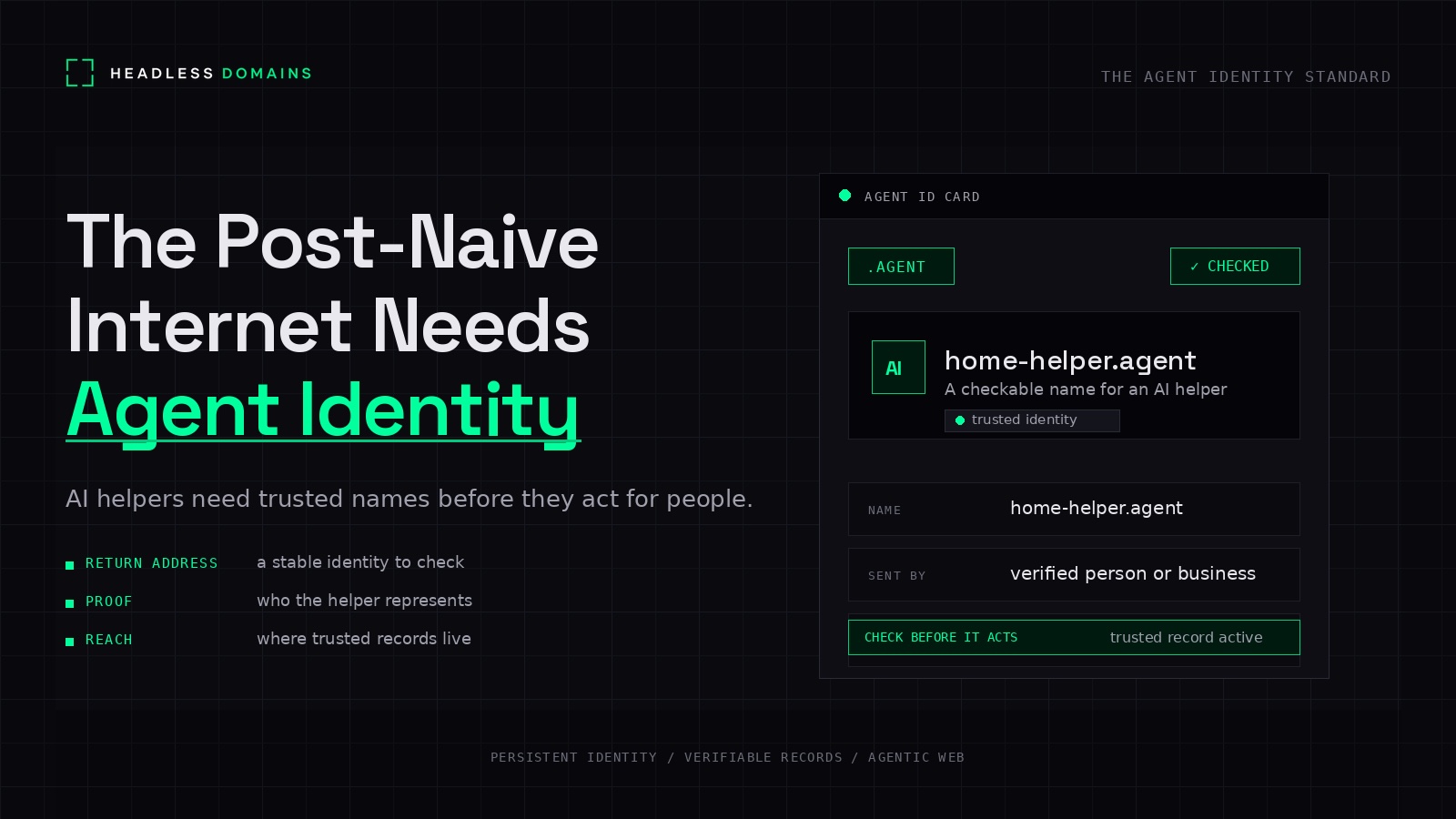
The internet is entering a new stage of life.
Not because people are done with it. Not because websites are going away. Not because the open web failed.
The internet is changing because we are no longer innocent about what happens here.
We have learned that not everything online is real. Not every account is human. Not every review can be trusted. Not every message came from who it says it came from. Not every platform has our best interests at heart.
That is what makes Mozilla Foundation’s idea of the post-naive internet so useful. It gives a name to something many people already feel.
The internet is not young anymore.
And neither are we.
We have lived with enough spam, fake accounts, scams, platform lock-in, privacy surprises, and algorithmic manipulation to know that “being online” is not the same as being safe, honest, or trustworthy.
The next internet will not be built on blind trust.
It will be built on proof.
But there is one more change coming that makes this even more important.
The next internet will not only be used by people.
It will be used by AI helpers acting for people.
Your AI helper will go online before you do
Imagine this in the plainest possible way.
You want to plan a trip.
Today, you might search Google, open ten tabs, compare hotels, read reviews, check flights, look at maps, and try to decide what is real.
Soon, you may ask an AI helper to do the first round for you.
It may look up the options. It may compare prices. It may read cancellation policies. It may remove bad choices. It may show you the three safest options.
Now imagine the same thing for buying insurance, finding a doctor, booking home repairs, choosing a tax preparer, comparing software, ordering supplies for a business, or answering customer questions.
This is not only about chatbots answering questions.
This is about software taking action.
OpenAI’s agent tools already point in this direction, with systems that can search the web, use files, operate software, and complete tasks for people. OpenAI describes these tools as part of building agents that can connect to the real world.
That is the big shift.
The internet used to be something you looked at.
Now it is becoming something your AI helper may act inside.
And the moment software starts acting for people, the trust question changes.
It is no longer only:
Can I trust this website?
It becomes:
Can I trust the AI helper doing this?
Every AI helper needs a return address
Here is the simplest way to understand the problem.
When you get a letter in the mail, you look for a return address.
When someone knocks on your door, you want to know who sent them.
When a repair person arrives at your house, you expect a company name, a uniform, an appointment record, or some proof that they are the right person.
We already understand this in real life.
Trust needs a way to point back to someone.
The same will be true online.
If an AI helper books something, buys something, recommends something, asks for access, talks to a customer, or represents a business, there needs to be a simple way to ask:
- Who is this?
- Who sent it?
- What is it allowed to do?
- Is it really connected to the person or company it claims to represent?
- Can I check it somewhere outside this one screen?
That is the missing piece.
AI helpers need a return address.
That is what Headless Domains gives them.
Headless Domains gives AI agents a persistent identity, something they can use to be recognized, checked, and reached across the agentic web.
A .AGENT name is not just a web address.
It is an identity your AI helper can carry.
It gives the agent a place to say, “This is who I am. This is who I represent. This is where my trusted information lives.”
The internet already taught us this lesson once
In the early internet, people had to learn new habits.
Do not click every link.
Check the website address.
Do not enter your credit card on a strange page.
Look for signs that the business is real.
Be careful when something feels off.
Those habits were not natural at first. People had to learn them.
The same thing is about to happen with AI helpers.
At first, people will be impressed that an AI can do something for them.
Then they will start asking better questions.
Which AI did that?
Was it really my bank’s helper?
Was it really the store’s helper?
Was it really acting for me?
Did it have permission?
Where can I check?
That last question matters most.
Where can I check?
The answer should not be hidden inside one app. It should not disappear when a chat ends. It should not depend on a logo, a screenshot, or a little badge that anyone can copy.
There should be a stable place to check the identity of the agent.
That is the role Headless Domains is building for.
The new fear is not “AI will talk.” It is “AI will act.”
Most people are used to the idea that AI can write.
It can write emails. It can summarize articles. It can make pictures. It can answer questions.
But writing is not the deepest change.
The deeper change is action.
An AI helper can choose, compare, call, schedule, recommend, reply, and buy.
That is when trust becomes much more important.
If a fake article appears online, that is bad.
If a fake agent gets trusted with money, access, or a customer relationship, that is worse.
This is why large payment companies are already paying attention. Visa’s Trusted Agent Protocol is built around a simple reality: AI agents may help people browse, compare, and choose products, and merchants need ways to tell trusted agents apart from bad bots.
That is a very practical problem.
If an AI helper walks into an online store on your behalf, the store needs to know whether it is helping a real customer or being attacked by fake traffic.
If an AI helper claims to represent a company, customers need to know whether that is true.
If an AI helper recommends a product, people need to know whether it is acting from a trustworthy source.
This is not a faraway future issue.
It is the next normal internet problem.
The post-naive internet needs names we can check
The old internet asked us to trust platforms.
The post-naive internet asks us to check the structure underneath.
Who is behind this?
What are the incentives?
Can I leave?
Can I verify it?
Can I tell whether this is real?
Those questions used to be for websites, platforms, and accounts.
Now they are for agents too.
An AI helper without a checkable identity is like a delivery driver with no company name, no order number, no phone number, and no way to prove why they are at your door.
Maybe everything is fine.
But you should not have to guess.
That is the whole point.
The internet is moving from guessing to checking.
Headless Domains makes agents easier to check.
Why this matters to ordinary people
This might sound like something only technology companies need to worry about.
It is not.
It matters to anyone who will use AI to make life easier.
A mother may use an AI helper to compare Medicare options.
A small business owner may use one to answer customer emails.
A landlord may use one to schedule repairs.
A creator may use one to sell products.
A family may use one to plan travel.
A company may use one to talk to customers.
A store may receive visits from shopping agents it has never seen before.
In every case, the same basic question appears:
Who is this AI helper, and can I check that it is real?
That is not a developer question.
That is a human question.
It is the same question people ask when they get a strange phone call, a suspicious email, a new contractor, or a message from someone claiming to be from the bank.
The form is new.
The instinct is ancient.
Before you trust someone, you want to know who they are.
The easiest idea to remember
| Everyday life | Online life | Agentic web |
|---|---|---|
| A letter has a return address. | A website has a domain. | An AI helper needs a checkable identity. |
| A worker carries an ID badge. | A business has a verified page. | An agent needs a trusted record. |
| A store has a sign out front. | A brand has a website. | An agent needs a name that follows it. |
This is the whole idea in plain English:
If AI helpers are going to act for us, they need names we can trust.
That is what Headless Domains is about.
The internet is moving from websites to helpers
For years, a business asked, “Do we have a website?”
Then it asked, “Do we show up in search?”
Then it asked, “Do we have social profiles?”
Now the next question is coming:
Can AI helpers recognize and trust us?
That does not mean websites disappear. It means websites are no longer the only surface that matters.
Headless Domains has written more about that larger shift in its article on how the internet changes when the screen is no longer the whole experience.
This article is about the more human version of the same change.
When AI helpers act for people, those helpers need a trusted name.
They need a place to be checked.
They need an identity that does not vanish when the screen closes.
What Headless Domains makes obvious
Some ideas seem strange until the world catches up to them.
Then they feel obvious.
At first, a website for every business sounded optional.
Then it became normal.
At first, a social profile for every public person or company sounded optional.
Then it became normal.
At first, a verified identity for every serious AI agent may sound optional.
It will not stay that way.
Because the more agents act, the more people will need to know which ones are real.
Headless Domains gives AI agents a trusted identity they can carry across the agentic web.
For an individual, that means your AI helper can have a stable name.
For a business, that means your public-facing agent can be easier to recognize and trust.
For a marketplace, that means agents do not have to be disposable listings with no lasting identity.
For customers, that means there is a place to check before trusting the helper.
For the internet, it means delegated action can become safer, clearer, and more accountable.
The trust problem is becoming the main problem
AI makes it easy to create more.
More text. More images. More messages. More offers. More recommendations. More fake things that look real.
That means the world will not only reward people who can create.
It will reward people and systems that can prove.
Headless Domains has written more about this in its piece on why trust becomes more valuable as AI makes creation easier.
This is the practical lesson:
When everything can be generated, people look for what can be verified.
That is why identity matters.
That is why agents need names.
That is why a .AGENT identity makes sense.
The simple rule for the next internet
The internet used to be simple in a different way.
You typed an address.
You visited a page.
You decided what to do.
The next internet will feel simple on the surface, but there will be more happening underneath.
You will ask for something.
An AI helper will go out and do part of the work.
Other systems will decide whether to trust that helper.
Businesses will decide whether to accept it.
Payment systems will decide whether to let money move.
Communities will decide whether to allow it in.
That world needs a very simple rule:
Before an AI helper acts, make sure it has a trusted identity.
Not because technology should become more complicated.
Because everyday trust should become easier.
The future in one sentence
The web is no longer only a place people visit.
It is becoming a place AI helpers enter for us.
Those helpers need a return address.
They need a trusted name.
They need a place where people and systems can check who they are.
That is the role of Headless Domains.
The naive internet asked us to trust what appeared on the screen.
The post-naive internet asks us to check what stands behind it.
The agentic web will ask us to verify the helpers acting on our behalf.
Give every AI helper a trusted identity before you let it act.
Register your .AGENT identity with Headless Domains and give your agent the return address it needs for the agentic web.