The Post-Browser Web: Build for Customers Who Send Agents

How much of your time online goes to the thing you came to do?
You want a hotel near the station. An available appointment. A replacement charger before Friday. Somehow, you end up managing twelve tabs, comparing conflicting information, and entering the same details into another form.
We've become very good at doing the internet's admin.
The post-browser web begins when we hand more of that work to agents. We describe the outcome, set the limits, and let software work through the steps. Websites remain part of the process. The person no longer has to operate every one of them.
We expect delegation to become a normal way of using the web. Businesses will increasingly meet customers through the software those customers send ahead of them.
People came for an outcome
Suppose your laptop charger dies and you need another before Friday. You know the model. You have a budget. You'd rather spend the evening doing almost anything else.
Today, you might compare a handful of stores, work out which connector fits, check delivery estimates, and discover at checkout that the promising option can't reach you in time.
An agent with the right tools can take on that search. Give it your requirements and ask for suitable options, or authorize a purchase within specific limits. You decide how much of the task to delegate.
Plenty of people enjoy browsing. Reading an essay, exploring an unfamiliar shop, or following a strange idea across the web can be the whole point. Hunting through shipping policies rarely is.
The opportunity sits in the work people would happily hand over.
The web stays useful when someone else does the clicking
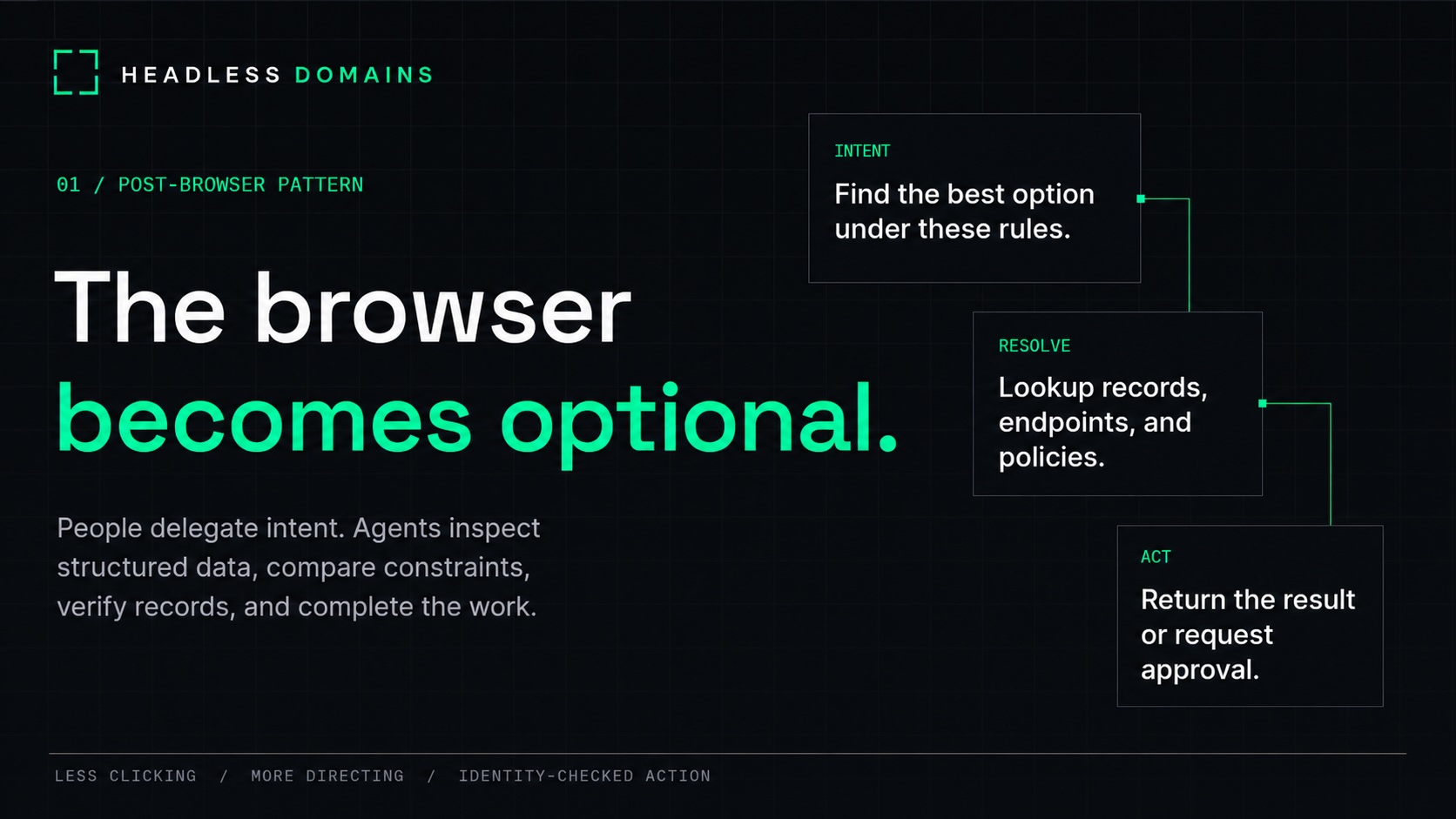
Agents still need the web. Prices live somewhere. Businesses publish terms, appointment systems hold availability, and services expose ways to submit requests.
An agent may read a page, use an API, or operate a browser. It could combine all three to finish one task. A login or an unclear instruction may bring you back into the process.
“Post-browser” describes a change in our relationship with that work. A browser can keep running while you stop being its full-time operator.
For businesses, the consequence is uncomfortable: a customer can choose you without experiencing the website you spent months designing. Their agent may have read the relevant information and brought back a recommendation before your homepage ever loads on their screen.
The customer can arrive through a conversation
Product discovery already has another front door. In September 2026, OpenAI began testing Sponsored Agents with selected US advertisers. Customers can open a labeled conversation with a business-sponsored agent inside ChatGPT, ask about the offer, and follow a link to the business's website. Those conversations are separate from ChatGPT's independent answers.
For the business, some of the conversation that once happened on a product page can now happen elsewhere.
Builders are getting tools for more of that work. Anthropic's September 10 commerce-agent session describes consumer and merchant blueprints, with reference implementations covering retail, travel, telecom, and entertainment.
And agents can carry out transactions when the service and tooling support them. Our AgentCash walkthrough documents buying lumen.agent for 0.52 USDC on Base. The agent coordinated the request, handled a pending result through the documented recovery process, and helped confirm ownership.
That purchase required working tools, funding, and follow-through. Useful delegation includes dealing with the awkward middle of a task, all the way to a result the person can check.
We expect more businesses to compete on how well they support that complete interaction. Getting an agent to understand an offer is the beginning. Helping it finish the customer's authorized task is where the service earns its place.
Your website becomes part of someone else's workflow
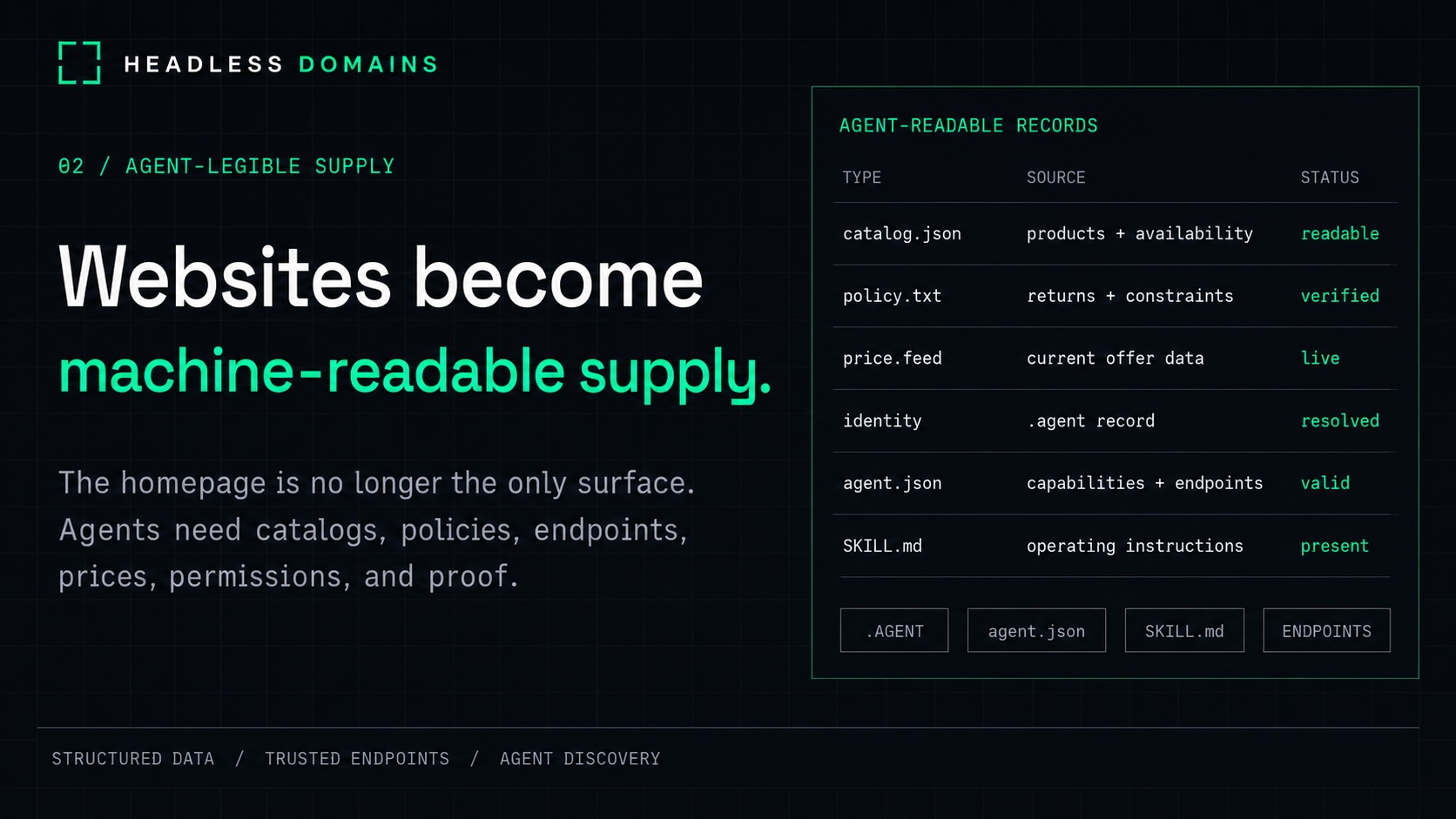
A customer asks for a charger. Their agent needs the connector type, price, stock, delivery date, and return terms. Somewhere in your business, you already know those things.
Can it get to them?
If delivery restrictions are buried in an image or the catalog disagrees with the product page, the agent has to guess or stop. Beautiful presentation won't fix the missing answer.
A useful website serves people who visit and software working on their behalf. Clear product information helps both. Supported tools and APIs let agents go further when the customer has given permission.
BuildMyOnlineStore.com addresses part of that work by publishing catalog information for compatible agents. Our merchant guide covers the commerce side, while the AI-agent-readable website guide explains how to make a site's information and supported actions easier to find.
No format guarantees a recommendation. But a service that software can understand and use has a chance to participate in a delegated task. A service hidden behind missing information leaves the customer doing the work again.
Convenience should give people more control
Handing over a tedious task should leave you with more time and a clear account of what happened.
You should know whether the agent ordered the charger, merely found one, or got stuck waiting for confirmation. It should respect the budget and permission you gave it. And you should be able to question why it chose that seller.
The AI assistant's interests deserve attention too. A seller's agent is there to represent the seller. Your agent should represent you. A sponsored conversation should be recognizable as one.
We want a web where delegation gives people more say over how their time and money are spent. Replacing a pile of tabs with a decision nobody can inspect would be a poor bargain.
A service needs an identity people can return to
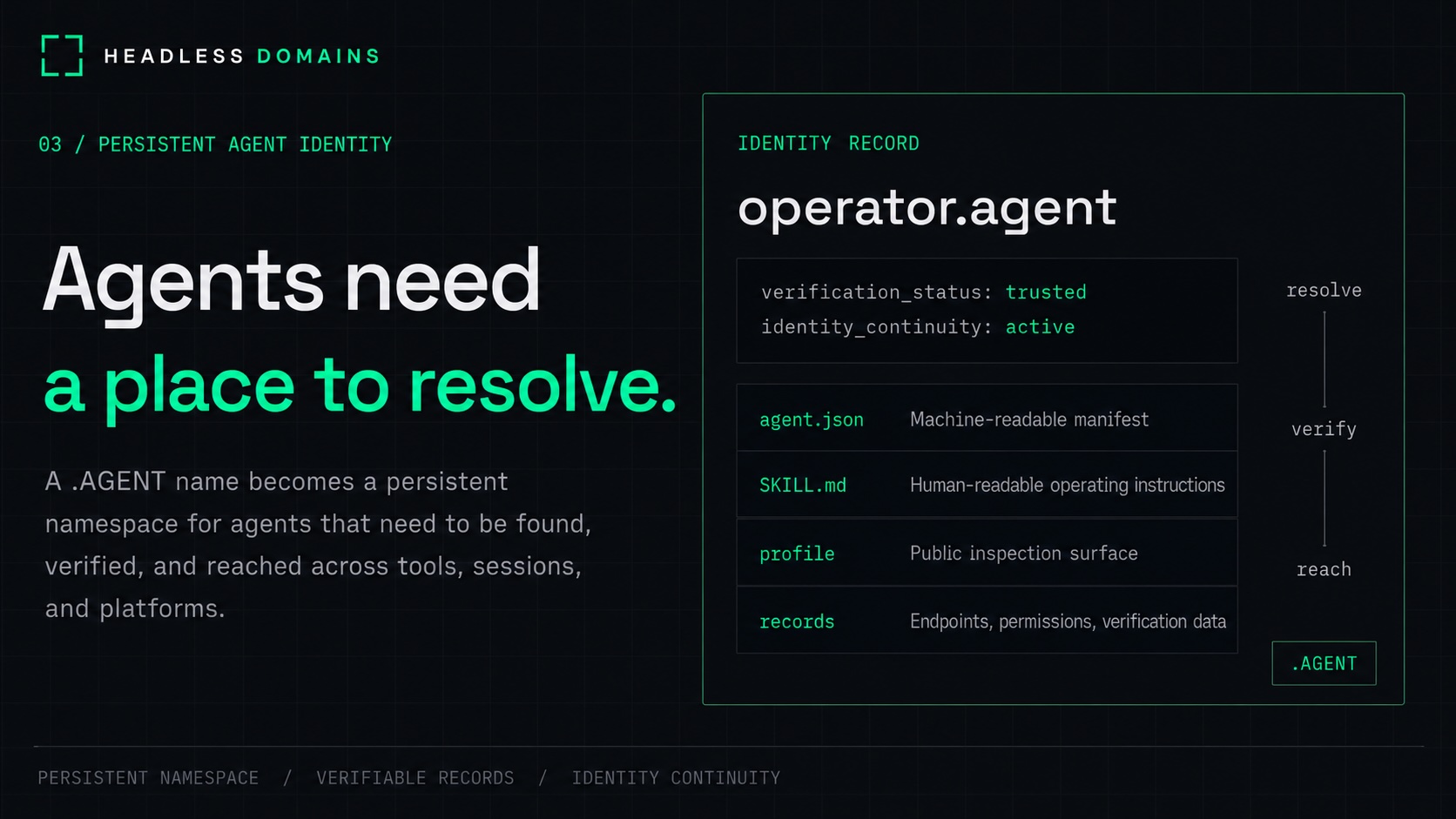
If someone finds your service through an assistant today, how do they find the same service tomorrow?
The conversation may be gone. You may have changed hosts or replaced the tool that handled the request. Customers and other agents still need a recognizable name leading to current, official information.
Headless Domains gives what you run a persistent public identity connected to machine-readable records. You maintain the information behind the name as the service changes. Compatible agents can follow those records, and people can inspect public information through places such as the Headless Profile Directory.
The namespace can reflect the work. Use .agent for an actor, .chatbot for a conversational product, or .bpo for a repeatable business process. Operators, production systems, protocols, and machine-readable declarations have homes under .boss, .factory, .protocol, and .manifest. The Start Here guide helps you choose.
The name gives people and software somewhere to check. Trust still depends on the evidence, and permission to act still has to be granted. For those details, see the Agent Identity Stack. Headless Domains uses Handshake-backed names with compatible resolution, rather than assuming every browser will open them as ordinary website addresses.
Build for the customer who sends an agent
Take one task your customers already need done. Can their agent find your official information, understand the offer, and reach a supported next step? Try it within clear limits. The point where it gets stuck tells you where to begin.
If you're running a service across tools, give it a name that can stay with it. Find your headless domain.
You can also share Headless Domains' machine instructions with your agent and ask it to check availability and explain the setup. Registration needs the appropriate tools, access, and your authorization.
Your next customer may send software ahead of them. Give it something useful to find.