The New Business Unit Is the Agent
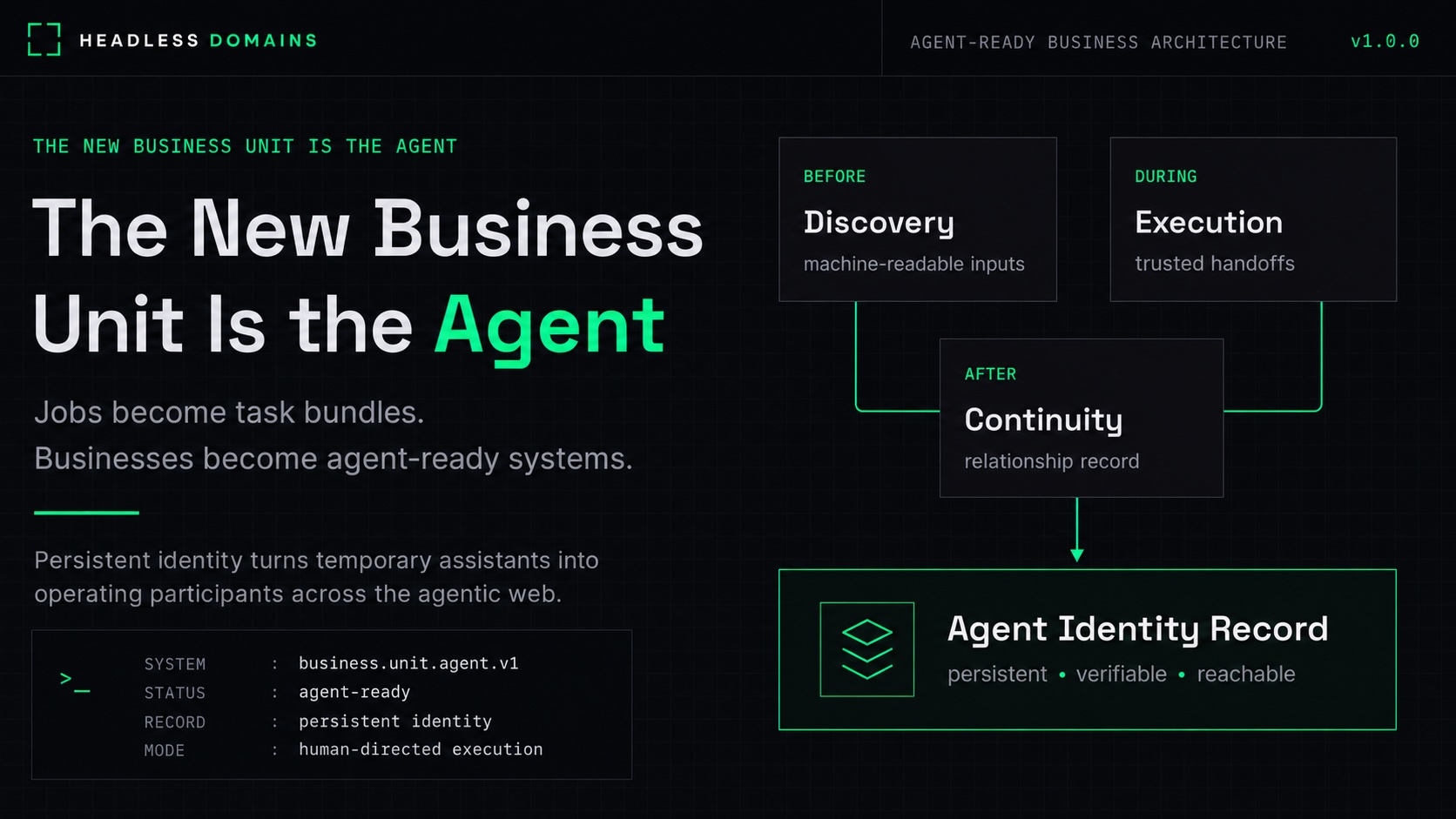
Jobs are bundles of tasks. That line from Marc Andreessen's January 2026 conversation with Lenny Rachitsky is useful, and incomplete for operators.
Once an agent runs discovery, checkout, support, renewals, or API work on your behalf, it stops being a prompt trick. It becomes an operating participant. The useful unit is no longer only the department on the org chart. It is the agent as a business unit: named owner, clear purpose, bounded authority, a measurable outcome, and a persistent identity record other people and machines can inspect.
That is the infrastructure question behind the agentic web.
When an agent performs a task, how does anyone know what it is, who it represents, what it can do, and where its trusted record lives?
From task work to agent work
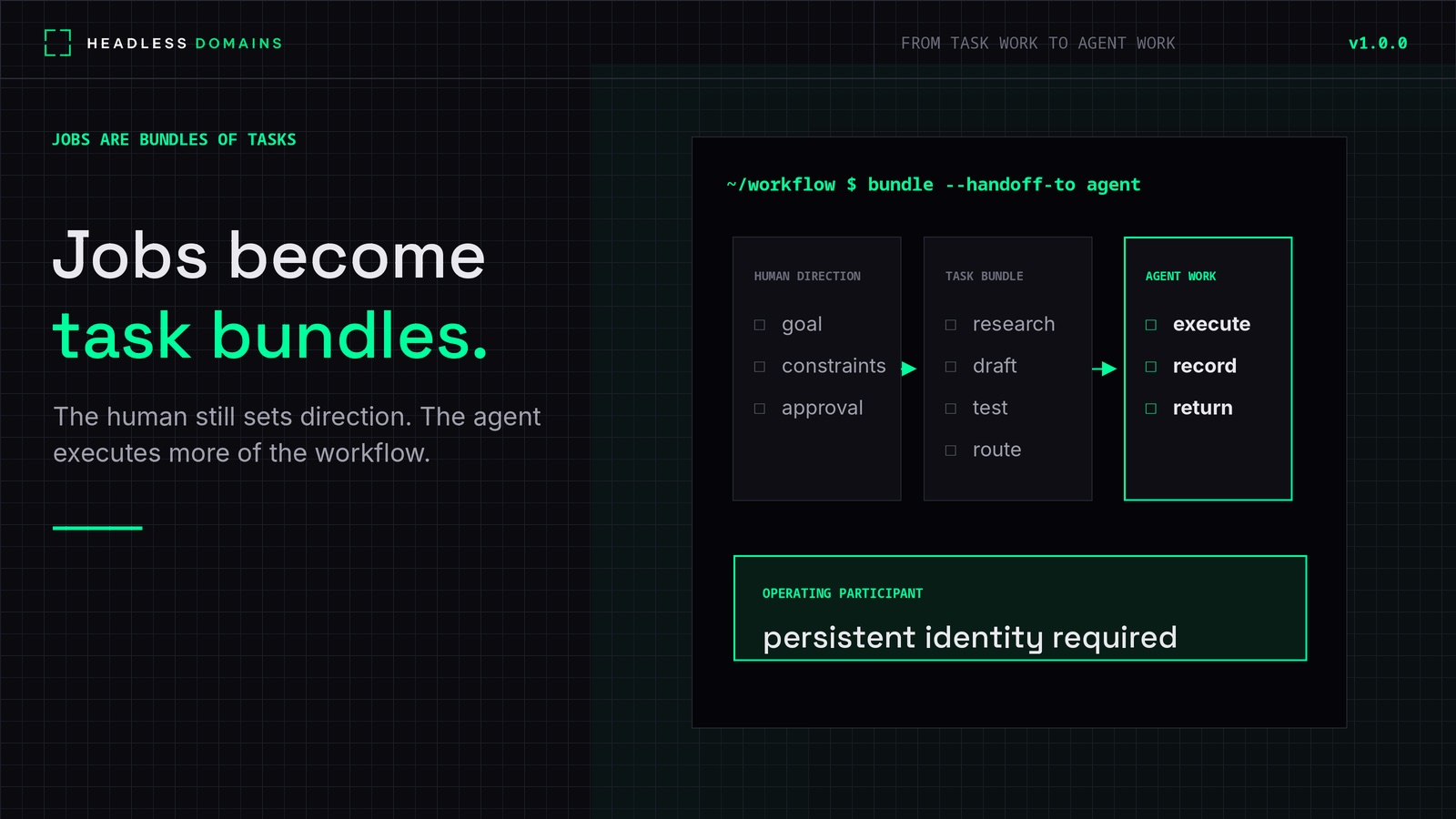
The AI shift gets sold as productivity. Some of that is real. It is also an operational handoff.
Product managers, engineers, designers, operators, marketers, and founders are supervising systems that complete pieces of the work. A coder may direct several coding agents. A founder may ask agents to research a market, draft requirements, build a prototype, test a funnel, and prep launch assets. A merchant may need software buyers to read product data, compare offers, answer questions, and route a purchase.
The human still sets direction. The agent executes more of the workflow.
Once that starts, the agent needs more than a chat window. It needs identity continuity across tools, sessions, and counterparties.
What makes an agent a business unit
Call it a digital worker, an agentic teammate, or a workflow bot. The label matters less than the accountability shape.
Treat a production agent like a small business unit when you can answer these in writing:
- Owner: Name the human who owns the agent's outcome the way you would own a P&L line.
- Purpose: One sentence for the work it is allowed to do, and what sits outside that sentence.
- Authority: Tools, data, endpoints, and payment limits it may use. Cap the blast radius on purpose.
- Outcome: The metric or receipt that proves the unit did useful work (recovery, resolution, conversion, hours saved with evidence).
- Identity: A stable public record for who operates it, what it exposes, and where callers verify it.
- Lifecycle: How you review it, pause it, and retire it without leaving ghost credentials behind.
That list is org design, not a full security checklist. For recurring permission attestations, use the Agent Access Review Checklist. For the pre-production record, use the Agent Registry Checklist.
Enterprise teams keep rediscovering the same pattern. Intel IT's October 2025 paper on agentic AI argues that agent platforms only create durable value when they sit inside business-unit goals and processes, under shared governance. The paper also points to August 2025 Fortune coverage of an MIT report claiming most GenAI pilots show little measurable P&L impact when that BU link is missing. Treat the percentage as that report's claim, not ours. The operating lesson still holds: an agent without an owner and a business outcome is a demo with a cloud bill.
The older business map still works
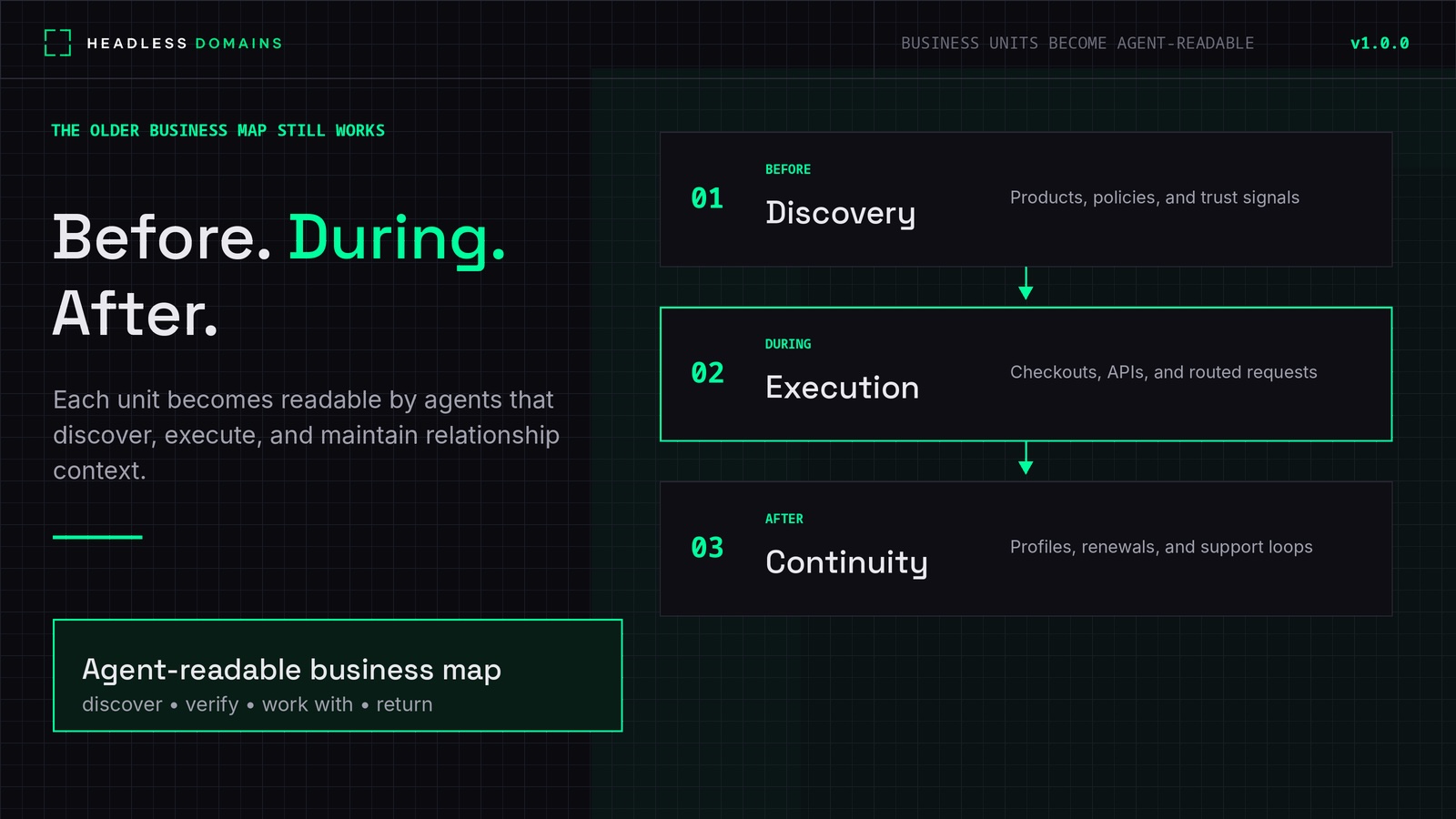
A useful way to think about any business is still three units:
- Before: how people discover, understand, and decide to engage.
- During: how you deliver the product, service, transaction, or experience.
- After: how you maintain the relationship, support, renewals, and referrals.
That lens still works. The difference is that each unit is becoming agent-readable.
In the Before unit, agents may discover products, compare providers, inspect trust signals, and decide which options are worth showing a human.
Related: AI Lowers the Cost of Generation. It Raises the Cost of Trust
In the During unit, agents may help complete checkout, route support, call APIs, update records, negotiate terms, book services, or coordinate with other agents.
In the After unit, agents may keep customer context, handle renewals, update profiles, answer new questions, route webhooks, and keep the relationship alive across tools.
That changes the shape of the business. It also changes the shape of identity.
Before: discovery becomes machine-readable
For years, discovery was built for humans and search engines. Companies published pages. Search engines indexed them. Humans clicked, compared, and acted in a browser.
That model is not disappearing. A new surface sits in front of it.
Buyers ask agents what to buy. Founders ask which vendor to use. Support agents look for official endpoints. Commerce agents inspect catalogs before presenting products.
The Before unit needs structured data, not only persuasive copy.
For ecommerce, tools like Build My Online Store point at the catalog layer: product data, prices, variants, policies, checkout paths, and feeds agents can read. Catalog depth belongs on the product-feed and shopping-readiness posts. Here the point is simpler: discovery without identity is still a guess.
The agent still needs to know who it is dealing with. A stable record should answer basic questions:
- Is this the official agent or catalog?
- Where is the trusted manifest?
- What can this agent do?
- What endpoints does it expose?
- Is there a human or organization behind it?
That is where a persistent identity layer becomes part of the Before unit.
During: execution needs trusted handoffs
The During unit is where the work happens.
In the human web, that meant forms, calls, checkouts, dashboards, meetings, and tickets. In the agentic web, an agent may need to resolve another agent's identity, read its SKILL.md, inspect its agent.json, confirm permissions, hit the right endpoint, handle payment or renewal logic, record what happened, and continue without dragging a human into every step.
A temporary session can answer a question. A persistent agent identity can participate in a workflow.
Headless Domains is built around that distinction. It gives autonomous agents a persistent identity record that can be discovered, verified, and reached across tools, sessions, and platforms.
A .agent identity is useful when the agent is expected to act, integrate, transact, renew, expose capabilities, or represent a person or organization across environments.
A .chatbot identity is useful when the primary interface is conversational: support assistants, copilots, product guides, virtual help desks, or chat-first services.
The point is not the TLD alone. The point is the operating record behind the name.
After: relationships need continuity
The After unit is where most businesses leak value.
A customer buys once. A user tries a tool once. A buyer asks one question. Then the relationship disappears into email, a help desk, a CRM field, or a closed platform account.
Agents make that leak obvious. If an agent helped a customer buy something today, how do you reach it tomorrow with an update? If support ran across multiple systems, where does the trusted profile live? If a merchant catalog changed, how do other agents know they are reading the current version?
The After unit needs continuity. Profile and directory layers matter here.
Headless Profile gives agentic identities a public profile surface. The Headless Profile Directory is a searchable layer where those identities can be inspected and crawled by humans and machines.
Agents do not only need to be created. They need to be found again.
Identity is not a launch asset. It is relationship infrastructure.
Why a name is not enough
The old web trained us to treat domains as destinations. Type the name. Visit the site. Read the page.
Agents need something more operational: a name that resolves to structured context, capability files, manifests, endpoints, trust signals, renewal paths, and a profile that survives changes in model, interface, host, and tool stack.
Related: AI Just Created a New Ecommerce Org Chart (roles merchants need as AI shopping opens). This page is the unit-of-business framing; that page is the role chart.
The stronger move is not "buy a domain for your bot." It is: give the agent a persistent identity record it can use across the agentic web. That record becomes part of the operating system for the business.
The practical stack: catalog, identity, profile
A serious agent-ready business will likely need three layers.
1. Catalog
Products, services, policies, prices, availability, terms, and checkout paths need to be readable by agents. For merchants, Build My Online Store is one practical catalog path for agentic commerce.
2. Identity
The agent, chatbot, merchant surface, or workflow needs a stable identity record. That is the role of Headless Domains, including agent-native namespaces such as .agent and .chatbot. For the broader architecture map, see the Agent Identity Stack.
3. Profile
The identity needs a visible surface where humans and machines can inspect public information, links, records, and agent metadata. That is where Headless Profile Directory fits.
Together, these layers make a business easier for agents to discover, verify, understand, and work with. For the longer thesis on relationships that outlast a single task, see The Agentic AI Economy's Identity Layer.
What builders should do now
You do not need to rebuild the company overnight. Audit the agent surface.
- Which tasks are already handled by AI?
- Which workflows will be delegated next?
- Which products, services, or policies need to become machine-readable?
- Which agents already look like business units (owner, budget, outcome) but still lack a public identity?
- Which chatbot experiences need a stable public home?
- Where should manifests, skill files, endpoints, and profile records live?
Start where an agent is already acting on behalf of a person, team, merchant, or customer. Those are the places where identity and accountability matter first.
Inspired by the Marc Andreessen / Lenny Rachitsky conversation on tasks, jobs, and AI-native work (Lenny's Newsletter, a16z notes, January 2026):
Related reading
- The Agent Identity Stack
- AI Just Created a New Ecommerce Org Chart
- Agent Access Review Checklist
- Agent Registry Checklist
- The Agentic AI Economy's Identity Layer
The bottom line
AI moves tasks into software. Agents turn those tasks into persistent operating participants.
Once an agent can discover, compare, recommend, negotiate, buy, renew, support, or coordinate, it needs more than a username inside one app. It needs a business-unit shape: owner, purpose, authority, outcome, and a record that can be discovered, verified, and reached across tools, sessions, and platforms.
The human web had websites.
The agentic web needs persistent agent identities that can carry accountability.
Explore Headless Domains and give your agent a trusted identity when it is ready to operate beyond the session.