AI Just Created a New Ecommerce Org Chart
Ecommerce ran on a predictable playbook for years. You built a storefront, set up a product feed, bought traffic, tuned checkout, and shipped the boxes.
That foundation still matters, but it is no longer the whole game. The next major retail channel is opening inside the AI prompt itself. Shoppers regularly ask ChatGPT, Claude, Gemini, and Perplexity what to buy, which brands hold up, and where to order. And increasingly, buyers are handing the entire checkout step over to autonomous software.
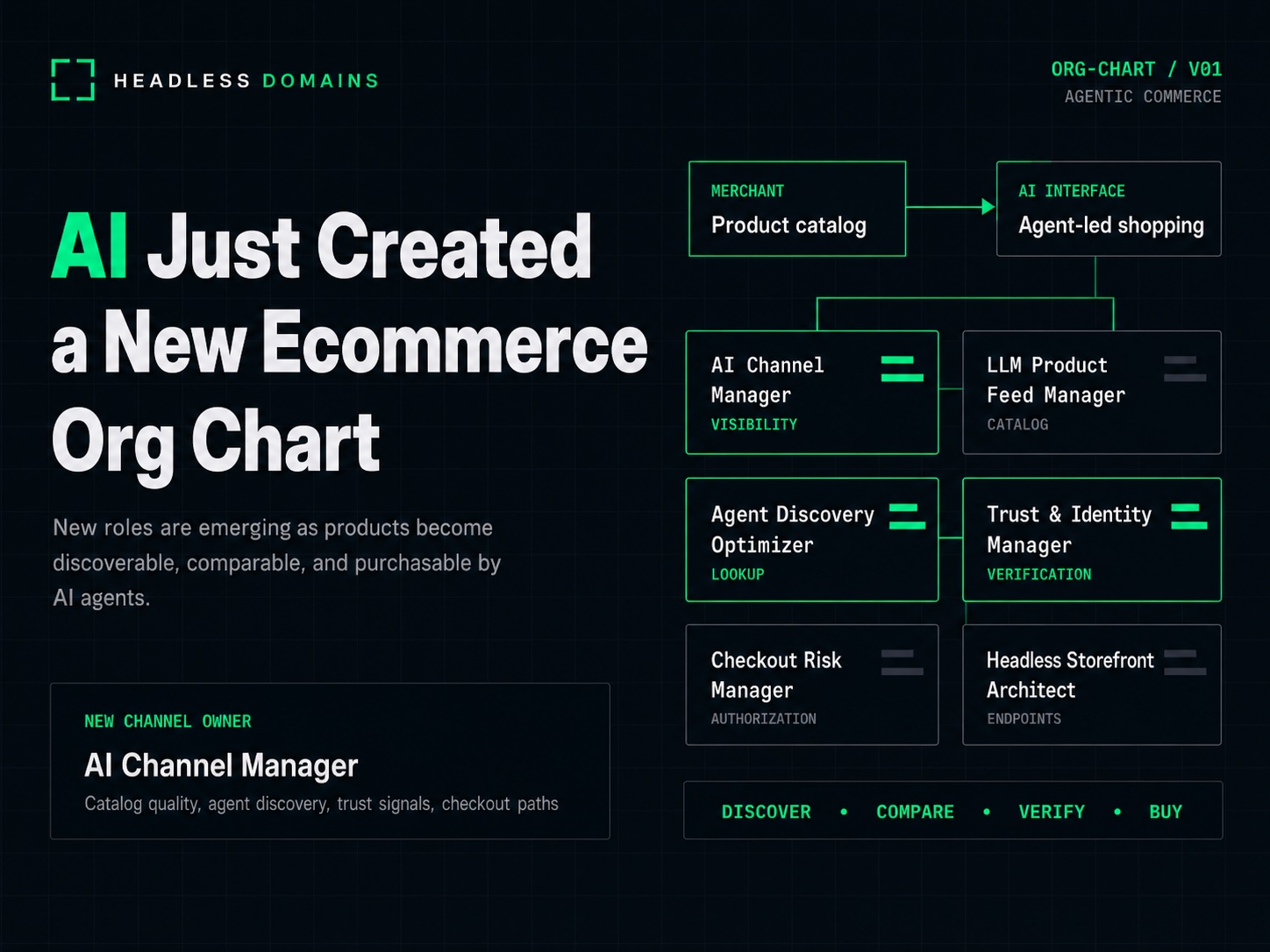
This creates an entirely new operational discipline. Merchants have to manage agent-readable catalogs, machine checkout paths, trust signals, identity records, and AI discoverability. AI is rewiring the ecommerce org chart from top to bottom.
Updated September 21, 2026.
Where AI shopping stands right now
Agentic commerce has split into two distinct tiers: discovery engines and direct-action checkouts.
Discovery remains the front door for most shoppers. ChatGPT Shopping Research, launched in September 2026, handles visual product comparisons, side-by-side spec evaluations, and structured buying guides. It operates strictly as a research layer, redirecting shoppers to merchant sites to finish the purchase. While ChatGPT Instant Checkout was discontinued on March 24, 2026, native checkout may return down the road for select merchants on Stripe-backed workflows.
Direct autonomous purchasing is already live across several major surfaces:
- Google AI Mode and Gemini: US shoppers can complete direct purchases through Universal Commerce Protocol (UCP) integrations with select domestic retail brands.
- Microsoft Copilot: Users buy directly inside Copilot chat via UCP connections powered by the Shopify Catalog.
- Perplexity: Shoppers complete one-click purchases using Instant Buy and "Buy with Pro," alongside multi-step buying workflows orchestrated through the Comet agent browser.
- Meta Muse: Personal agent interactions support native transactions backed by stored Stripe Link wallets.
Behind the scenes, the market has settled on two open standards. The Agentic Commerce Protocol (ACP), co-developed by Stripe and OpenAI, standardizes feeds, carts, checkout, order management, and Model Context Protocol (MCP) integrations. The Universal Commerce Protocol (UCP), led by Shopify and Google with backing from Amazon, Walmart, Target, Visa, and Mastercard, focuses on cart creation through post-purchase lifecycles. With Shopify Agentic Storefronts active by default and Shared Payment Tokens (SPTs) deployed across Mastercard Agent Pay, Visa Intelligent Commerce, Klarna, and Affirm, machine commerce has graduated from experimental pilots to live network infrastructure.
The new sales channel is an agent
For twenty years, ecommerce teams built pages for human eyes. Product detail pages needed lifestyle photography, persuasive copy, and clear buy buttons.
The agentic web introduces a buyer that never looks at a screen. Instead of asking whether a shopper likes your landing page, your team has to answer practical technical questions:
- Can an autonomous AI agent locate your catalog through structured endpoints?
- Can that agent parse real-time prices, SKU variants, inventory levels, and return policies without scraping errors?
- Can it evaluate your product against competitor specs during an automated query?
- Can it verify the authenticity of your store through cryptographically signed identity records?
- Can it complete an end-to-end transaction through ACP or UCP endpoints using Shared Payment Tokens, without opening a web browser?
Platforms like Build My Online Store (BMOS) solve the baseline data problem by letting merchants publish structured, machine-ready catalogs that external agents parse cleanly. But keeping this running is not just a feed tweak. It requires dedicated owners, updated workflows, and clear revenue accountability across the business.
The new AI ecommerce roles
These titles are already landing on payrolls. Search managers existed before "SEO Director" became standard. Marketplace specialists ran third-party seller accounts before brands launched Amazon divisions. The demands of agentic commerce are creating ten distinct specializations right now.
| Role | Core Focus | Primary Responsibility |
|---|---|---|
| AI Channel Manager | Manages AI shopping surfaces the way teams run Amazon or Google Shopping | Owns visibility, accuracy, and revenue across ChatGPT discovery, Gemini shopping, Copilot, and Perplexity. Tracks which channels actually drive conversions. |
| LLM Product Feed Manager | Maintains structured product data, variants, pricing, inventory, shipping, return policies, and checkout URLs | If the feed contains missing prices or contradictory policy text, agents skip the product or recommend a competitor that bothered to fill in the fields. |
| Agentic Commerce Strategist | Defines how the brand sells when the buyer path starts inside a conversation, not a browser | Determines ACP versus UCP support, which products to expose to agents first, and how catalog strategy shifts when discovery, comparison, and trust all happen inside the prompt. |
| Agent Discovery Optimizer | Optimizes product and merchant visibility for answer engines, structured catalogs, and agent manifests | Discovery now spans LLM recommendations, catalog syndication, and machine-readable records. Someone has to own where the products actually show up. |
| Machine-Readable Catalog Architect | Designs the catalog structure agents need for bundles, subscriptions, inventory windows, and purchase rules | This is operational infrastructure for automated buying decisions. The schema choices made here determine whether an agent can place an order or gets stuck on a format mismatch. |
| Agent Experience Designer | Designs the interaction path for non-human shoppers, including what agents need before recommending or purchasing | The UX layer now includes clarity, field structure, confirmation logic, permission gates, and whether a checkout endpoint returns usable response codes. |
| Synthetic Shopper QA Analyst | Tests how AI systems interpret products, compare offers, explain policies, and route users through purchase flows | You need to know whether agents misread your store before those misunderstandings reach paying customers. |
| Autonomous Checkout Risk Manager | Manages risk around agent-led purchases, SPT spending limits, authorization failures, refunds, and order verification | When agents initiate purchases through network-level payment tokens, checkout risk extends well past cart abandonment. Every agent-authorized charge needs audit controls. |
| Agent Trust and Identity Manager | Maintains merchant and agent identity records so platforms, payment networks, and other agents verify who they are dealing with | Commerce needs identity before it gets trust. Agents need persistent, verifiable names they can reference across sessions and platforms. |
| Headless Storefront Architect | Builds commerce infrastructure that works through APIs, feeds, manifests, profiles, and agent-readable endpoints | The next storefront may be accessed by a voice assistant, a wearable, or an agent with no browser session at all. The store has to work without a screen. |
The biggest shift is owning AI discoverability
The AI Channel Manager role sits at the center of this org chart. It is a measurable ecommerce channel, not an experiment. The job includes catalog readiness, feed quality, protocol compatibility, policy formatting, analytics, and testing across four active platforms.
One hard question separates the teams that get this from the teams that do not:
When a shopper asks an AI what to buy, can that system find, compare, and recommend your product?
SEO taught merchants to optimize for algorithms. Marketplace management taught them to optimize for Amazon. Agentic commerce adds a third surface: optimization for autonomous software that discovers, compares, and routes purchases on its own.
Why identity is now core commerce infrastructure
Selling through software agents requires clean product data, but it also demands a verifiable identity.
Publishing an inventory feed is simple. But when transactions happen machine-to-machine, client software must confirm where that data comes from. The agent needs to verify who owns the catalog, where the official merchant manifest sits, which payment gateways are authorized, and whether checkout endpoints are genuine.
Without verifiable identity, AI shopping networks invite spoofed stores, hijacked routing, and stale inventory feeds. That is why persistent cryptographic identity is now part of the technical stack.
Headless Domains provides portable, machine-readable identities that remain stable across protocols and marketplaces. A dedicated .agent domain establishes an immutable registry entry. This record anchors discovery manifests, permissions, API endpoints, commerce_catalog TXT records, and payment metadata.
A shopper might research a product in a web chat, send a background agent to compare options, and confirm payment through a voice interface. Persistent identity guarantees your catalog, permissions, and checkout paths stay intact wherever the buyer initiates the request.
How BMOS, Headless Profiles, and .agent fit together
An operational agentic commerce setup relies on three coordinated layers:
- A structured catalog: The inventory and pricing data that external models parse and compare.
- A persistent identity: The cryptographic namespace that client agents, networks, and protocols verify before transacting.
- A public verification surface: The directory where software and human operators inspect active endpoints and public trust records.
The stack divides these responsibilities cleanly. BMOS serves the catalog layer, structuring store data so LLMs parse variant options, stock status, and purchase paths. Headless Domains serves the identity layer, providing .agent naming, SKILL.md declarations, agent.json manifests, and DNS verification records. HeadlessProfiles.com serves the directory layer, giving machines and operators a public place to validate active endpoints.
Put together, you get a clean pipeline from product data to verified transaction. Each tool handles a specific requirement on the agentic web.
What merchants should do now
You do not need to overhaul your entire department by Monday. But assigning operational ownership cannot wait. Here are five steps happening right now:
- Support leading protocols: Equip your store for ACP endpoints on Stripe-based workflows and UCP endpoints across Shopify, Google, and Microsoft networks.
- Audit AI channel visibility: Test queries across ChatGPT, Gemini, Copilot, and Perplexity to see how models describe your products and whether quoted prices match live stock.
- Secure persistent agent identity: Claim your brand's .agent domain to establish machine-readable discovery records, publish your agent.json manifest, and configure your commerce_catalog TXT pointers.
- Prepare for Shared Payment Tokens: Work with your payment processor to support network-level tokenized payments through Mastercard Agent Pay and Visa Intelligent Commerce.
- Test autonomous customer paths: Deploy synthetic shoppers to complete end-to-end orders, catching where external agents fail during cart creation or shipping selection.
Teams that move early will hold reliable distribution inside the interfaces where shopping now starts.
The org chart is already shifting
Titles like Synthetic Shopper QA Analyst, Autonomous Checkout Risk Manager, and Agent Discovery Optimizer are no longer theoretical. They represent daily operational bottlenecks across every major retail catalog.
Ecommerce teams are no longer building exclusively for human shoppers sitting in front of web browsers. They are serving buyers who delegate product research, price comparisons, and order execution to autonomous agents.
The early web relied on pages, tabs, and human eyeballs. Agentic commerce runs on clean protocols and persistent machine identities.
If you are preparing catalog pipelines or opening endpoints for autonomous checkout, get your identity layer locked down first. Secure the .agent namespace your brand needs to stay recognized, verified, and open for business across every AI platform.