Agent Access Review Checklist for AI Agents
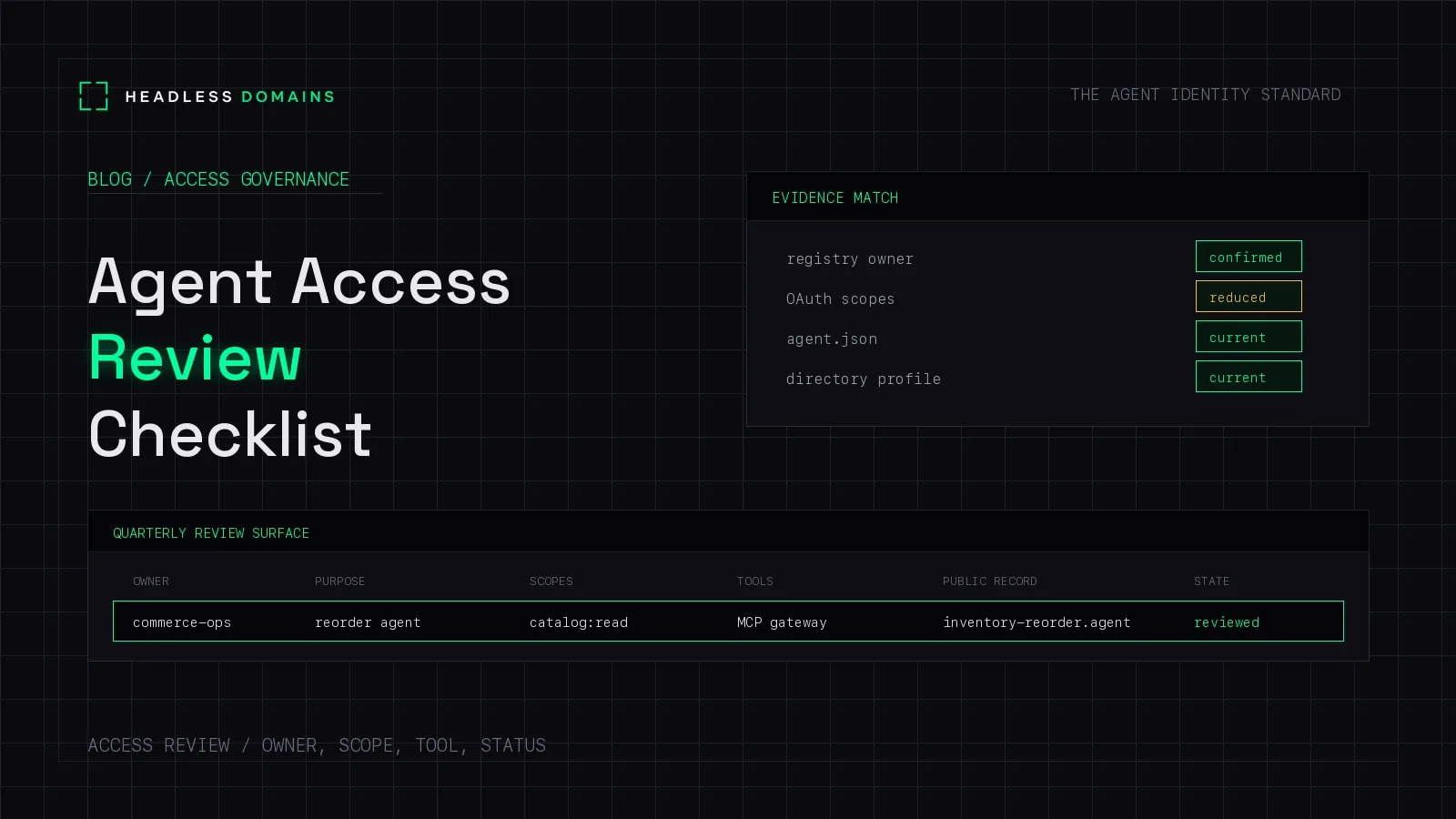
An AI agent access review is a recurring check that each live agent still has the right owner, purpose, identity model, scopes, tools, endpoints, payment authority, credentials, public records, logs, and lifecycle state. The point is simple: every permission should be intentional, current, auditable, and tied to a named agent identity.
This is not registry creation and not offboarding. The agent registry checklist builds the record before production access. Offboarding retires access when the agent should stop. An access review sits in the middle. It re-attests agents that already run, compares live grants to the approved job, removes drift, and routes failures to pause, fix, offboarding, or incident response.
For HeadlessDomains.com, the review needs private and public evidence. IAM, OAuth grants, MCP gateways, and payment rails show internal authority. A .agent record, agent.json, SKILL.md, auth.md pointers, and a Headless Profile Directory page show what partners, marketplaces, and auditors can inspect.
Access Review Checklist
| Review area | Question | Evidence | Action if unclear |
|---|---|---|---|
| Owner | Who answers for this agent? | Registry owner, sponsor, approver, support path | Pause new access until ownership is assigned |
| Purpose | Does the agent still perform the approved task? | Manifest purpose, launch doc, recent usage logs | Retire or reapprove the agent |
| Identity model | Is it acting as a user, a workload identity, or its own agent identity? | Delegation notes, service account or agent identity IDs, auth.md / IAM principal | Stop shared human credentials for production agent work |
| Scopes and OAuth grants | Do live scopes still match the approved baseline? | Approved scope manifest, live token or app grants, consent history | Revoke unexplained expansions; narrow unused grants |
| Effective permissions | What can the agent actually do after roles, groups, and resource policy combine? | IAM policy simulator or equivalent, role bindings, resource ACLs | Remove inherited or transitive access that exceeds the job |
| Tools | Which MCP tools, APIs, and apps can it call? | MCP metadata, gateway allowlists, API clients, plugin list | Disable unknown or stale connections; re-run an MCP security checklist before adding tools |
| Endpoints and actions | Are published endpoints and Action Cards still approved? | Endpoint inventory, Action Card versions, skill or gateway routes | Disable or republish actions that no longer match policy |
| Payment authority | Can the agent spend, refund, or bind payment mandates beyond the approved limits? | Mandate records, wallet or processor roles, spend caps, receipt routes | Freeze payment paths until limits and owners are reapproved |
| Credentials and revoke proof | Are keys and tokens short-lived, owned, and actually revocable? | Credential inventory, expiry, last rotation, successful revoke test | Rotate or revoke; block agents with untested revoke paths |
| Public identity | Can others inspect the official record? | .agent record, agent.json, SKILL.md, directory profile, auth.md links | Publish or correct the public identity before expanding access |
| Outbound signing (if used) | Do HTTP Message Signature / Web Bot Auth keys still match the approved operator? | Signature-Agent directory URL, JWKS, key rotation notes | Rotate or retire keys; do not treat draft protocol support as proof of authorization |
| Logs | Can you reconstruct who acted, on whose behalf, with what scope? | Action logs with agent identity, resource, correlation ID, on-behalf-of user | Pause consequential actions until logging is adequate |
| Lifecycle | Is the agent active, paused, replaced, or retired? | Registry state and directory status | Start offboarding if the state is stale |
How Often to Review Agents
Review high-risk production agents at least monthly. Review payment-capable agents after any payment policy, mandate, or processor change. Review external-facing agents after every endpoint or Action Card change. Review OAuth and AI SaaS grants on a fixed cadence (many security teams use quarterly) and whenever a tool update requests broader scopes. Lower-risk internal helpers can wait for a quarterly pass if nothing material changed.
Material change beats the calendar. New tools, new data classes, new tenants, new spend limits, or a move from user-delegated credentials to a dedicated agent identity should trigger a review before the next scheduled window.
Microsoft's least-privilege guidance for AI agents stresses unique agent identities, named owners, effective-permission review, and tested revocation. That is the same posture this checklist uses.
Google Cloud's current docs separate three patterns you should label in every review: user credentials (actions attributed to a person), service accounts or impersonated workloads, and Agent Identity for attested per-agent principals. An agent borrowing a human's OAuth session creates different audit and revoke questions than an agent with its own identity. Write the model down. Do not leave it implied.
Review Workflow
- Export the current agent inventory from IAM, OAuth/app consents, MCP gateways, payment rails, and public directories.
- Match every entry to a named owner, sponsor, business purpose, identity model, and lifecycle state.
- Compare live scopes and effective permissions against the approved manifest. Flag scope drift and unused grants.
- Check whether the agent still needs every endpoint, tool, Action Card, and payment authority it holds.
- Verify public-facing records match internal state.
- Prove revoke works: rotate or revoke a non-critical credential in a controlled test, or verify the last successful revoke for that class of credential.
- Remove broad, unused, inherited, or stale access.
- Flag agents that need ownership changes, offboarding, or incident review.
- Record reviewer, date, evidence, findings, revoke result, and next review window.
Cloud Security Alliance research on AI SaaS OAuth grants makes the same operational point in plain language: treat unused or over-broad grants like privileged footholds. Review them. Revoke what the business no longer needs.
Example Access Review Record
Illustrative only. Hosts and IDs are examples, not a live integration.
{
  "agent": "inventory-reorder.agent",
  "owner": "commerce-ops",
  "sponsor": "security-team",
  "reviewer": "security-team",
  "review_date": "2026-09-25",
  "identity_model": "agent_identity",
  "purpose": "create restock purchase orders within approved SKUs",
  "scopes_baseline": ["catalog:read", "order:create"],
  "scopes_live": ["catalog:read", "order:create"],
  "oauth_grants_removed": ["customer_export"],
  "tools_reviewed": ["mcp://inventory-gateway", "orders-api"],
  "payment_authority": {"enabled": true, "cap_usd": 500, "mandate_id": "po-mandate-17"},
  "revoke_tested": true,
  "public_record": "https://inventory-reorder.agent/.well-known/agent.json",
  "lifecycle": "active",
  "next_review": "2026-10-25"
}
Where HeadlessDomains.com Fits
HeadlessDomains.com turns access review findings into public inspection evidence. When a review confirms owner, endpoint, capability, and status, put that state on the .agent record and profile page. When a review fails, mark the identity paused, restricted, replaced, or retired.
Use auth.md for how agents authenticate and how Headless Domains API keys are verified and revoked (POST /oauth2/revoke). Be honest about current limits: Headless Domains issues an API key that proves agent identity; scopes_supported describes service capabilities, and the current single-key model does not persist per-credential scope grants. Your IAM and OAuth providers still own fine-grained scope enforcement. The public identity layer shows who the agent is and how to talk to it. It does not replace your internal access review.
If the agent signs outbound traffic with HTTP Message Signatures / Web Bot Auth drafts, keep key directories and rotation notes in the review packet. Treat those drafts as identification helpers, not finished standards and not proof that a grant is approved. Pair failed reviews with AI agent offboarding so exceptions do not linger quietly.
Related Reading
- AI Agent Identity Security
- The Agent Registry Checklist
- AI Agent Offboarding
- MCP Security Checklist
- Shadow Agents Are the New Shadow IT
- AI Agent Incident Response
- The Agent Identity Stack
FAQ
What is an AI agent access review?
An AI agent access review is a periodic check that confirms each live agent has a current owner, approved task, correct identity model, limited scopes and effective permissions, inspected tools and endpoints, valid credentials with a working revoke path, matching public records, usable logs, and an accurate lifecycle state.
How is this different from an agent registry checklist?
A registry checklist builds a complete record before production access. An access review re-checks agents that already have access, looks for drift, and proves you can still revoke or retire them.
Who should own the review?
Security sets the review standard. The agent owner attests to purpose, scopes, tools, and lifecycle state. High-risk findings route to IAM, platform, legal, payments, or incident teams.
What evidence should reviewers collect?
Collect registry entries, IAM grants, OAuth or app consents, service accounts or agent identity IDs, MCP metadata, gateway allowlists, endpoint and Action Card lists, payment mandates, credential inventories, public manifests, directory profiles, recent action logs, and the last successful revoke test.
What should happen after a failed review?
Remove unused access, pause risky endpoints or payment paths, update public records, start offboarding, or trigger incident response if logs show suspicious activity. Do not leave a failed review as an open exception without an owner and a due date.