AI Shopping Readiness Checklist: 10 Checks Before Launch
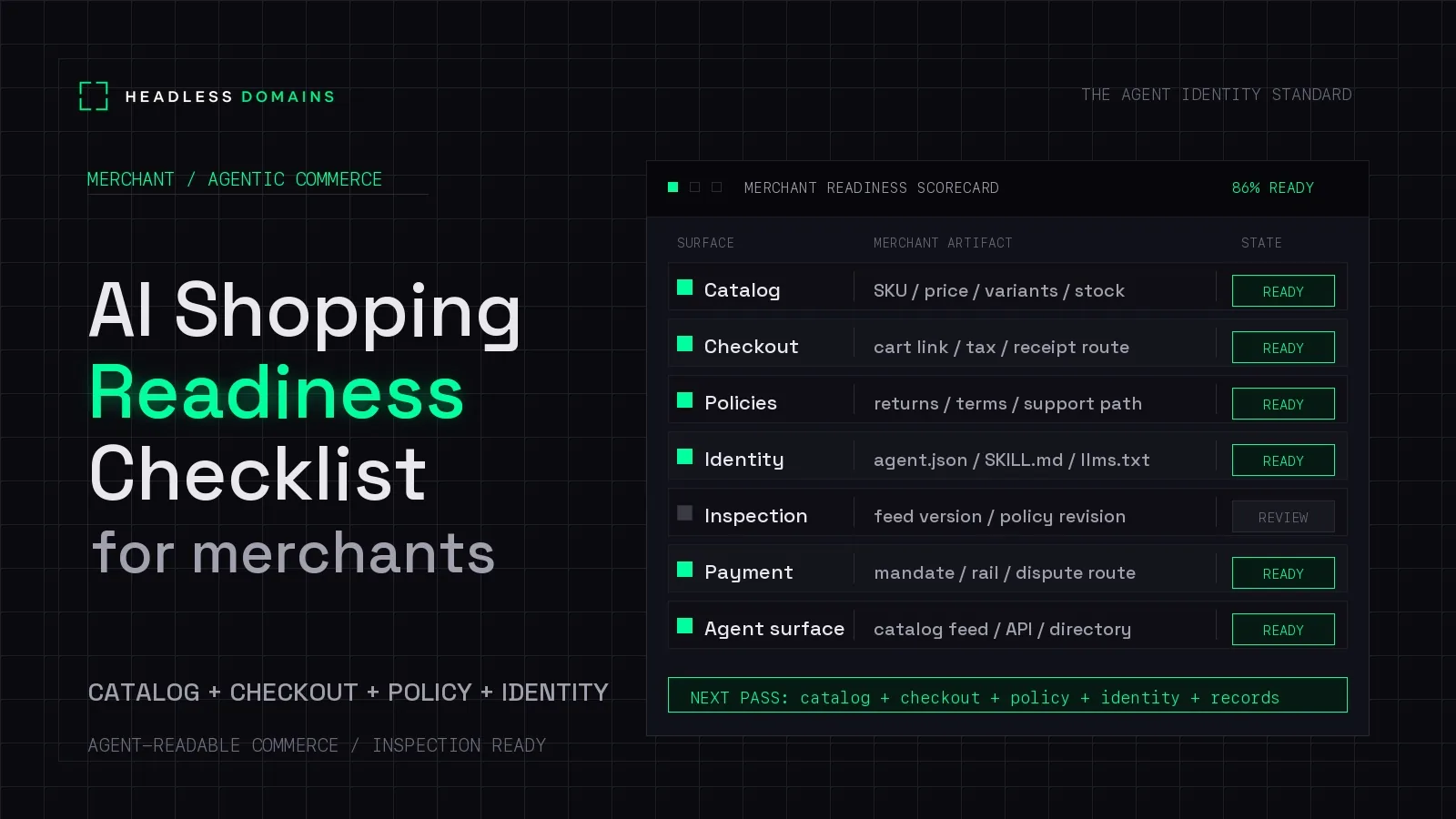
An AI shopping readiness checklist helps merchants prepare the product, checkout, policy, identity, and evidence surfaces that shopping agents inspect before they recommend or buy. Start by publishing complete catalog fields, clear checkout routes, policy pages, payment context, and public inspection records tied to a merchant identity.
Agentic commerce is moving from product discovery into checkout and support. Google says its Universal Commerce Protocol launch covers discovery, buying, and post-purchase support, while new Merchant Center attributes help retailers get discovered in conversational commerce. The Universal Commerce Protocol also gives businesses a way to meet customers in AI assistants and agents without rebuilding checkout for every surface.
Readiness Scorecard
Use this scorecard as a prelaunch pass. A merchant is ready when every row has a public, current, and inspectable artifact rather than only a visual storefront page.
| Readiness area | Ready state | Agent check |
|---|---|---|
| Catalog | Products have stable IDs, titles, descriptions, images, variants, price, availability, shipping, and category context. | Can an agent compare offers without scraping visual layout? |
| Checkout | Human checkout, machine checkout, supported payment routes, cart rules, tax and shipping inputs, and receipt paths are documented. | Can an agent present the purchase path and its limits? |
| Policies | Returns, refunds, terms, warranty, support, cancellation, and exception rules are linked from product and identity records. | Can an agent explain the buyer protections before checkout? |
| Identity | The merchant has a Headless Domains identity with operator proof, official endpoints, agent-readable files, and update timestamps. | Can an agent confirm which catalog and checkout endpoints are official? |
| Inspection records | Feed version, price check time, policy revision, endpoint owner, support route, and receipt issuer are logged. | Can a reviewer trace the offer shown to the buyer? |
| Payment context | Allowed rails, mandates, spending constraints, idempotency, and dispute routes are visible to approved buyer agents. | Can an agent verify authority and receipt expectations? |
| Agent-readable surfaces | agent.json, SKILL.md, llms.txt, catalog feed, API docs, and directory profiles tell agents what to read and call. |
Can an agent discover the store without guessing from page design? |
Clean The Catalog Before You Promote The Store
BMOS positions itself as the merchant-friendly product catalog layer for the agentic web. A BMOS catalog feed can publish product data, current pricing, variants, images, availability, refund policy, terms, agent metadata, and machine checkout links. For merchants, the practical job is to make every buyable item consistent across the storefront, the feed, and the identity record.
- Give each product a stable SKU, title, short description, long description, image set, category, price, currency, and availability value.
- Keep stock and price syncs frequent enough that an agent is not recommending a stale offer.
- Expose variant choices as structured options instead of prose-only descriptions.
- Attach shipping, return, warranty, support, and terms URLs to the feed.
- Keep image URLs, alt text, and category labels consistent across product pages and feed records.
Make Checkout Inspectable
The next checkpoint is checkout. Google's Universal Cart update describes UCP and payment infrastructure supporting checkout from AI shopping surfaces, including Google Pay or transfer to the merchant site while the brand remains merchant of record. Merchants should publish the checkout path that an agent can present, the payment options available, and the evidence created after purchase.
Agent-readable checkout context should include cart creation rules, price expiry, shipping address inputs, tax calculation, coupon handling, allowed payment methods, receipt route, and support contact. If an agent cannot explain the checkout boundary, the purchase flow is not ready for delegated buying.
Put Policies Where Agents Can Read Them
Policy pages are part of the product offer. A shopping agent evaluates shipping zones, return windows, refund terms, subscription renewal, warranty, age restrictions, hazardous goods limits, support response, and dispute path before recommending a purchase.
Link policy URLs from the product page, catalog feed, and identity record. Keep language specific: eligibility, time window, fees, who pays return shipping, support SLA, and evidence required. Agents cannot apply policy context if the only version is hidden inside a FAQ accordion or checkout modal.
Attach Merchant Identity And Inspection Records
HeadlessDomains.com gives merchants a public identity anchor for the surfaces agents inspect. Use HeadlessDomains.com to connect the merchant profile, agent.json, SKILL.md, llms.txt, BMOS feed, endpoint list, policy URLs, payment metadata, and proof links. The identity record helps agents confirm which catalog and checkout endpoints are official before value moves.
Inspection records turn a published feed into an auditable workflow. Track feed version, last catalog sync, price check timestamp, policy revision, endpoint owner, support route, payment handler, receipt issuer, and rollback contact. A buyer agent can then compare the offer with the record presented at checkout.
Example Merchant Readiness Record
{"merchant":"northstar-outfitters","identity":{"headless_domain":"northstar.agent","agent_json":"https://northstar.agent/.well-known/agent.json","skill_md":"https://northstar.agent/SKILL.md","llms_txt":"https://northstar.agent/llms.txt"},"catalog":{"feed":"https://app.buildmyonlinestore.com/agentic-commerce/feeds/northstar","sync_status":"current","fields":["sku","price","availability","variants","images","returns"]},"checkout":{"human_url":"https://northstar.example/checkout","machine_url":"https://machine.checkout.example/northstar","payments":["UCP","x402","AP2-ready evidence"]},"inspection":{"feed_version":"2026-05-21.1","policy_revision":"returns-2026-05","receipt_route":"https://northstar.example/receipts","support":"mailto:support@northstar.example"}}Implementation Checklist
- Audit top product pages against feed rows for title, SKU, price, currency, stock, variant, image, shipping, and return parity.
- Publish or connect a BMOS feed with current catalog data and machine checkout links.
- Add crawlable policy pages for returns, refunds, shipping, warranty, support, terms, subscriptions, and restricted products.
- Publish
agent.json,SKILL.md, andllms.txtwith merchant profile, catalog feed, endpoint list, policy URLs, support route, and payment metadata. - Add checkout context for cart creation, tax and shipping calculation, payment methods, mandate evidence, receipt path, idempotency, and support.
- Record feed version, price check timestamp, policy revision, endpoint owner, payment handler, and receipt issuer for inspection.
- Test buyer-agent prompts that compare products, ask about returns, assemble carts, and verify merchant identity before checkout.
- Make a human owner accountable for stale data, failed checkout links, payment disputes, and support escalation.
Where To Go Next
Prepare catalog, checkout, policies, identity, and inspection records as one launch bundle before inviting agentic commerce traffic. For the full merchant setup, read How to Make Your Store Discoverable to AI Shopping Agents, then connect the store identity to the broader Agent Identity Stack.
FAQ
What is AI shopping readiness?
AI shopping readiness is the merchant preparation work that lets shopping agents inspect products, policies, checkout, payment context, identity, and evidence before they recommend or buy.
Is a product feed enough for agentic commerce?
No. A product feed is the catalog layer. Agents also use checkout instructions, policy URLs, payment context, support routes, and a public identity record to evaluate a merchant surface.
How do UCP and BMOS fit together?
UCP provides a shared commerce protocol for agentic shopping surfaces. BMOS gives merchants a practical catalog and checkout feed that can support UCP-style agent discovery and buying workflows.
Where does HeadlessDomains.com fit?
HeadlessDomains.com provides the identity layer that connects the merchant profile, catalog feed, agent-readable files, endpoints, policies, payment metadata, and proof links into one public inspection path.
What should a merchant prepare first?
Start with the items an agent must compare: product data, price and availability, checkout path, return policy, support route, merchant identity, and inspection record. Then add payment context and agent-readable workflow files.