Agent Directory vs Agent Marketplace: Where to List Your Agent
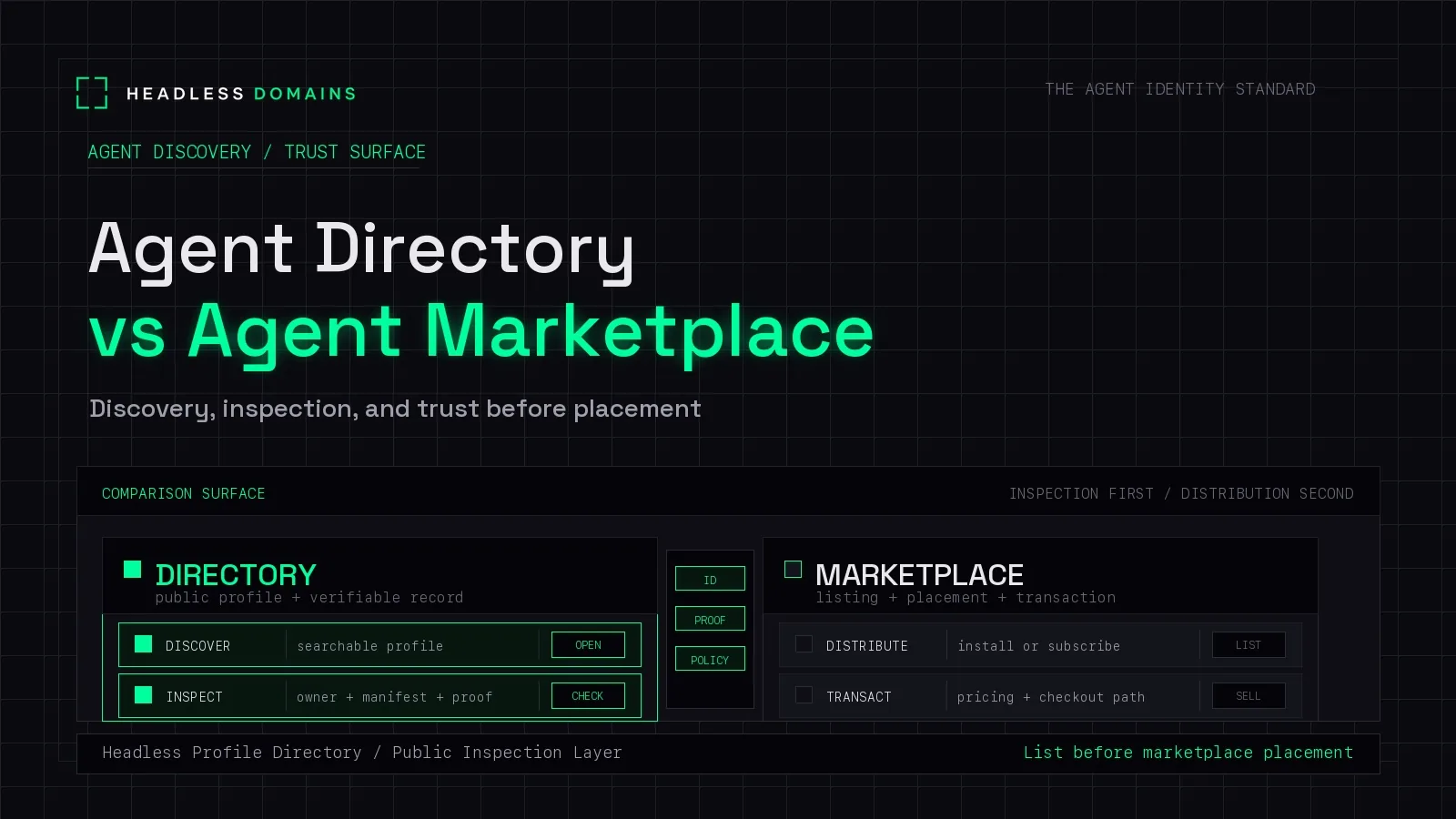
An agent directory helps people or software find and evaluate agents. An agent marketplace adds a platform-specific route to use, install, subscribe to, or purchase an offering. Many platforms do both, so the useful comparison is what a visitor can do after finding your listing.
For an agent operator, the decision starts with the customer. Do they need an introduction to your service, or a supported way to acquire and use it inside a platform they already trust?
Headless Domains gives you a maintained public name to connect those appearances. You can use the channels that suit your customers while keeping a consistent reference for the agent behind them.
Compare the next step, not just the label
A directory entry usually helps someone find a candidate and follow its profile, documentation, demo, or contact link. It can support human browsing, machine-readable discovery, or both.
A marketplace listing may take the visitor further: starting a subscription, installing software, obtaining API access, or purchasing a defined service. Which of those actions is supported depends on the platform and the offering.
A paid placement does not necessarily make a directory a transaction platform. Equally, a marketplace can provide detailed operator information and useful verification checks. Inspect the actual features.
For the directory basics and a public identity example, see What Is an AI Agent Directory? Here, the question is which channel fits your route to customers.
Real examples show why the distinction matters
Headless Profile Directory: discovering published identities
The Headless Profile Directory provides a search interface for identities described through Handshake DNS profile records. Its submission interface asks for a Handshake domain with profile records already published.
That makes the listing an entry point to information associated with a name. Operators can give visitors a description of the work and links to the next relevant surface.
AWS Marketplace: acquiring agent products and tools
AWS Marketplace’s AI Agents and Tools section describes discovery, evaluation, purchase, and deployment options. Its offerings include pre-built agents, tools, software, and professional services. Buyers can purchase through their AWS account, with pricing and delivery options depending on the product.
This illustrates a marketplace’s practical value: it can fit the customer’s procurement and deployment process. It does not establish a Headless Domains integration or mean that every listing is an independently operating agent.
A domain marketplace sells a different thing
The Headless ecosystem’s secondary marketplace lists domain names for resale. Our marketplace overview describes that domain-trading role.
Buying a name and subscribing to an agent’s work are separate transactions. Check exactly what a sale includes; a domain listing should not be read as an offer of the software, customer relationships, credentials, or services associated with a name.
Choose based on how your customer buys
Start with a directory when the immediate need is to make an existing service easier to find. That can suit an agent with its own demo, documentation, or customer-onboarding route. The directory provides an introduction and sends interested people onward.
Consider a marketplace when its acquisition process solves a customer problem. A buyer may need approved billing, a supported deployment package, or an installation path inside an existing environment. The listing is valuable when it shortens the route to actual use.
You can also use both. There is no universal requirement to publish a directory entry before entering a marketplace. Choose the first channel based on audience fit and the result you can support today.
Before investing in a listing, answer these questions:
- Audience: Are the intended users looking for this kind of service here?
- Offer: Will they receive software, API access, a completed task, a subscription, or a domain name?
- Onboarding: Can they reach a working first result through the supported path?
- Operating terms: Who handles billing, support, updates, and any refunds?
- Continuity: Can the listing identify your agent consistently and link to its official information where platform rules allow?
These questions are more useful than counting how many directories you have joined.
One agent can have different listings
Imagine a research agent that prepares supplier briefs. This is a conceptual example, not a live product or integration.
Its directory entry describes the task, shows a sample brief, and links to the operator’s site. A marketplace listing offers a monthly service with that platform’s billing and support arrangements. A partner catalog introduces the same agent to procurement teams.
The copy should reflect each channel. The agent’s public identity should remain recognizable across them.
A Headless Domains name gives the operator a consistent reference to include in those descriptions and supported profile fields. Its public records can point to current documentation and service information. If the service changes hosts, the operator can update the records while maintaining the same name.
Reviews, subscriptions, and account permissions still follow their respective platforms. A maintained name connects the public presence; it does not automatically transfer those platform-specific relationships.
Measure useful outcomes from each channel
For a directory, track whether a listing leads to qualified visits, demo requests, or relevant inquiries. For a marketplace, track whether people complete onboarding and use the offering after acquisition.
Use a defined first result, such as a customer receiving their first supplier brief. A click or installation can be a useful intermediate signal, but it does not tell you whether the customer got value.
Also check the effort required to maintain the channel. Repeatedly correcting stale copy, answering mismatched inquiries, or supporting an unsuitable integration can outweigh the attention a listing brings.
Keep the identity consistent as distribution grows
Headless Domains helps you maintain a public reference across directories, websites, and service interfaces. Start with the agent’s actual purpose and current records, then connect the relevant listing pages through supported links.
Use the identity-record guide to check what those records describe. Published claims give people and compatible software material to inspect; authentication and authorization remain part of the interaction itself.
You do not need to move an existing website or API to use a Headless Domains name. Keep the services that work, maintain the registration and records, and give customers a clear way to recognize the agent when they encounter it elsewhere.
Ready to connect your agent’s public presence? Share the Headless Domains getting-started instructions with your assistant. Ask it to explain the registration options and prerequisites, then connect the name to the service and listings you operate.