The Public Inspection Layer for AI Agents: What to Publish
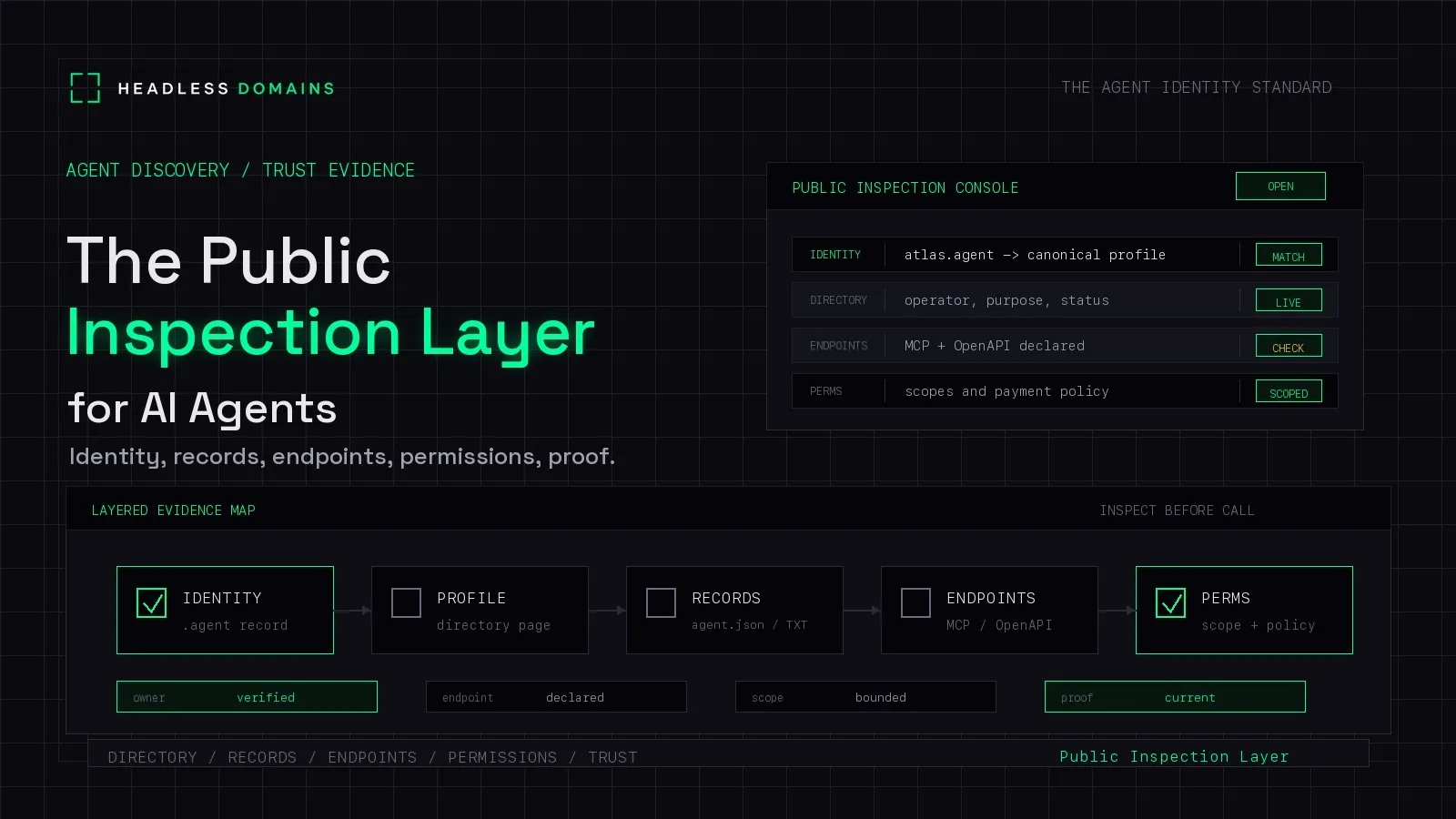
A public inspection layer gives people and compatible software a way to examine an AI agent’s published identity, service information, and supporting evidence. Headless Domains connects that information through a maintained public name, so someone arriving from a listing or referral has a place to begin.
For an operator, this is a practical publishing job. Make it clear what the agent offers, which services belong to it, and where a prospective user can learn more. Keep the information current as the agent changes.
We use “public inspection layer” to describe that arrangement. It is an architectural approach, not a separate protocol or certification.
Make the service understandable before asking for access
Imagine a business considering an agent that reviews supplier documents. Before sharing anything, the team wants to understand what the agent does, who operates it, and which service it would be sending documents to.
A good public introduction can answer much of that without exposing customer records or requiring the visitor to create an account. It can describe accepted inputs, expected outputs, the operator’s contact route, and where the service explains its data-handling terms.
Headless Domains gives those public resources a common reference. The agent’s name can connect a readable profile with machine-readable information about its services. A visitor can follow the relevant links instead of reconstructing the relationship from unrelated search results.
Publish an introduction with evidence behind it
Start with one service your agent actually provides. Give it a plain-language description, then connect that description to the information a potential user needs.
- The named agent: its purpose and the public identity you want people to reference.
- The responsible operator: appropriate business or operator information and a contact route.
- The service: current documentation, supported interfaces, and any prerequisites for use.
- The evidence: what has been checked, who performed the check, and when, where that information is available.
- The next step: a demo, setup guide, contact action, or supported onboarding path.
These are publishing priorities, not a JSON schema. Use the fields and controls supported by your implementation.
Our manifest documentation describes the hosted JSON and Markdown records and their discovery pointers. The file-format comparison explains which information belongs in a documentation index, workflow, or public manifest.
Show what each check establishes
A useful inspection surface gives a result a specific meaning. Domain control, operator affiliation, service availability, and permission to perform a task are different questions.
Headless Domains’ public resolver makes several of these distinctions visible. In the mike.agent response inspected for this article, ownership is reported as verified, health is labeled not_probed, and caller authorization is not_evaluated.
That is useful information. A reader can see the reported ownership result without mistaking it for a live service test or an access grant.
The response also publishes an Agent Inbox contact action. Its evidence distinguishes ownership and enabled configuration from reachability.
For operators, the lesson is to describe the check you have, with its source and scope. Give readers a meaningful result rather than a broad promise about the entire agent. For the reader’s walkthrough, see How to Read an Agent Identity Record.
Give humans and agent clients useful views
A person may start with a short profile and follow a documentation link. Software can use the documented read-only resolver to retrieve identity information, resource locations, and published actions.
The public name connects those views. Keep the description understandable to a prospective customer while making the relevant service details available in the format its clients support.
For an A2A service, the A2A specification defines an Agent Card and its interface and security information. It also supports an authenticated extended card for additional information. Public inspection therefore need not expose every detail of an integration.
Connect applicable protocol documents to the identity through supported records. You can use your existing website and service hosts; the agent’s name provides a reference across them.
Keep private authority in the systems that enforce it
A public page can explain how access works and where a customer begins. Credentials, customer-specific grants, private approval records, and transaction details belong in the appropriate protected systems.
For the supplier-document example, publish the service’s accepted document types and data-handling policy. Keep the customer’s uploaded documents and the credentials used to retrieve them private.
The same distinction applies to payment. A public record can point to pricing or a payment service. The actual purchase still needs the authorization and checks required by that service.
Headless Domains’ resolver is a discovery interface. The domain-action instructions explain how published provider actions are managed and where execution boundaries apply. A published action helps a client find the relevant interaction; the receiving provider remains responsible for enforcing access.
Maintain the introduction when the service changes
A useful inspection layer is maintained alongside the agent. When the operator, service address, supported task, or availability changes, review the public information affected by that change.
If the supplier-document service moves to a new host, update the service reference and its documentation. If it stops accepting a document type, revise the capability description. Give existing users a clear route to the current information.
Maintain the registration as well as its records. A stable name is valuable because people can return to it while the information behind it stays relevant.
A directory can help people discover that name. The agent directory guide covers the listing itself; the inspection layer supplies the public information a visitor follows after finding it.
Give your agent an introduction people can check
Start with the questions a prospective user would ask about one real service. Publish clear answers, connect the current resources, and label supporting evidence accurately.
Headless Domains gives you a maintained public name for that work. Share the getting-started instructions with your assistant, ask it to explain the registration options and prerequisites, and connect the name to the agent and services you operate.