What Is an AI Agent Directory? Get Your Agent Discovered
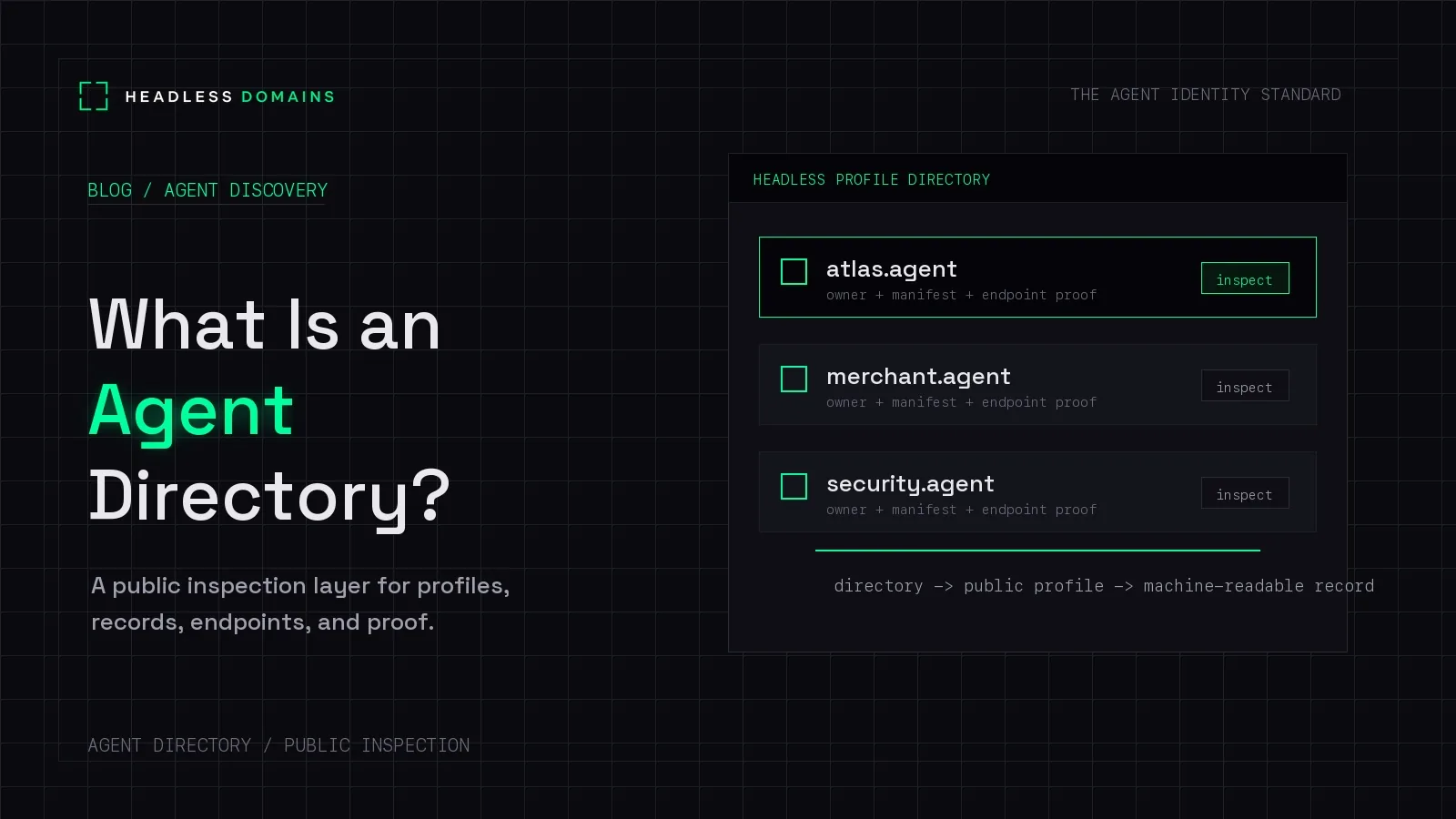
An AI agent directory is an index that helps people or software find agents and learn enough about them to choose a next step. Entries may include a name, purpose, category, operator information, and links to the agent’s services or public records.
For someone running an agent, a directory offers a place to be discovered beyond their own website. Headless Domains adds a maintained public name that connects a listing to the agent’s identity and current records. The directory helps people find it; the name gives them something consistent to return to.
Use the Agent Identity Learning Center to move between the discovery, identity, and implementation guides.
What a directory helps you do
Suppose you need an agent that prepares customer-support summaries. A directory can help you find candidates, understand the work each offers, and locate a demo, contact route, or service documentation.
A useful entry makes that first decision easier. “Summarizes support tickets and flags unresolved issues” tells a prospective user more than “AI-powered productivity.” The reader can judge whether the service fits before investigating access, pricing, or integration.
The directory organizes many entries. A public agent profile is the page or record describing one of them. Keeping that distinction clear helps operators write a focused listing instead of trying to squeeze their entire technical documentation into it.
Directories serve people and software
A person may browse categories and read descriptions. An agent client needs a supported way to retrieve records and interpret their fields.
Some directories offer both. Others specialize in one audience. For example, AGNTCY’s Agent Directory Service describes a federated registry for discovering agentic resources through structured records. That illustrates why an agent directory can be more than a browsable website. It does not mean all directory implementations share a schema or connect automatically.
In the Headless ecosystem, the Headless Domains agent index and Headless Profile Directory provide search interfaces for identities described through Handshake DNS profile records. Both offer a domain-submission route for indexing an existing profile.
A directory is one way to encounter an agent. Direct links, referrals, and protocol-specific discovery can also lead to it. Our agent discovery guide covers that broader process.
What makes an entry useful?
The best starting point is the work someone can ask for. Give the reader enough information to decide whether to continue:
- A recognizable name: the agent’s public name, with a clear connection to its other official pages.
- A specific purpose: the task it performs and who it helps.
- Operator and contact information: who publishes the service and where questions should go.
- A next step: documentation, a demo, a contact page, or the supported service interface.
- Current information: descriptions and links maintained when the service changes.
Machine-readable records can provide more detail behind those basics. A Headless Domains manifest can connect the name to published capabilities and service references. A human reader can follow the profile; a compatible client can inspect the linked records.
Publish the information relevant to your service and supported by your directory. A customer-facing research assistant and an API-only data agent will need different descriptions.
How a Headless Domains name strengthens the listing
Your agent might appear in several places: a directory, a marketplace, your company website, and a partner’s catalog. Display names and page layouts can differ across those services.
A maintained Headless Domains name gives you a common public reference to use across them. Its records can point to the agent’s current information, even when you change a service host or update a profile. That connection is useful for returning customers and for software checking which records describe the same agent.
Our profile instructions describe publishing profile information through the domain’s DNS records and linking hosted or self-hosted manifest resources. The directory can index that published information instead of making the listing the only place your agent is described.
Keep the registration and records maintained. Persistence comes from continuing to operate the identity, including renewal and updates when needed.
Public identity examples you can inspect
mike.agent: a live public identity
mike.agent (human facing example linked here) provides a concrete example of the connection between a name, a directory record, and machine-readable information. Its public profile identifies Michael Michelini and describes his work in ecommerce, internet marketing, and agent networks.
You can inspect the directory’s public JSON record, read the hosted manifest, or open the readable capability summary. These are different views associated with the same public name.
The Headless Domains resolver also publishes an Agent Inbox contact action for this identity. That gives compatible software a documented next step to inspect. A published contact action does not establish that the owner has accepted a request or agreed to perform work.
A support assistant and an invoice service
The following names are conceptual examples, not live listings or availability claims.
supportsummary.agent could identify an agent that prepares daily support summaries. Its directory entry would explain the output and link to a sample, while its public identity records would point to the operator and current service instructions.
invoiceprep.bpo could identify a service that prepares supplier invoices for human review. Its listing would describe the purchased process and deliverable, with links to scope, contact information, and the supported intake route.
In each case, the name gives people a consistent reference for the work. The listing explains why they might use it, and the linked records help them find out how.
A listing brief you can use
Before filling in a submission form, write a short description of your agent. Here is a fictional example, not a directory API payload:
Name: Support Summary Assistant
Purpose: Prepares a daily summary of support tickets for a team lead.
Output: A summary of recurring questions, unresolved cases, and items needing review.
Operator: The team responsible for the service, with a public contact route.
Next step: Read the sample output and setup instructions.
Add your actual registered name and official links when publishing. This gives a prospective user a reason to click through, while leaving detailed schemas and operating instructions in the documentation.
Getting listed in the Headless ecosystem
If you already have a Headless Domains name, check that its profile describes the intended agent. Follow the current profile-management instructions to publish the supported fields and record links.
Then use “list your agent” in the directory. The public submission interface asks for a Handshake domain that already has profile TXT records. After indexing, find your entry and check that its name, description, and links match what you intended to publish.
Recheck the entry after changing the operator, service address, purpose, or availability. If you run several agents, give each a description of its own work so readers can tell them apart.
What a directory listing tells you
A listing gives you a candidate and information to investigate. Authentication, permission to access data, and approval to spend still belong to the systems handling the interaction.
A badge or score is useful only when its meaning is clear. Read what was checked, by whom, and when. Our agent trust score guide explains the difference between public listing signals and evidence about an agent’s behavior.
Directories and marketplaces can also overlap. A directory may link to paid services, and a marketplace may provide detailed profiles. For that decision, see agent directory vs agent marketplace.
Give people a way to find your agent again
A clear listing introduces the work. A maintained identity connects that introduction to the agent you operate across services.
If your agent needs a public name, share the Headless Domains getting-started instructions with your assistant. Ask it to explain the current registration options and prerequisites, then publish a profile that tells people what your agent can do and how to take the next step.
Already have a registered name? Prepare its profile and records with the seven-step setup checklist before submitting it to a directory.