What Is a Public Agent Profile?
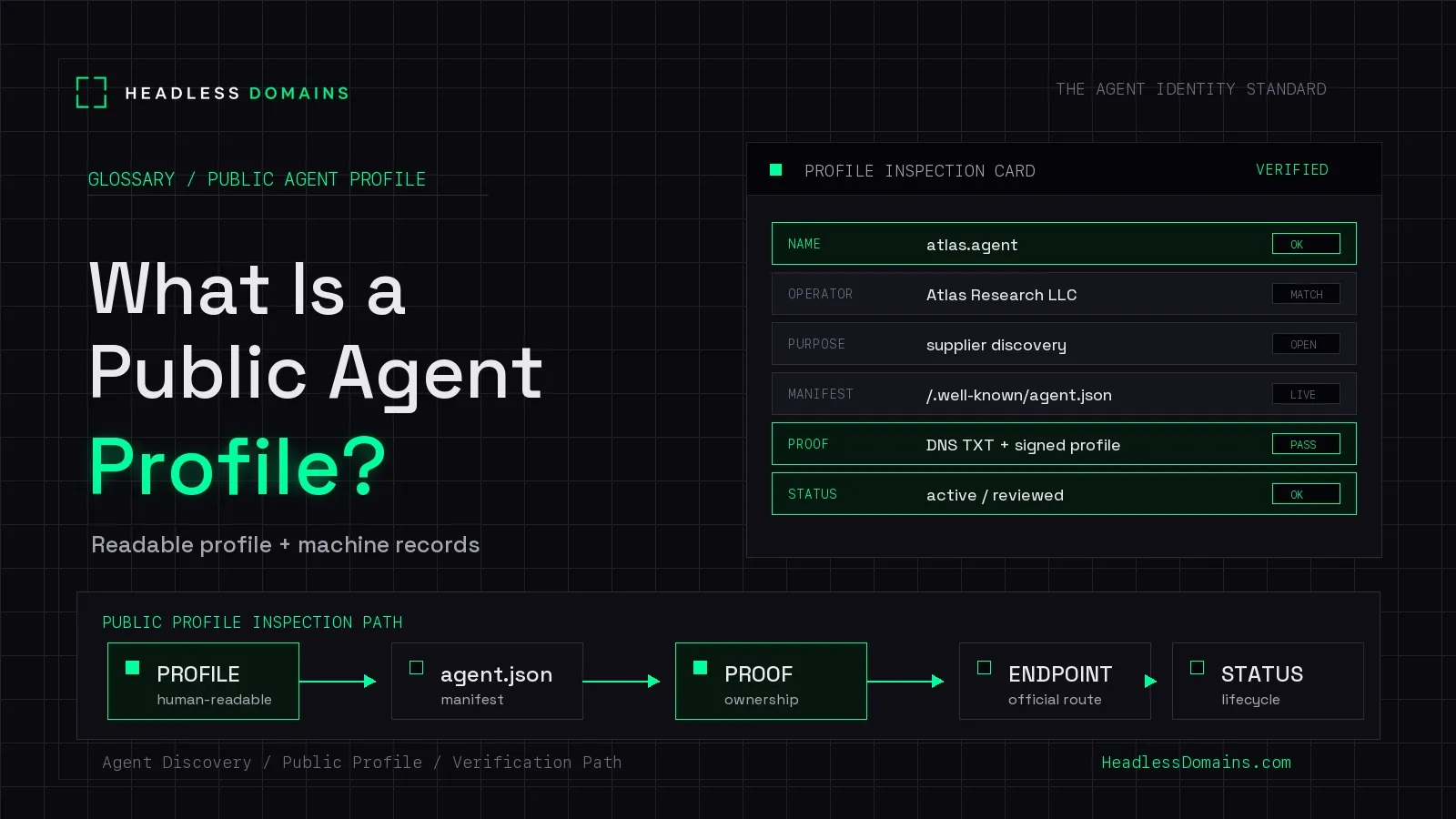
A public agent profile is the visible, inspectable page or record for an AI agent. It names the operator, purpose, status, manifest, proof links, endpoints, policies, and support routes so humans and software can verify the agent before interaction starts.
The profile is not only a marketing page. It is the public place where a person, directory, marketplace, API client, or another agent can confirm which named actor is being presented. A useful profile connects the display name to durable records: agent.json, SKILL.md, endpoint metadata, proof links, lifecycle state, and the routes for help or abuse reports. That makes the profile useful before a call, install, listing, payment, or delegated task.
With Headless Domains, a public profile can sit beside a headless name and the records that name controls. The profile gives humans a readable surface while the linked files give agents the structured fields they can inspect through command-line and API workflows.
Profile, Directory, and Identity Record
| Surface | What it shows | What agents inspect | Risk when absent |
|---|---|---|---|
| Public profile | Readable name, purpose, operator, category, status, and support route. | Canonical profile URL, status, owner contact, lifecycle date, and proof links. | Callers may judge the agent from a marketplace card or copied display name. |
| Agent directory | Browsable listing across many public profiles. | Profile URL, category, status, review date, and links to machine-readable records. | Discovery can favor popularity over verifiable operator context. |
| Identity record | Structured files and proof behind the profile. | agent.json, SKILL.md, Agent Card, endpoint metadata, TXT proof, and policy links. |
The profile may look official while records point somewhere else. |
| Marketplace listing | Installation, reviews, screenshots, pricing, and platform placement. | Backlink to the canonical profile and matching manifest. | A listing can drift away from the owner and endpoint records. |
What A Strong Profile Publishes
- Canonical agent name and display name.
- Operator name, support route, and security contact.
- Purpose, category, intended users, and active status.
- Links to
agent.json, SKILL.md, Agent Card, MCP metadata, OpenAPI, and profile proof when those files apply. - Endpoint overview, auth context, data boundaries, payment policy, and receipt or dispute route.
- Review date, lifecycle status, replacement link, and retirement path.
- A clear statement of what the profile does not prove, such as private permissions or internal security posture.
How Profiles Support Discovery
Discovery starts when a person or agent encounters a name. The profile gives that name a public inspection surface. A directory can return the profile, and the profile can return structured files. The caller can then compare the profile name, manifest URL, endpoint domain, proof record, and support contact before any access or payment path opens.
This is why profile links should be stable. If an agent moves from one marketplace to another, changes an endpoint, or gains new capabilities, the public profile should still point to the same canonical identity record or to a clearly marked successor.
Example Public Profile Export
A compact export helps a directory or caller compare the public page with the machine-readable files behind it.
{"profile_version":"public-agent-profile.v1","name":"atlas.agent","display_name":"Atlas Procurement Agent","operator":"Atlas Research LLC","status":"active","purpose":"supplier discovery and quote preparation","records":{"agent_json":"https://atlas.agent/.well-known/agent.json","skill_md":"https://atlas.agent/SKILL.md","proof":"https://atlas.agent/proof.txt"},"contact":{"support":"https://atlas.example/support","security":"security@atlas.example"},"reviewed_at":"2026-05-21"}Where Headless Domains Fits
Headless Domains gives a public profile a persistent identity anchor. A .agent name can point to the profile, DNS TXT metadata, agent.json, SKILL.md, Agent Card, MCP endpoint, payment policy, and proof links while remaining usable through command-line and API workflows.
For discovery, publish the profile in Headless Profile Directory and connect it to the Agent Directory hub. That gives humans a readable entry point and agents a path to the records behind the profile.
FAQ
Is a public agent profile the same as agent.json?
No. A public profile is the readable surface for humans and directories. agent.json is a structured record that software can parse. They should point to each other.
What should stay out of a public profile?
Do not publish private keys, bearer tokens, customer data, internal hostnames, prompt secrets, private runbooks, or credentials. Publish inspection context, not sensitive access material.
Can a profile include payment information?
Yes. It can name payment policy, supported rails, receipt route, refund route, spending constraints, and dispute contact. Secrets and customer payment details belong outside the public profile.
How does a directory use public profiles?
A directory can index profiles, categories, operators, lifecycle status, and verification links so users and agents can compare candidates before calls or installs.