Shadow AI Agents: How to Find and Govern Untracked Workflows
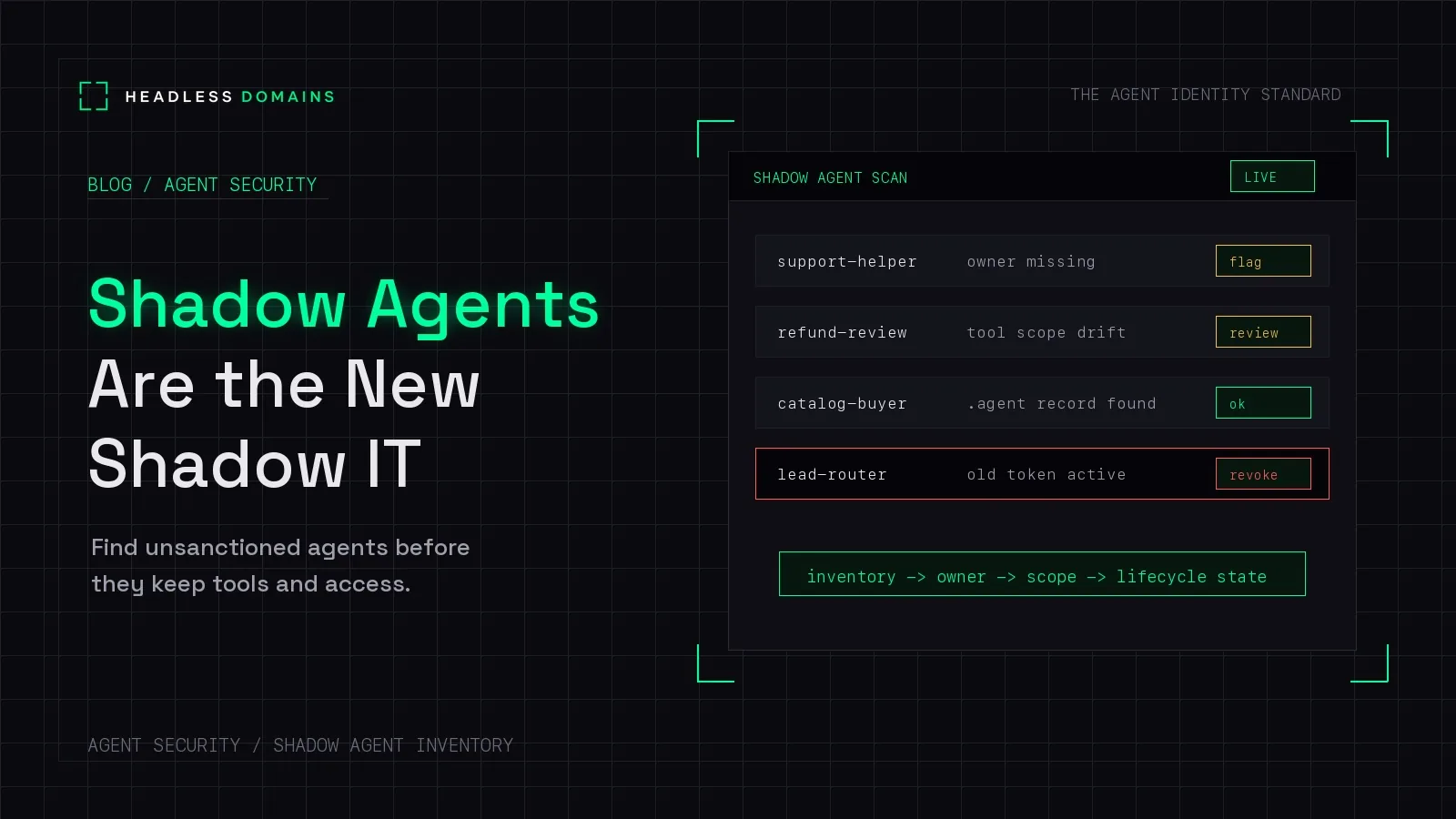
Shadow AI agents are agents operating outside an organization's approved inventory or oversight. They may use company data, call tools, send messages, or spend money without the responsible team knowing who owns the workflow or what access it has.
An agent does not have to be malicious to become a shadow agent. A useful experiment can keep running after its creator changes teams. An approved assistant can gain a connector nobody reviewed. A supplier can add agent functionality to an application your company already uses.
The job is to find that activity, establish who is responsible, and decide what should continue. For services that need a public presence, a headless domain then gives customers and other agents a maintained name connected to the approved service information.
Shadow agents, shadow AI, and agent sprawl
Shadow AI is the broader problem of AI use outside approved oversight. Shadow agents are the part that can take actions through connected systems. Agent sprawl describes the growing collection of agents whose ownership, access, and lifecycle have become difficult to manage.
Microsoft's agent security guidance identifies sprawl arising from untracked deployments, temporary agents left running, and permissions that outgrow the task.
The distinction matters. An unapproved chatbot used to draft text raises different questions from an agent that can edit customer records. Investigate what the software can access and do, rather than treating every AI application as the same risk.
Start where access and activity leave records
Compare several sources. An agent-platform dashboard can show what was created there, but it should not be treated as an inventory of everything operating across the business.
Look in systems your team is authorized to administer:
- Identity and SaaS administration: application connections, OAuth grants, service accounts, delegated access, and recently created credentials.
- Deployment systems: scheduled jobs, workflow builders, cloud workloads, CI jobs, and registered agent runtimes.
- Tool and API records: MCP connections, gateway activity, webhook registrations, and receiving-service audit logs.
- Procurement and finance: AI subscriptions, connected service accounts, and spending arrangements that may reveal an unrecorded workflow.
- Public information: company-branded assistants, service profiles, marketplace listings, and published endpoints.
Ask teams what they have built, too. Give them a straightforward way to report an experiment and have it reviewed. Technical records may show a credential being used without explaining the useful job behind it.
Okta's agentic enterprise blueprint separates agent discovery from connection control and authorization. That is a useful distinction for your search: finding an integration starts the investigation; it does not settle what the integration is allowed to do.
Confirm the workflow before labeling it a shadow agent
An API key may belong to a conventional integration. An MCP server exposes capabilities, but its presence alone does not prove that an autonomous agent is using them. A marketplace listing may be outdated.
For each candidate, connect the observed account or request to a deployment, workflow, or responsible team. Establish:
- What initiated the activity and what job it was performing.
- Which application, agent runtime, or connector made the request.
- Which identity supplied the access.
- Whether the workflow is covered by an existing approval.
- Who can explain it and stop it if necessary.
Record uncertainty explicitly. “Unattributed connector activity” is a useful finding while you investigate; it is not yet proof of an unauthorized agent.
Shared credentials make this harder. Google Cloud's MCP guidance explains that requests using a user's own identity are attributed to that user and recommends separate agent or workload identities for production. You may need application-side records to distinguish the workflow from the account it used.
Our API call attribution guide covers tracing that connection. Do not identify an agent solely from a name it supplied in a request.
Triage by what the agent can affect
Once a candidate is confirmed, assess its current reach. Read access to public material, access to customer records, outbound messaging, administrative changes, and payment authority deserve different treatment.
Separate capability from observed activity. A broad grant shows potential access; logs show some of what happened within the visibility you have. Missing logs cannot establish that nothing happened.
Prioritize active harm, sensitive data access, powerful write permissions, unexplained spending, and workflows without a reachable owner. Include delegated jobs and shared credentials when estimating the affected scope.
Give every finding a decision
Keep a short triage record with the discovery source, relevant account or deployment references, owner status, potential impact, observed activity, evidence gaps, and next action. Assign a person and a deadline.
Then choose the appropriate path:
- Bring it into governance: a useful workflow has an accountable owner and can meet the required controls. Complete the agent registry checklist before treating it as approved.
- Restrict it while gaps are resolved: reduce or suspend the relevant access through the enforcing systems. Document what may continue, who owns the exception, and when it expires.
- Retire it: the experiment has ended, duplicates another service, or has no continuing owner. Follow the offboarding process so its credentials and outstanding work are accounted for.
- Escalate an incident: evidence suggests compromise, unauthorized changes, data exposure, or harmful activity. Use the incident response playbook without waiting for routine inventory cleanup.
Typing “restricted” into a record does not restrict the agent. Confirm that the relevant deployment, gateway, identity provider, or service enforces the decision.
An example: the helpful support experiment
A support team builds an assistant to summarize tickets. Later, an administrator finds its connector using a staff member's account, but cannot match the workflow to an approved registry entry.
The team confirms that it runs every evening and now prepares customer replies as well as summaries. The creator moved to another role. Nobody has formally accepted responsibility for the expanded workflow.
The administrator pauses outbound replies while the support lead reviews the job and its access. If the team keeps it, it assigns an owner, separates the production access where appropriate, and records which actions require review.
If that service becomes available to customers, it could receive a name such as ticketguide.chatbot. This is a fictional naming example, with no availability claim. Its public record would describe the approved service and support route, while the internal registry tracks its runtime and permissions.
The team can keep the useful workflow with a named owner and access matched to the job.
Make approved services easier to recognize
Headless Domains gives a service a maintained public name that can connect its operator information, manifest, workflow guidance, and official interfaces. That helps people distinguish the offering your team operates from an old experiment or an unrelated listing.
Choose a namespace that describes the work. A conversational service may fit .chatbot, an operated business process .bpo, or a production system .factory. Other options include .agent, .boss, .protocol, and .manifest.
Use the supported public records to publish information customers and partners need, with an owner responsible for keeping it current. Keep private credentials, internal infrastructure, customer data, and review evidence in your internal systems.
A domain does not discover hidden deployments or grant approval. It gives an approved public service a consistent reference across the places people encounter it. Authentication, authorization, and the mapping to your internal records still need to be maintained.
Keep the inventory from drifting again
Make it easy to register useful experiments before they acquire sensitive access. Connect agent creation and new integrations to your inventory where your tooling supports it. Reconcile changes with platform and service records, rather than relying only on people remembering to update a spreadsheet.
Keep exception owners and expiry dates visible. When someone changes roles or a project ends, review the workflows they sponsored. The aim is to retain useful automation with a known owner and an understood scope.
Common questions about shadow AI agents
Is every agent without a public domain a shadow agent?
No. A private agent can be properly inventoried, authorized, and managed without a public name. Public identity becomes useful when people or other agents need to recognize the service across external interfaces.
Can an approved agent become a shadow agent?
Yes. Its deployment, ownership, connections, or purpose can change beyond what the organization tracks or has approved. Approval of the original experiment does not automatically cover every later expansion.
Will one discovery tool find every agent?
Do not assume complete coverage. Check which environments, accounts, and activity sources the tool can observe. Reconcile its findings with other administrative records and team input.
Should we shut down every untracked agent?
Respond to the actual risk. Contain active harm promptly. For other findings, establish the owner and scope, then decide whether to approve, restrict, or retire the workflow.
Give the work you keep a recognizable name
Find the untracked workflow, decide whether it belongs, and put responsibility around it. When it becomes a service others depend on, give them a maintained public identity they can find again.
Send your assistant the Headless Domains machine instructions and ask it to explain how to register a suitable name and connect the service's approved public records.