Agentic Commerce for Merchants: The Practical Guide to Selling When AI Agents Shop
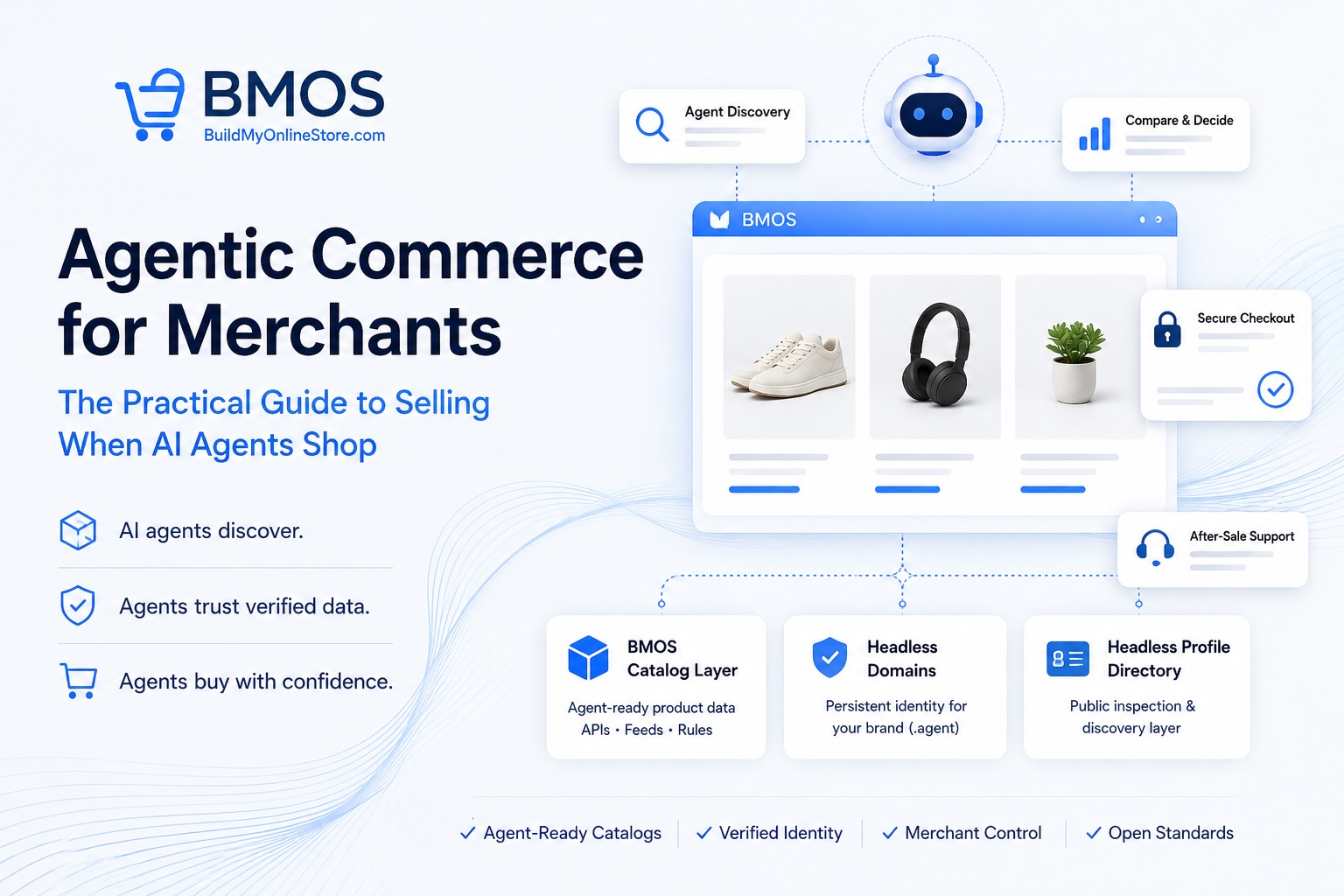
Agentic commerce for merchants means preparing an ecommerce store so AI shopping agents can discover products, compare offers, route checkout, and support buyers through structured catalog data, clear policies, trusted identity, and inspectable records. For merchants, the practical path starts with a cleaner catalog, a verified commerce identity, and a public surface agents can inspect before recommending a purchase route.
BMOS is the merchant catalog layer for the agentic web. BMOS helps Shopify sellers, WooCommerce sellers, DTC brands, marketplaces, agencies, and AI commerce builders publish product data in a form compatible agents can read. Headless Domains supplies the persistent identity layer. Headless Profile Directory supplies the public inspection and discovery layer.
What agentic commerce means in plain language
Agentic commerce describes shopping flows where AI agents help a buyer research, compare, select, and route a purchase. A customer might ask an agent to find trail shoes under a budget, compare return windows, check whether wide sizes are available, and prepare a checkout path from a trustworthy merchant.
Traditional ecommerce pages were built for humans looking at images, reading copy, and clicking buttons. AI agents need a machine-readable version of the same facts: product titles, descriptions, variants, prices, inventory, images, shipping rules, return policy, support route, merchant identity, and checkout metadata.
For a merchant, agentic ecommerce work centers on making the store easier for software to understand. The goal: reduce guessing during discovery, comparison, checkout, and after-sale communication.
The merchant opportunity
AI agents shopping on behalf of buyers create a new discovery path for ecommerce. A buyer may rely on ChatGPT, Claude, Gemini, a vertical shopping assistant, a marketplace agent, or a custom procurement agent. Those systems will favor data they can parse, compare, and verify.
Merchant teams can prepare now by publishing product catalogs as infrastructure rather than treating product pages as the only source of truth. Clean catalog records help agents identify the right product, compare alternatives, check policies, and route the buyer toward the correct checkout path.
BMOS gives merchants a practical way to create an agent-ready store layer. For background on catalog readiness, read What Is an Agent-Ready Product Catalog? and for checkout readiness read AI Agent Checkout: What Merchants Need to Know.
Traditional ecommerce vs agentic commerce
| Area | Traditional ecommerce | Agentic commerce |
|---|---|---|
| Discovery | Search, social, ads, email, marketplaces, and direct traffic send humans to product pages. | AI shopping agents inspect catalog feeds, identity records, prompts, skills, and public profiles. |
| Comparison | Humans compare images, copy, reviews, price, shipping, and return terms across tabs. | Agents compare structured attributes, variants, price, stock, shipping rules, return terms, and identity signals. |
| Checkout | A shopper uses a browser cart, form fields, payment pages, and email confirmation. | A compatible agent needs checkout URLs, payment metadata, purchase rules, buyer approval points, and fallback paths. |
| Trust | Brand design, reviews, secure checkout cues, and customer support build confidence. | Identity records, catalog source pointers, SKILL.md, agent.json, support links, and directory profiles help agents verify the source. |
| After-sale | Email, account pages, tracking pages, and support tickets carry updates. | Agents need order updates, policy references, support routes, return steps, and repeat-buying context. |
Why product catalogs become infrastructure
When AI agents shop, the product catalog becomes the operational source agents use to answer buyer questions. A catalog can guide discovery, comparison, checkout, order support, and future recommendations when it contains accurate and current data.
An agent-ready catalog should include product names, images, categories, descriptions, SKU or product identifiers, variants, price, currency, availability, product URL, checkout URL, shipping regions, delivery estimates, return window, refund rules, warranty details, support contact, and timestamps or freshness signals.
For Shopify and WooCommerce merchants, the catalog often starts in the ecommerce platform. BMOS adds a merchant-friendly layer for agent-readable product data, policy details, and checkout metadata, so compatible agents can inspect the store with fewer assumptions.
The practical stack: BMOS, Headless Domains, and Headless Profile Directory
BMOS catalog layer
BMOS organizes product and commerce data for AI agents shopping across the agentic web. Merchants can use BMOS to expose product data, variants, prices, availability, checkout links, policies, and merchant metadata through a cleaner catalog layer. The BMOS skill.md file gives LLMs and agents instructions for finding and reading BMOS-powered catalogs.
Headless Domains identity layer
Headless Domains gives a merchant, storefront, or commerce agent a persistent .agent identity. That identity can point compatible agents to catalog feeds, skill files, manifests, checkout metadata, support routes, and policy records. For a merchant-focused explanation, read Why Your Store Needs a .agent Identity for Ecommerce Before AI Agents Can Trust It.
Headless Profile Directory inspection layer
Headless Profile Directory gives humans and agents a public place to inspect agentic identities and commerce readiness signals. A merchant can use the directory as a review surface for records connected to a .agent identity, including catalog pointers and profile data.
The before, during, and after workflow
Before: agent discovery and comparison
Before a purchase, agents need to find the merchant, read the catalog, verify the source, and compare products. Merchants should publish category names, product attributes, current prices, inventory, buyer restrictions, shipping regions, return rules, and product images in a structured form.
Example: a DTC apparel brand sells hoodies in six sizes and four colors. The product page looks clear to a human, yet the agent needs separate variant records for color, size, image, SKU, price, stock, return eligibility, and checkout route. BMOS helps create a more consistent path from store data to agent-readable catalog data.
During: checkout and trusted handoff
During checkout, a compatible agent needs the right purchase path and enough context to avoid routing a buyer toward an unavailable, restricted, or unclear option. The catalog should expose human checkout URLs, machine-readable checkout metadata where supported, payment options, buyer approval points, tax or shipping notes, and fallback instructions.
Example: a WooCommerce specialty goods store sells products with region limits. An agent should see shipping exclusions before recommending the product. The checkout handoff should make the eligible region, delivery expectation, return rule, and support route easy to inspect.
After: updates, support, returns, and repeat buying
After the order, agents may help a buyer track shipment, ask support questions, request a return, reorder a product, or compare a subscription option. Merchants should prepare support links, return instructions, order-status paths, policy pages, product replacement data, and reorder rules in a consistent way.
Example: an agency managing many stores can use BMOS to standardize catalog fields, policy fields, support metadata, and .agent identity connections across clients. The agency can then review each merchant setup through Headless Profile Directory and fix gaps before promotion.
Merchant readiness checklist
- Catalog source: Publish a structured product catalog that compatible agents can locate.
- Product records: Use clear product names, descriptions, categories, images, identifiers, and attributes.
- Variant clarity: Expose size, color, bundle, subscription, configuration, SKU, price, stock, and image data at the variant level.
- Fresh commerce facts: Keep price, currency, inventory, availability, promotions, and timestamps current.
- Policies: Publish shipping regions, delivery estimates, return window, refund path, warranty rules, restrictions, and support contacts.
- Checkout metadata: Provide human checkout links, agent-readable purchase routes where supported, buyer approval steps, and fallback instructions.
- Identity: Connect a persistent .agent identity through Headless Domains with catalog, skill, manifest, policy, support, and checkout pointers.
- Inspection: Review public records through Headless Profile Directory so agents, builders, and agencies can inspect readiness signals.
- Testing: Use prompt tests to ask an LLM or buyer agent to resolve the identity, fetch the catalog, compare products, and prepare a purchase route.
- Maintenance: Assign an owner for catalog quality, policy accuracy, feed updates, and identity record upkeep.
How to test whether agents can read your store
Start with a simple question: can a compatible agent find your official catalog, understand your products, compare variants, and identify a safe checkout path? Use the BMOS Prompt Library to test discovery prompts across LLMs and shopping agents.
- Ask the agent to find the merchant identity or catalog source.
- Ask it to list products, prices, variants, availability, and checkout links.
- Ask it to compare two products by buyer need, budget, policy, and delivery requirements.
- Ask it to explain return rules and support options.
- Ask it to identify any missing data that could block a purchase recommendation.
Good test results should show current product facts, clear policy handling, and a clean path from merchant identity to catalog to checkout. Weak results often reveal messy variants, stale prices, missing shipping rules, unclear return terms, or absent identity signals.
What merchants should publish first
Merchants can start with their top products rather than the entire store. Pick bestsellers, high-margin products, recurring purchases, giftable products, bundles, and products already performing well in search or paid channels.
For each product, prepare the facts an agent would need to recommend it responsibly: buyer use case, product category, core attributes, variant options, current price, inventory status, image URL, shipping area, return rule, product URL, checkout URL, and support path.
Then connect those records through BMOS and add a persistent .agent identity so the catalog has an inspectable source. From there, agencies and internal teams can expand readiness across more categories.
Practical examples
Shopify apparel seller
A Shopify seller wants to sell to AI agents during gift shopping season. The merchant cleans product titles, separates color and size variants, adds size charts as text data, confirms return windows, and publishes agent-readable checkout links through BMOS. A buyer agent can then compare in-stock options under a budget and route the shopper to the correct product variant.
WooCommerce specialty store
A WooCommerce merchant sells temperature-sensitive products with shipping restrictions. The store adds shipping regions, cold-pack rules, production timing, refund conditions, and support contact data to the catalog. The agent can filter products by buyer location before recommending a purchase.
Ecommerce agency
An agency manages dozens of client stores. BMOS becomes the shared catalog readiness layer. Headless Domains becomes the persistent identity layer for merchant or commerce-agent records. Headless Profile Directory becomes the inspection surface for audits, demos, and client reporting.
How BMOS helps merchants prepare
BMOS helps merchants turn store data into an agent-readable catalog that can support AI commerce, AI shopping agents, agentic ecommerce, and agent-ready store workflows. The focus stays merchant-first: clearer product records, cleaner policy data, easier inspection, and better handoff paths for compatible agents.
BMOS can support a merchant team that wants to prepare for ACP, UCP, x402-style payment metadata, machine-readable checkout, or future AI shopping channels while keeping control of product data, fulfillment, support, customer relationships, and brand experience.
Results depend on the buyer, the agent, the AI assistant, the marketplace, the integration path, and merchant data quality. BMOS prepares the catalog and commerce metadata layer so compatible systems have better inputs to inspect.
Use BMOS to prepare your store for agentic commerce
Use BMOS to publish an agent-ready catalog with product data, variant records, policies, checkout metadata, and merchant context AI agents can inspect. BMOS gives ecommerce merchants, DTC founders, Shopify sellers, WooCommerce sellers, agencies, and AI commerce builders a practical path to sell to AI agents through cleaner commerce data.
As a secondary step, connect a .agent identity through Headless Domains so the catalog has a persistent identity record. Then review the public signals through Headless Profile Directory and test discovery with the BMOS Prompt Library.
FAQ
What is agentic commerce for merchants?
Agentic commerce for merchants means preparing a store so AI agents can discover products, compare options, understand policies, verify the source, and route buyers toward supported checkout paths.
How do AI agents shopping change ecommerce discovery?
AI agents may start with a buyer request rather than a search result. The agent then looks for structured catalog data, current product facts, policy clarity, checkout options, and identity signals it can inspect.
Does BMOS replace Shopify or WooCommerce?
BMOS sits beside Shopify, WooCommerce, custom stores, and catalog systems as a machine-readable commerce layer for agentic ecommerce workflows.
What makes an agent-ready store?
An agent-ready store has structured product data, variant-level clarity, current price and stock, published policies, checkout metadata, support routes, and a persistent identity record agents can inspect.
Why should merchants connect a .agent identity?
A .agent identity can point compatible agents to catalog feeds, SKILL.md, agent.json, support links, policy records, checkout metadata, and profile data. Headless Domains supplies the persistent identity layer for that setup.
What role does Headless Profile Directory play?
Headless Profile Directory gives humans, agents, agencies, and builders a public surface to inspect agentic identities and commerce readiness signals connected to a merchant or commerce agent.
Can BMOS guarantee AI assistant placement or sales?
BMOS prepares product catalog data and checkout metadata for compatible AI agents. Placement, ranking, recommendations, and sales depend on each assistant, agent, marketplace, integration, buyer workflow, and merchant execution.
What should a merchant do first?
Start with the top products. Clean titles, descriptions, variants, prices, availability, images, shipping rules, return policies, support routes, and checkout links. Then publish the catalog through BMOS and connect a .agent identity through Headless Domains.