Why Your Store Needs a .agent Identity for Ecommerce Before AI Agents Can Trust It
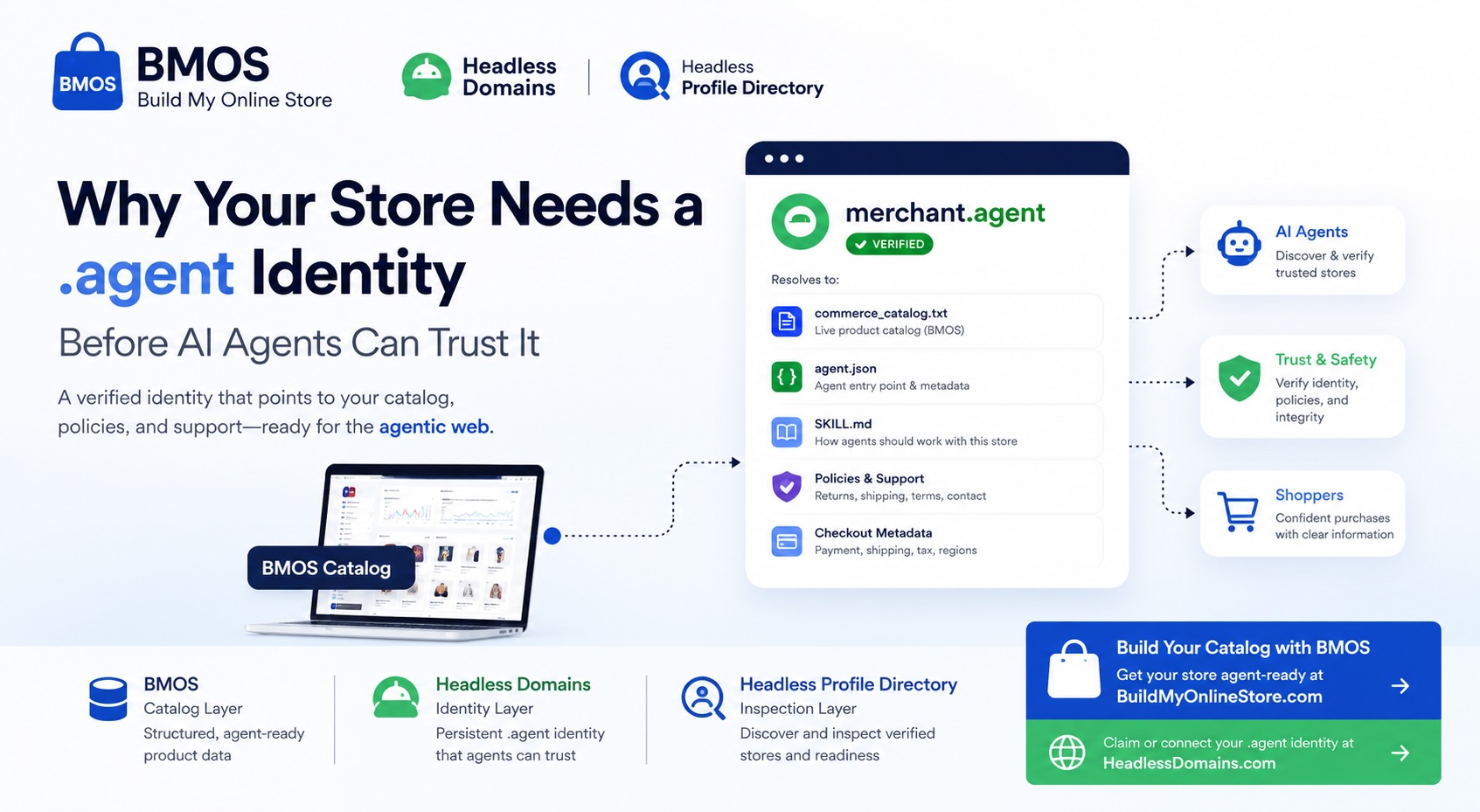
.agent identity for ecommerce gives AI agents an inspectable merchant record before they rely on a catalog. BMOS publishes agent-readable product data, Headless Domains anchors the persistent identity, and Headless Profile Directory gives humans and agents a place to review records, catalog pointers, policies, support links, and checkout metadata.
A product feed can describe items, prices, variants, availability, shipping, and returns. Agents also need to confirm where the trusted feed lives, who controls it, and which records support purchase routing. A .agent commerce identity supplies those verification clues through records such as commerce_catalog, SKILL.md, agent.json, support URLs, policy pointers, and checkout metadata.
The trust gap in agentic commerce
AI shopping agents are starting to perform tasks once handled by shoppers, merchandisers, search engines, comparison tools, and checkout flows. A buyer can ask an agent to find a jacket under a price cap, compare return policies, check size availability, and prepare a purchase path. The agent needs clean product data, plus a way to verify the merchant source before recommending a store.
BMOS solves the catalog side of the problem by helping merchants publish structured commerce data for the agentic web. The BMOS homepage positions BMOS as the merchant-friendly product catalog layer for AI agents. For a companion explanation of catalog readiness, read What Is an Agent-Ready Product Catalog?.
Headless Domains solves the identity side by giving a merchant, agent, or storefront a persistent namespace record agents can inspect. The Headless Domains identity layer helps agents prove who they represent, where trusted endpoints live, and how records can be checked across apps, APIs, marketplaces, and commerce workflows.
BMOS publishes the catalog layer
BMOS turns store data into an agent-readable store surface. A compatible agent can use a BMOS catalog to read product names, descriptions, variants, prices, images, availability, shipping rules, return policies, and checkout paths. Clean catalog data helps the agent compare options with fewer guesses.
The BMOS skill file gives agents direct discovery instructions. It tells an agent to resolve the merchant record, inspect TXT records, look for commerce_catalog, fetch the live feed URL, then follow the BMOS commerce workflow. The BMOS prompt library gives merchants and builders prompt examples for testing catalog discovery across LLMs and shopping agents.
Headless Domains provides the persistent identity layer
Headless Domains gives a merchant a durable identity surface for agentic commerce identity. Instead of relying on a raw URL floating around in prompts, a merchant can connect the catalog to a .agent record. That record can point to the feed, agent.json, SKILL.md, merchant support, policy pages, profile records, and checkout metadata.
The Headless Domains blog article AI Lowers the Cost of Generation. It Raises the Cost of Trust. explains why agents need inspectable identity, commerce feeds, discovery surfaces, and records before they transact. For ecommerce teams, the key takeaway is simple: product data and AI merchant identity should travel together.
Headless Profile Directory makes readiness inspectable
Headless Profile Directory acts as the inspection layer. A merchant, agency, buyer, or AI commerce builder can use Headless Profile Directory to inspect an agentic identity on Handshake DNS, review machine-readable records, and check commerce readiness signals. Inspection reduces ambiguity around who operates the merchant identity and where the catalog source lives.
Think of the stack as three connected layers: BMOS publishes the verified product catalog, Headless Domains anchors the identity record, and Headless Profile Directory lets people and agents review the public signals. The Headless Domains BMOS connection gives merchants a practical route from product data to trusted agent discovery.
Catalog without identity vs catalog with .agent identity
| Commerce surface | Catalog without identity | Catalog with .agent identity |
|---|---|---|
| Discovery | Agents may receive a feed URL from a prompt, page, marketplace listing, or copied link. | Agents can resolve merchant.agent and inspect records for the trusted feed location. |
| Verification | The agent sees products but has fewer signals about merchant control, source authority, or support paths. | The agent can inspect AI merchant identity records, profile data, skill files, and policy pointers. |
| Routing | Checkout links may be available, yet the agent may lack context for supported paths or approval rules. | Checkout metadata, support links, and commerce_catalog TXT record data can guide safer purchase routing. |
| Maintenance | Feed URLs can move, prompts can age, and marketplace listings can drift from the trusted source. | Persistent identity records give agents a stable place to re-check catalog location and store context. |
| Inspection | Humans and agents need extra work to verify the same source. | Headless Profile Directory gives a public profile surface for identity and readiness review. |
A simple merchant.agent example
Imagine a merchant selling outdoor gear through BMOS. The merchant connects a .agent identity such as merchant.agent. In Headless Domains, the identity record includes a commerce_catalog TXT record with a feed_url pointing to the live BMOS catalog feed.
- The buyer asks an agent to find a lightweight camping mug under a specific price.
- The agent resolves merchant.agent through the Headless Domains lookup path or a compatible resolver.
- The agent inspects commerce_catalog and finds the BMOS feed_url.
- The agent fetches the BMOS catalog feed and checks product title, price, availability, image, shipping policy, return policy, and checkout metadata.
- The agent reviews Headless Profile Directory for public identity and readiness signals.
- The agent presents the buyer with a verified product catalog result and a purchase route.
That flow gives the agent a path from identity to catalog to purchase context. The catalog tells the agent what can be sold. The .agent identity helps the agent verify where the trusted catalog lives and who the catalog represents.
What to publish in a .agent commerce identity
A strong .agent commerce setup should point agents toward current, useful records. Merchants and catalog managers can start with:
- commerce_catalog TXT record: feed_url, storefront ID, status, and freshness clues for the BMOS catalog.
- SKILL.md: agent instructions for discovery, catalog fetching, product interpretation, and checkout routing.
- agent.json: structured identity data, merchant role, approved capabilities, and links to trusted endpoints.
- Support links: customer service, returns, disputes, security contacts, and merchant contact paths.
- Policy links: shipping regions, return windows, privacy, terms, restrictions, and approval rules.
- Checkout metadata: human checkout URL, machine-readable checkout path, payment options, and any human approval requirement.
- Profile directory entry: a public inspection path through Headless Profile Directory.
Practical examples for merchants and agencies
DTC brand with multiple variants
A direct-to-consumer apparel brand sells hoodies in several sizes and colors. BMOS can publish variants, current availability, images, prices, and return rules in a structured feed. The .agent record can point agents to the approved feed and support policies, so a buyer agent can recommend an in-stock option and avoid outdated product assumptions.
Specialty store with shipping limits
A specialty product store has shipping restrictions by region. BMOS can expose shipping zones and checkout paths. A .agent identity can connect those policies to an inspectable merchant record, helping agents avoid recommending products to buyers outside supported regions.
Marketplace operator with many sellers
A marketplace can use BMOS for catalog normalization and Headless Domains for seller-level identity records. Each seller can connect a .agent commerce identity to its catalog, policies, and support path. Agents then have a repeatable way to inspect sellers across a broader catalog network.
How to prepare your store
Before connecting BMOS and Headless Domains, clean the data agents need most. Start with product titles, descriptions, prices, currencies, variants, inventory, images, shipping rules, return policy, support contacts, and checkout links. Then map each field into a BMOS catalog and connect the catalog to a persistent identity record.
Checkout readiness should also be part of the review. The BMOS article Best Online Payment Methods Used for E-Commerce Stores gives merchants a useful foundation for payment thinking before adding agentic commerce paths.
Why agencies and technical founders should care
SEO teams optimized pages for crawlers. Performance marketers optimized landing pages for paid traffic. AI commerce teams will optimize catalog and identity records for agents. A store with structured products but weak identity leaves agents with unanswered questions. A store with identity but weak product data gives agents little to recommend. The strongest agent-readable store connects both.
For agencies, the deliverable can include a BMOS catalog audit, .agent identity connection, commerce_catalog TXT record setup, skill file review, Headless Profile Directory inspection, and checkout metadata review. For technical founders, the same checklist can become an agent-ready API and commerce readiness roadmap.
CTA: publish the catalog, then claim the identity
Use BMOS to publish an agent-readable catalog with product data, policies, checkout paths, and merchant metadata AI agents can parse. Start with the BMOS homepage, review the BMOS skill file, and test discovery with the BMOS prompt library.
Then claim or connect a .agent identity through Headless Domains. Connect commerce_catalog, agent.json, SKILL.md, support links, policy links, and checkout metadata so agents can verify your AI merchant identity before relying on your catalog.
FAQ
What does .agent identity for ecommerce mean?
.agent identity for ecommerce means a merchant, storefront, or commerce agent has a persistent, inspectable record that points to trusted catalog data, support links, policies, skill files, profile data, and checkout metadata for agentic commerce.
How does BMOS work with Headless Domains?
BMOS publishes the catalog layer. Headless Domains anchors the persistent identity layer. Together, they let agents move from a merchant identity record to a live BMOS catalog feed and related commerce instructions.
What is a commerce_catalog TXT record?
A commerce_catalog TXT record can hold structured pointers such as feed_url, storefront ID, and status. Compatible agents can inspect the record to find the trusted BMOS catalog feed for a merchant identity.
Why use Headless Profile Directory?
Headless Profile Directory gives humans and agents a public inspection surface for agentic identities. It helps buyers, builders, agencies, and operators review profile records and commerce readiness signals.
Can a product feed alone support AI agents?
A product feed helps agents understand items for sale. Identity records add source verification, merchant context, support links, policies, skill files, and checkout metadata. Agentic commerce needs both catalog legibility and merchant verification.
Does BMOS guarantee placement inside any AI assistant?
BMOS helps merchants prepare structured catalog data for compatible AI agents and commerce workflows. Placement inside any specific assistant depends on each platform, agent, integration, and buyer workflow.
What should merchants do first?
Clean product data, publish a BMOS catalog, connect a .agent identity through Headless Domains, add commerce_catalog records, then inspect the setup through Headless Profile Directory.
Who should own the setup?
The owner can be the merchant, technical founder, ecommerce agency, marketplace operator, or catalog manager. The key responsibility is keeping catalog data, identity records, policies, and checkout paths current.