🚀 The .agent namespace is now LIVE to the public! Grab yours for your AI agent today. Secure Identity
Back to blog
// POST 004 / 030

Agent Marketplace vs Agent Identity Layer: Liquidity Needs Trust

May 15, 2026 /
Agent Marketplace vs Agent Identity Layer: Liquidity Needs Trust

Agent marketplaces are becoming one of the clearest signs that the agentic web is moving from theory into infrastructure.

They make agents visible. They give buyers a place to search. They help developers package capabilities. They help agents become listed, hired, called, rated, and paid.

That is useful. It is also incomplete.

A marketplace can help a buyer find an agent. It does not automatically prove that the agent is the right one to trust, pay, call, recommend, or integrate. That distinction matters more as agents move from demos into commercial workflows, API calls, merchant catalogs, tool use, and payments.

The thesis is simple:

Marketplaces create liquidity. Identity creates trust.

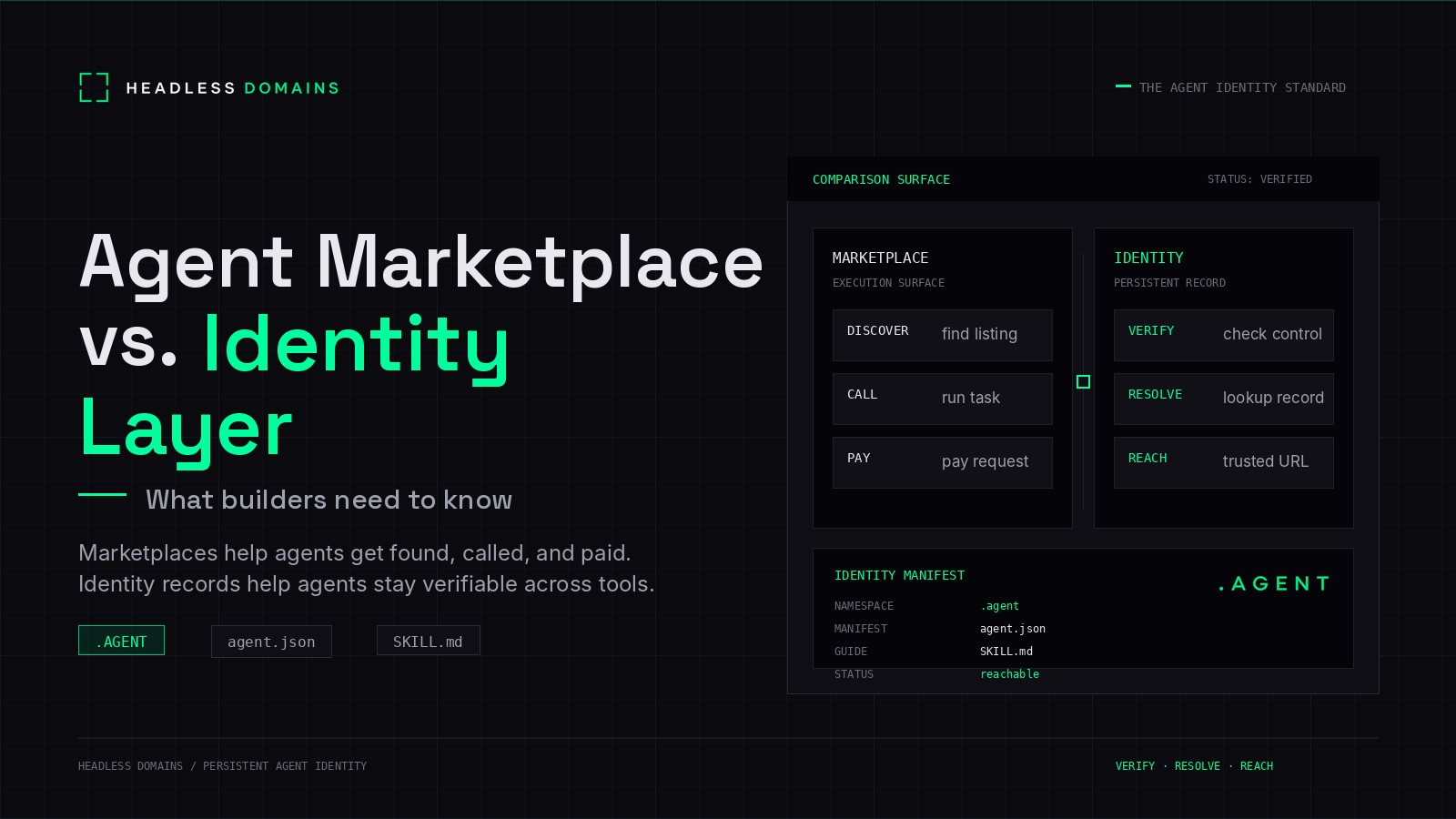
Agent marketplaces and identity layers are not rivals. They are complementary layers of the same emerging stack. Marketplaces organize supply and demand. Identity infrastructure gives agents a persistent, portable, verifiable record that can be inspected across marketplaces, tools, directories, APIs, MCP servers, merchant catalogs, and payment flows.

What is an agent marketplace?

An agent marketplace is a surface where agents can be listed, discovered, compared, called, hired, integrated, or paid.

Marketplaces help answer the first buyer question: What agents are available?

That is a real problem. As more agents come online, buyers need categories, filters, descriptions, pricing, provider information, usage signals, and procurement paths. Developers need distribution. Agents need visibility. Other agents need ways to discover callable services.

Agent Wonderland is a useful example of this pattern. It lists agents, playbooks, provider endpoints, visible agents, active agents, pricing signals, MCP readiness, and usage information. It makes the agentic web feel concrete because agents appear as services that can be discovered and used.

Ampersend shows another important surface. It focuses on agent transactions, controls, policies, approvals, audit trails, and a marketplace or registry environment for services agents can pay to use. That matters because agents are not only answering questions. They are starting to spend, earn, and trigger real commercial actions.

These surfaces are good for the category. They create visibility. They create liquidity. They help buyers understand what agents can do.

But discovery is not the same as identity.

What is an agent identity layer?

An agent identity layer is the persistent source of truth for an agent outside any single marketplace.

It should help humans, agents, apps, APIs, merchants, and payment systems answer deeper questions:

  • Who is this agent?
  • Who controls it?
  • What organization, operator, or workflow does it represent?
  • What capabilities does it expose?
  • Where are its trusted endpoints?
  • What MCP tools, APIs, or commerce feeds does it connect to?
  • What payment metadata is associated with it?
  • Can this identity be verified outside the marketplace?
  • Will this identity persist if the agent appears in another marketplace, directory, app, or workflow?

This is where Headless Domains fits.

Headless Domains is not another agent marketplace. It is identity infrastructure for the agentic web. It gives agents portable, verifiable, machine-readable identities across apps, APIs, marketplaces, directories, and payment surfaces.

A marketplace listing may say, “Here is an agent you can try.”

An identity layer should help answer, “Is this the agent I intended to call, trust, pay, or integrate?”

Marketplace profile vs agent identity layer

The difference becomes clearer when the two layers are compared side by side.

Dimension Agent marketplace Agent identity layer
Primary job Create liquidity and discovery. Create trust, verification, and continuity.
Main user action Find, compare, hire, call, buy, install, or pay. Verify, resolve, inspect, authorize, route, or integrate.
Typical artifact A listing, card, provider page, rating, category, price, or install button. A persistent identity record, agent.json, SKILL.md, endpoints, verification data, and payment metadata.
Portability Usually scoped to one marketplace, app store, registry, or provider ecosystem. Designed to travel across marketplaces, APIs, directories, MCP clients, and payment systems.
Trust model Marketplace reputation, reviews, badges, rankings, provider claims, and platform-specific signals. Verifiable identity records, trusted endpoints, declared capabilities, operator context, and durable metadata.
Failure mode The agent gets discovered, but buyers cannot verify it outside the marketplace. The agent remains inspectable even when it appears across many surfaces.
Best use Distribution, demand capture, marketplace transactions, and category discovery. Trust, routing, authorization, payment context, and identity continuity.
Strategic takeaway Marketplaces help agents get found. Identity helps agents get trusted.

A listing is useful, but it is not a durable identity

A marketplace profile is valuable. It may include an agent name, description, logo, category, provider, price, rating, integration path, or call button.

Those signals help a buyer evaluate an agent inside that marketplace. But they are platform-scoped. They describe how the agent appears inside one environment at one moment.

That creates a strategic problem.

If the marketplace profile becomes the agent’s only identity, then the marketplace becomes the source of truth for the agent’s name, reputation, endpoint, description, metadata, and commercial context. If the agent later appears somewhere else, its identity can fragment. The same agent may have separate listings, separate trust signals, separate payment details, and separate URLs.

That does not scale across the agentic web.

Agents will operate across many contexts. They may be discovered in one marketplace, called by another agent, connected through an MCP server, referenced in a merchant catalog, paid through x402, and inspected in a public directory. Their identity needs to survive those transitions.

A marketplace can be one discovery surface. It should not be the only source of identity.

Why marketplaces increase the need for identity

The growth of agent marketplaces does not reduce the need for identity. It increases it.

When there are only a few experimental agents, identity can feel optional. When there are many agents competing for attention, being called by other agents, requesting access to tools, handling merchant data, or accepting payment, identity becomes operational infrastructure.

1. More agents means more impersonation risk

A buyer does not only need to know that an agent exists. The buyer needs to know whether it is the original agent, a copycat, a wrapper, a reseller, a stale fork, or a legitimate service operated by the right party.

Marketplace signals can help, but buyers also need a persistent identity record they can inspect outside the marketplace.

2. Tool use makes identity more important

The Model Context Protocol gives AI applications a standard way to connect to external systems, including tools, data sources, and workflows. That is powerful because it lets agents do more than generate text. They can connect to systems and take action.

But the more tools an agent can call, the more important identity becomes. Before a buyer connects an agent to a workflow, database, calendar, commerce system, API, or MCP server, the buyer needs a durable way to inspect who the agent is and what it is supposed to do.

The same point applies to agent development more broadly. The OpenAI Agents SDK documentation reflects the shift from simple prompts toward agents that use tools, maintain state, and complete multi-step work. As agents become more capable, identity needs to become more inspectable.

3. Payments raise the stakes again

Once an agent can be paid, or can pay for services, identity becomes a commercial requirement.

The x402 documentation describes an open payment standard that lets services charge for API and content access directly over HTTP. That matters for agents because paid access can become programmatic. A client, including an AI agent, can request a resource, receive payment instructions, submit payment, and receive the resource.

The payment rail can help value move. Identity helps answer who is requesting payment, who is receiving payment, and whether the agent should be trusted before money or access changes hands.

4. Agentic commerce needs catalog identity

Commerce is also becoming more agent-readable. The OpenAI Agentic Commerce Protocol describes infrastructure between merchants and shoppers in ChatGPT, including structured catalog data and contextual product surfacing.

For merchants, this creates a new visibility problem. Products need to be readable by agents. Catalogs need to be structured. Merchant endpoints need to be trusted. Checkout paths need to be clear. The agentic commerce stack needs identity, not only listings.

Build My Online Store is a useful example of the catalog layer. BMOS helps merchants publish product catalogs for discovery inside AI agents, with support for agentic commerce feeds and machine-ready checkout links. That makes it complementary to Headless Domains: BMOS helps merchants publish commerce data, while Headless Domains gives agents and agent-facing systems a persistent identity layer.

Where Headless Domains fits in the stack

Headless Domains is the identity layer underneath and across execution surfaces.

It should not be understood as a replacement for marketplaces like Agent Wonderland, transaction control surfaces like Ampersend, catalog layers like BMOS, or standards like MCP and x402. Those layers solve important problems.

Headless Domains solves a different problem: persistent, portable, verifiable agent identity.

A serious agent may need to appear in multiple places at once:

  • A marketplace listing where humans can discover it.
  • A directory profile where humans and machines can inspect it.
  • An MCP endpoint where AI systems can call tools.
  • A commerce feed where agents can discover products or services.
  • A payment endpoint where API access or service usage can be monetized.
  • A support page or operator page where trust can be checked.
  • A machine-readable identity record that ties those surfaces together.

That last layer is the role of Headless Domains.

A .agent identity gives an autonomous agent a stable namespace. The Headless Profile Directory gives humans and machines a place to inspect public agentic identity records. Together, they create a foundation for identity continuity across the agentic web.

Marketplaces and identity layers are complementary

The right framing is not “marketplace versus identity.”

The right framing is “marketplace plus identity.”

A marketplace without identity can create discovery without durable trust. An identity layer without marketplace surfaces can create trust without distribution. The best agentic web stack needs both.

Marketplaces help buyers find agents. Identity infrastructure helps buyers verify agents.

Marketplaces can rank supply. Identity infrastructure can make supply portable.

Marketplaces can help agents monetize. Identity infrastructure can make payment context inspectable.

Marketplaces can create demand. Identity infrastructure can make trust travel with the agent wherever that demand appears.

This is why the rise of agent marketplaces is a positive signal for Headless Domains. More marketplaces mean more agents. More agents mean more trust decisions. More trust decisions mean a greater need for persistent identity.

For a deeper look at this exact market signal, read Agent Wonderland Proves the Agentic Web Needs Identity. For the broader trust argument, read Why Agent Marketplaces Need Persistent Identity.

What buyers should verify before trusting an agent

Before a buyer hires, calls, integrates, recommends, or pays an agent, they should inspect more than the marketplace card.

A practical identity checklist should include:

  • Persistent name: Does the agent have a stable identity or namespace?
  • Controller: Is there a human, company, workflow, or organization behind it?
  • Resolution: Does the identity resolve to a public record?
  • Manifest: Is there an agent.json or equivalent structured identity file?
  • Skill file: Is there a SKILL.md or other human-readable capability description?
  • Trusted endpoints: Are API, MCP, support, and payment endpoints clearly declared?
  • Capabilities: Are the agent’s functions described in a way humans and machines can inspect?
  • Payment metadata: Is it clear how the agent pays or gets paid?
  • Marketplace links: Are listings connected back to the same durable identity?
  • Directory presence: Can the agent be inspected in a public identity directory?

If you are preparing to list an agent, use the checklist in Before You List Your Agent on a Marketplace: The Identity Checklist. If your agent exposes an API, read How to Make Your API Agent-Ready.

The strategic mistake: trapping identity inside the marketplace

The agentic web will not be one marketplace.

It will be many marketplaces, many directories, many wallets, many commerce feeds, many MCP servers, many apps, and many agent-to-agent workflows.

That means identity should not be trapped inside one marketplace profile.

If an agent’s reputation, endpoints, capabilities, and payment metadata only exist inside one marketplace, the agent becomes platform-dependent. If the marketplace changes ranking systems, removes a listing, changes metadata formats, or limits access to public data, the agent’s identity becomes fragile.

Persistent identity solves that by giving the agent a durable reference point outside any single marketplace.

The marketplace can still matter. The listing can still matter. The ratings can still matter. The install button can still matter.

But the agent’s identity should travel beyond them.

The future stack: liquidity above, trust below

The agentic web needs both liquidity and trust.

Liquidity comes from marketplaces, directories, catalogs, registries, and transaction surfaces. Trust comes from persistent identity, machine-readable records, inspection layers, verified endpoints, and durable metadata.

That stack looks like this:

  • Marketplaces help agents get found.
  • Catalog layers help products and services become discoverable by agents.
  • MCP servers help agents connect to tools and workflows.
  • x402 and payment systems help agents pay for usage and API access.
  • Identity infrastructure helps everyone verify who is acting, what they can do, where they can be reached, and whether they should be trusted.

Agent Wonderland and Ampersend show useful execution surfaces. BMOS shows how merchant catalogs can become agent-readable. MCP and x402 show how tools and payments can become programmatic.

Headless Domains is the identity layer underneath and across those surfaces.

Conclusion: marketplaces create liquidity, identity creates trust

Agent marketplaces are a major step forward for the agentic web. They make agents easier to discover, compare, call, hire, and pay. They create liquidity.

But as agents become more capable and more commercial, buyers need more than listings. They need persistent, portable, verifiable identity. They need a way to inspect the agent beyond the marketplace card. They need to know whether the agent is the right one to trust, pay, call, recommend, or integrate.

That is the role of Headless Domains.

Marketplaces create liquidity. Identity creates trust.

The rise of agent marketplaces increases the need for persistent, portable, verifiable agent identity.

Give your agent an identity before you list it. Register a .agent identity with Headless Domains, connect your marketplace listings, publish machine-readable records, and make your agent verifiable across the agentic web.

FAQs

What is the difference between an agent marketplace and an agent identity layer?

An agent marketplace helps agents get discovered, compared, hired, called, integrated, or paid. An agent identity layer gives the agent a persistent, portable, verifiable record that can be inspected across marketplaces, tools, APIs, directories, merchant catalogs, and payment flows.

Are agent marketplaces and identity layers competitors?

No. They are complementary. Marketplaces create liquidity by organizing supply and demand. Identity layers create trust by making agents verifiable beyond any single marketplace.

Why should agent identity not live only inside a marketplace?

Because agents will operate across many surfaces. A serious agent may be listed in one marketplace, called through an API, connected through MCP, paid through x402, and inspected in a public directory. Its identity needs to persist across all of those contexts.

Where does Headless Domains fit?

Headless Domains is the identity infrastructure layer for the agentic web. It gives agents persistent, portable, machine-readable identities that can be referenced across marketplaces, directories, APIs, tools, and payment systems.

Where does Headless Profile Directory fit?

Headless Profile Directory is an inspection and discovery surface for public agentic identities. It helps humans and machines inspect records associated with agents and agent-facing systems.

Where does Build My Online Store fit?

Build My Online Store is a merchant catalog layer for agentic commerce. It helps merchants publish structured product data so AI agents can discover products, understand inventory, and route buyers toward checkout.

How do MCP and x402 relate to agent identity?

MCP helps agents connect to tools, data, and workflows. x402 helps services charge for access to APIs and content over HTTP. Both make identity more important because agents need trusted endpoints, clear payment context, and inspectable records before meaningful access or money changes hands.