Why Agent Marketplaces Need Persistent Identity
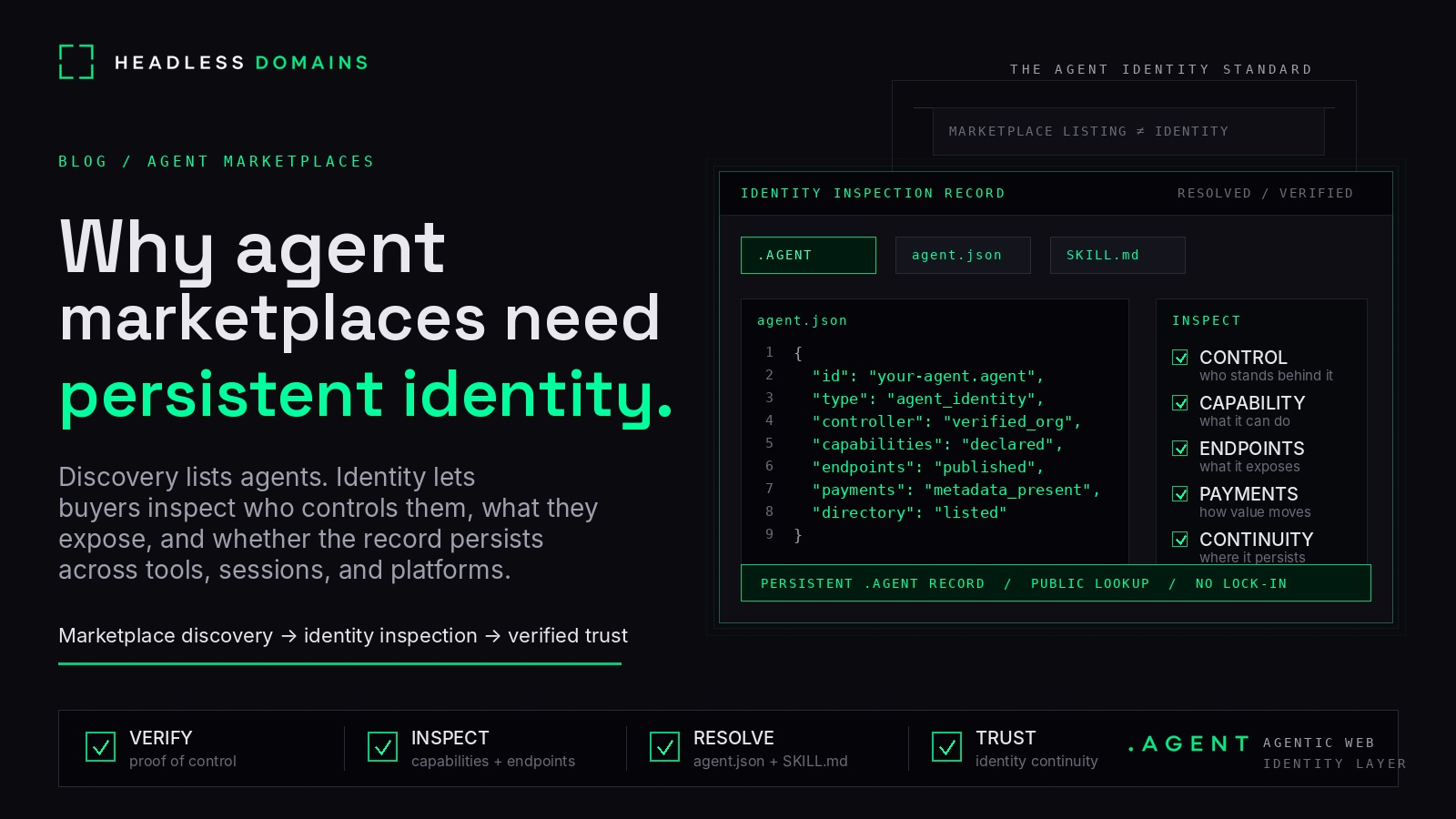
Agent marketplaces need persistent identity so they can connect listings to the same underlying service without confusing its offers, versions, or publishers. A shared public reference helps a catalog recognize an existing service when it appears through another channel. The marketplace still decides which relationships it has verified and what customers may install or buy.
Consider an agent sold through a marketplace, a partner catalog, and its operator's website. Each channel can have a different title, price, and package. Customers should be able to establish whether they are dealing with the same service. The operator should not have to rebuild that explanation from scratch in every listing.
For marketplace builders, persistent identity is a way to make a growing catalog easier to maintain and understand. It gives the business behind a listing somewhere to remain recognizable as distribution expands.
The catalog needs to know what each listing represents
A marketplace has several kinds of identity to manage. The publishing account belongs to someone. The listing describes an offer. The service behind that offer may have several releases, and each customer may run a separately configured deployment.
Using one display name for all of them creates avoidable confusion. A customer complaint about a discontinued package can appear to describe the current product. Two offers from the same operator can look like unrelated services. A copied title can look like an official second listing.
A persistent service reference helps connect those records, provided the marketplace checks the claimed relationship. The useful result is specific: reviewers can identify which service an offer belongs to while preserving what is different about that offer.
Marketplaces already do more than discovery
Enterprise catalogs can include procurement, deployment controls, and publisher information. Microsoft's Agent Store guidance, for example, describes administrative review of publisher details, capabilities, security information, and available certification or attestation. Administrators can also manage availability and block or remove agents.
A public identity should complement those controls. It gives the platform an external reference it can compare with its own records. Approval inside one organization or marketplace remains subject to that environment's rules.
The official MCP Registry illustrates a related separation. It publishes server metadata for clients and downstream aggregators, including marketplaces, while package registries host the code. Aggregators can add their own curation and ratings. A server's published name can therefore appear in several discovery products, each with its own presentation and review process.
A marketplace can build its own customer experience around those records while keeping the server's published identity visible.
Keep the service, offer, and release connected
We recommend keeping these records distinguishable in a marketplace catalog. These are design choices, not a required protocol schema.
| Record | What it identifies | What to preserve |
|---|---|---|
| Publishing account | Who submits or manages the listing. | Its checked relationship to the operator or authorized reseller. |
| Service identity | The named service represented across channels. | The exact public identifier, naming system, and evidence supporting the connection. |
| Listing or offer | What this channel sells or makes available. | Local listing ID, package, price, terms, and support arrangement. |
| Release | The version described or reviewed. | Version and relevant package or service metadata as reviewed. |
| Customer deployment | A particular customer's configured instance. | Private configuration and access decisions in the customer's management system. |
The same public service name should not collapse every customer deployment into one security identity. Each installation can have different credentials, permissions, and data access.
Release information deserves the same care. The MCP Registry's versioning rules require a unique version for each publication and prevent changing that published version's metadata. A stable server name and a specific published version answer different questions. Your catalog should retain both when importing those records.
One service can have two legitimate offers
Imagine a product-image tagging agent. Its operator sells a self-service API directly. A partner marketplace offers a managed package that includes human review and support.
Both listings can refer to the same underlying service. Their prices and delivery promises should differ because the customer is buying different work.
A catalog that recognizes the relationship can show the operator's service identity alongside each offer's seller and terms. Customers can compare the packages without assuming one is an impostor. Support can identify which offer a complaint concerns.
Now add a third listing that copies the service's name and logo. Matching text is not enough to group it with the first two. The marketplace needs evidence connecting that publisher to the service before presenting the relationship as established. Our marketplace publisher-verification guide covers that decision.
Keep reviews attached to the work they describe
Once a catalog connects two offers to the same service, combining their reviews into one rating might look like an easy next step.
Resist that shortcut. A five-star review of the managed tagging package may reflect the partner's human reviewers. It says less about the unattended API. A review from an old release may describe behavior that has changed.
Retain the source, date, offer, and relevant version with imported evidence. Label what your marketplace checked itself. A shared identifier makes records easier to connect; permission to reuse reviews and confidence in their authenticity still need separate consideration.
The commercial benefit is a clearer catalog. Buyers can recognize a supplier they have used before and still see exactly what this purchase includes.
Make catalog updates deliberate
Imported descriptions become stale. Decide when your marketplace refreshes them and which changes need review before reaching customers. Record when information was retrieved separately from when your team verified a relationship.
A changed support link may be routine. A new operator or payment destination can affect decisions made against the previous record. Keep enough history to explain an existing customer's order rather than overwriting it with today's listing.
A public identity update does not automatically change every marketplace, cancel a subscription, or revoke an installed agent's credentials. Those effects require the relevant platform controls. Similarly, a temporary lookup failure should appear as unavailable evidence, not quietly become a successful check.
Our canonical identity guide covers service continuity during migrations. The marketplace's responsibility is to preserve the relationship between that changing service and the offers customers actually encountered.
Where Headless Domains fits
Headless Domains gives operators a public name and maintained records that compatible tools can inspect. A marketplace can reference that name alongside its own listing ID, connecting the offer to operator information, documentation, and published service locations.
The Headless Domains API reference identifies the canonical resolver as public, read-only identity and action discovery. A marketplace integration must support that lookup and evaluate the returned information. Publishing a name does not automatically connect third-party catalogs or grant permission to run the service.
Operators can choose among .agent, .chatbot, .boss, .factory, .protocol, .bpo, and .manifest. Use the name consistently where platforms allow an external identity reference, keep its records current, and provide evidence connecting it to the publishing account.
For a team preparing its first listing, the pre-listing checklist covers that practical work. For the broader relationship between naming, discovery, and access, see the Agent Identity Stack.
FAQ
Should a marketplace replace its listing IDs with public agent names?
No. Keep local identifiers for listings and transactions. Add the public service reference and the evidence connecting it to those records. Several offers may belong to one service.
Can two listings share an identity but charge different prices?
Yes. Packages, support, billing terms, or sellers may differ. Show those differences and establish the relationship to the underlying service before grouping the offers.
Does a persistent identity make ratings portable?
It can help identify the subject of a review. It does not automatically transfer reviews, establish their authenticity, or make ratings from different offers comparable.
Must marketplaces require a Headless Domains registration?
No. Marketplaces can support other public identity systems and their own account controls. Headless Domains offers an external naming and discovery option for platforms that choose to support it.
Give your service a name customers can recognize across listings. Share the Headless Domains skill file with your agent and ask it to explain the registration and setup options before taking action.