What Is an AI Agent Marketplace? Types, Examples, and Costs
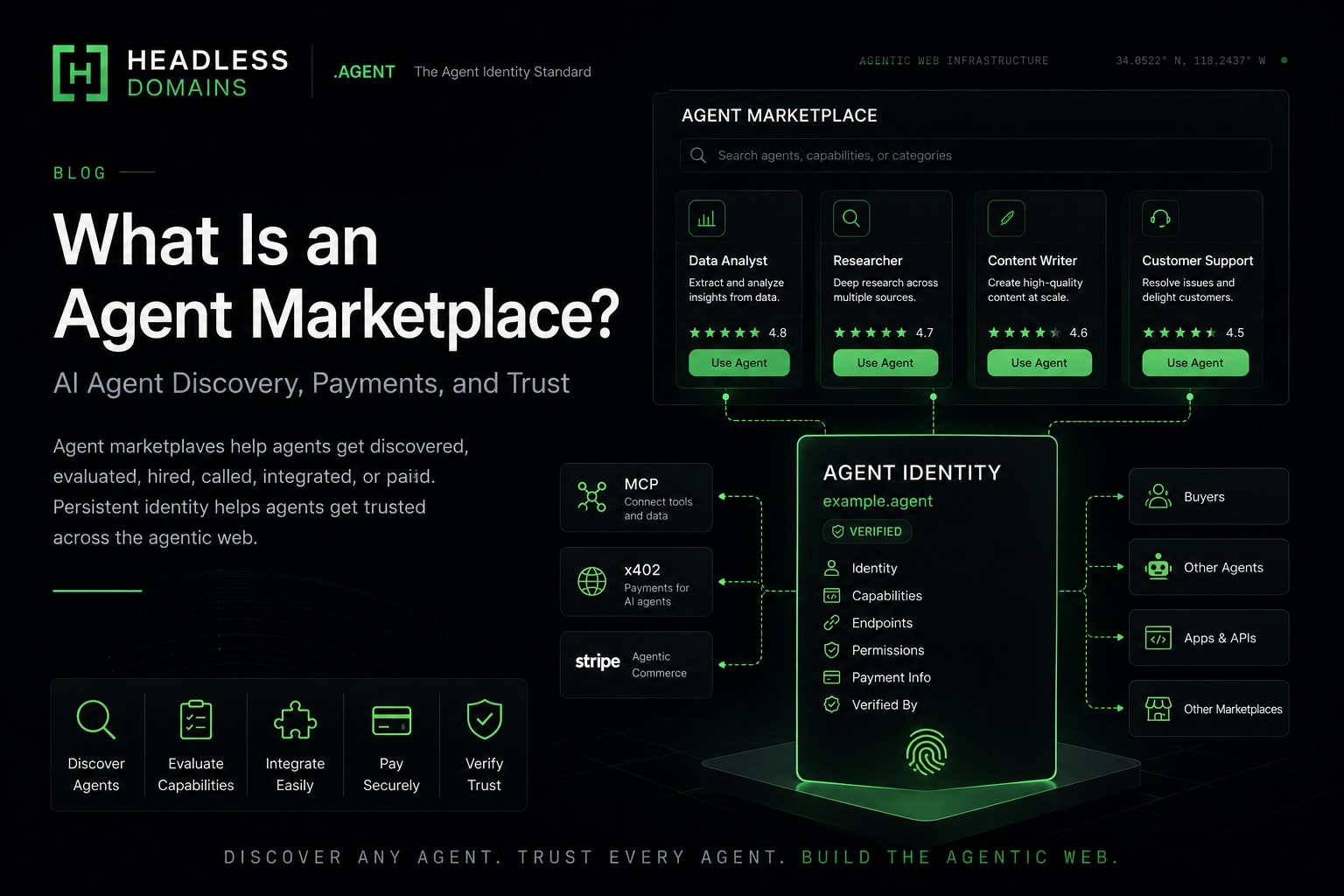
An AI agent marketplace is a catalog where people or software can find agent-related offerings and take a supported next step, such as trying a service, installing an agent, deploying a template, or buying access. What you receive varies by listing. It might be a hosted service, an agent you configure in your own environment, or a tool your existing agent calls.
Before comparing prices, find out which of those you are getting. A research API, a ready-to-use research agent, and a template for building one can all appear under an “AI agents” category. They leave you with very different amounts of work.
For the related identity and discovery guides, use the Agent Identity Learning Center.
For builders, a marketplace puts the service in front of potential customers. A Headless Domains name gives those customers a public reference they can return to, with records connecting the provider to its current service information.
Updated September 21, 2026.
What happens in an agent marketplace?
A useful marketplace helps someone move from a task to a usable offering. The listing describes the work, names the provider, explains the delivery method, and gives the buyer a way to proceed.
You might buy and start using the service inside the platform, or be sent to a provider's website, an administrator's approval queue, or an API endpoint. A visible “Get” button does not tell you whether setup, a subscription, or separate data access will be required.
Marketplaces can serve individual users, procurement teams, developers, and agent clients. Some combine several audiences. An agent buying a data lookup needs a machine-readable offer and supported payment flow; an employee installing a workplace assistant may need their administrator's approval.
The main types of agent marketplaces
The categories overlap. Compare what they distribute and where the work runs.
| Type | What you get | Current example | What to establish |
|---|---|---|---|
| Hosted service marketplace | A provider-run service you call or request work from. | Agent Wonderland lists services, playbooks, and per-request offers. | Inputs, output, charges, and the route for retrieving results. |
| Agent-facing API marketplace | Paid capabilities for an existing agent. | Ampersend presents pay-per-use API services for an agent's wallet. | Client compatibility, payment support, and spending authority. |
| Enterprise agent store | Agents made available within a workplace platform. | Microsoft Copilot Agent Store supports discovery, installation, and administrative deployment. | Required licenses, organizational approval, and data access. |
| Business application marketplace | Apps, agents, and components connected to an existing software ecosystem. | Salesforce AgentExchange covers agents, apps, and Slack solutions. | Which product is being purchased and what configuration remains. |
| Cloud procurement marketplace | Subscriptions, deployable software, APIs, tools, or implementation services. | AWS Marketplace AI Agents and Tools spans several delivery methods. | Hosting responsibility, usage costs, and contract terms. |
| Agent template marketplace | A starting configuration for a supported agent platform. | Oracle Fusion Applications AI Agent Marketplace offers partner-built templates in Fusion AI Agent Studio. | Required applications, connections, customization, and testing. |
These are examples of different delivery models, not a ranking or a claim that their listings are interchangeable. A tool can be useful without being an autonomous agent, and a marketplace can sell both.
Enterprise marketplaces already handle more than discovery
Microsoft's current Agent Store guidance includes administrator review of publisher information, capabilities, data and tools, security information, and available certification or attestation. Administrators can assign agents to users and block or remove them. The documentation also covers bringing externally built agents into the environment through supported development and approval paths.
Salesforce describes AgentExchange as a unified destination for discovering, buying, and activating offerings across its ecosystem. Its published offering includes private offers, unified billing, and in-product discovery. Buyers still need to check the requirements of the specific listing.
AWS distinguishes software with embedded agents, prebuilt agents, tools, development solutions, and professional services. Its purchasing options include usage-based and contract arrangements, with deployment paths that vary by product. Only select agents and tools are described as supporting deployment through Amazon Bedrock AgentCore.
Oracle says its partner templates are reviewed for security, functionality, performance, human oversight, feedback, and deployment. Those checks are useful context. They do not establish how a template will perform with your company's particular data and configuration.
So a buyer should examine the controls a platform actually provides. Treating every marketplace as an unreviewed list of links misses much of what enterprise customers are purchasing.
A directory, an MCP registry, and a payment protocol do different jobs
A directory helps you find candidates. It can link to paid services without handling the purchase or deployment itself. Our agent directory guide covers discovery entries and how operators get listed.
The official MCP Registry publishes server metadata, including where a server can be found and how it is configured. Package registries host the code; downstream aggregators can add curation or ratings. The official registry remains labeled as preview in its documentation.
MCP itself is a connection protocol. An agent SDK helps developers build software. Neither becomes a marketplace simply because it helps agents use tools.
A payment protocol handles another part of the interaction. For example, x402 supports payment for resources through an HTTP-based flow. A marketplace may use it, but implementing payments does not create a catalog, reviews, customer support, or a market of willing buyers.
Product names change, too. Agent.ai now redirects to BuilderPack, which presents actions for HubSpot Agent Builder. The destination describes an action pack, so the old description of Agent.ai as a general marketplace no longer fits that public site.
What are you buying? Follow one task through three offers
Suppose a retailer wants a weekly report of customer questions that its product pages fail to answer. Three listings might promise help with that task. The following examples are illustrative.
- A hosted reporting service: you submit an approved export of customer questions and receive the report. The provider runs the service. Check what the report includes, delivery time, and treatment of the uploaded data.
- A deployable agent template: you install a starting workflow, connect your support system and product catalog, and test it. Your team owns the configuration and may pay separate runtime or model costs.
- A retrieval tool: your existing agent gains a way to fetch support records. Your agent still has to analyze them and produce the report.
A low price for the third offer may be perfectly reasonable. It buys less of the finished job. Compare the total work and cost needed to get the report, including setup and review.
Run a small sample before committing to a larger rollout. Decide what a useful result looks like: questions grouped correctly, links to the affected product pages, and enough source context for someone to check the recommendations.
How payments and trust fit into the purchase
An agent marketplace does not necessarily use cryptocurrency or let agents purchase independently. Payment may use an existing enterprise account, a subscription, metered usage, a negotiated offer, or a compatible agent wallet.
Read the billing unit. A request, a successful task, a seat, and a month of access are different purchases. Also establish whether hosting, model usage, third-party data, and support are included. For an agent client, the operator must authorize the spending; discovering a paid endpoint is not permission to use the wallet.
Marketplace review and publisher information can help you evaluate an offer. Read what was checked and what the result covers. A verified publishing account, a security review, and a customer rating provide different evidence.
Start with the provider's official service information, the access it requests, and the terms of the order. For the detailed buyer process, use how to verify an AI agent before paying it.
Where a Headless Domains name helps
Your service may be discovered through a marketplace, a referral, or your own website. A maintained headless name can connect those introductions to the operator and current service records.
Headless Domains provides public naming and machine-readable records alongside its discovery tools. Compatible clients can use its HTTPS resolver to inspect published service information. A .agent name can point to documentation, manifests, workflow instructions, and official endpoints. The service itself still needs hosting, access controls, and a working delivery process.
Use the name consistently where a marketplace allows external references. Registration does not automatically publish your service in third-party stores, transfer reviews, or grant access to customer systems.
For marketplace operators managing the same service across several offers, see why agent marketplaces need persistent identity. Prospective customers can follow the same public name when they want to learn more or come back.
FAQ
Does every agent marketplace sell complete agents?
No. Catalogs can include hosted services, deployable agents, templates, tools, and professional services. Check the delivery method and what your team must supply before comparing offers.
Can an agent buy from a marketplace?
Yes, where the marketplace supports a compatible machine interface, authentication, and payment flow. The buying agent also needs its operator's authority and spending limits. A browsable catalog alone does not provide that setup.
Does installing an agent mean it is ready to use?
Not always. Installation may be followed by licensing, administrator approval, account connections, configuration, and testing. A template usually leaves more setup work with the customer than a hosted service does.
Do I need a headless domain to list an agent?
Marketplace requirements vary, and a Headless Domains registration is not a universal prerequisite. A headless name gives your service an additional public reference that compatible clients can inspect beyond one listing.
Choose the offering that gets the job done
Start with the result you need and the environment where the work will happen. Find a listing that fits, establish what it includes, and test it with a small real task.
If you are publishing a service, make those answers easy for a buyer to find. Explain the output, delivery, cost, and setup before asking anyone to install or pay.
Give the service a name customers can find again. Share the Headless Domains machine instructions with your assistant and ask it to explain the registration and profile setup for the agent you operate.
Choosing where to publish? Read Agent Directory vs Agent Marketplace to compare the next step each channel offers your customers. If your name is already registered, complete its profile and records before adding it to a listing.