AI Agent Name Collisions: How to Tell Similar Agents Apart
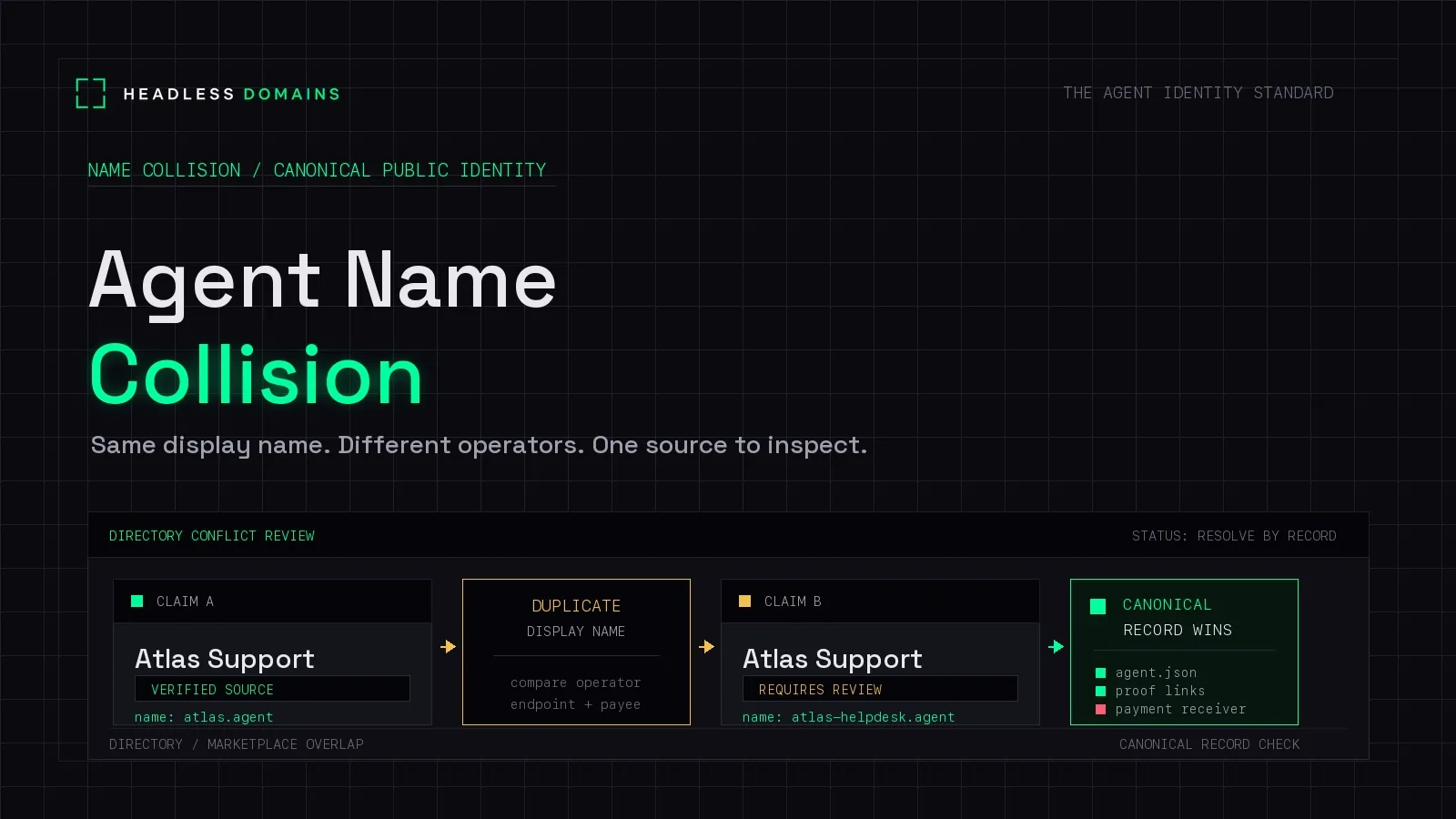
An AI agent name collision happens when two agents or services use the same or confusingly similar name. A directory might show two assistants called “Beacon.” Both could be legitimate. The problem starts when a person or another agent treats that shared label as enough information to choose a service, send data, or approve a payment.
To tell them apart, compare their full public identifiers, operators, source records, and intended services. Keep the candidates separate until you have evidence that they represent the same actor.
Headless Domains helps by giving the work you run a maintained public name linked to its current information. Customers can recognize the friendly name while compatible software follows a more specific identity.
A display name is not a unique destination
Names such as Research Assistant, Support Agent, or Beacon are easy to remember. They also leave plenty of room for unrelated builders to choose the same words.
The A2A specification, for example, defines an Agent Card's name as a human-readable name. The card separately describes supported interfaces and other service information. The friendly name alone should not decide which peer receives a task.
This is why a search result needs context. “Beacon, operated by Example Travel” means something different from “Beacon, operated by Example Support,” even if the icons happen to look alike.
The broader relationship between listings and public identity is covered in our marketplace-name guide. Here, the practical question is what to do when more than one candidate matches.
First establish what kind of collision you have
Two different services share a label
This can be ordinary naming overlap. A travel assistant and a helpdesk bot might both be called Beacon. Keep their records, reviews, credentials, and destinations separate. Matching words are not a reason to merge them.
One service appears in several places
A directory listing and a marketplace profile may describe the same service under different titles. Look for an established source connecting both profiles to the same public identity. A copied description or logo is insufficient.
A lookalike imitates an established service
A listing may copy a familiar name while changing a character, operator claim, or destination. Unicode's security guidance describes visually confusable strings, including characters from different scripts that can look similar.
Similarity detection can flag a candidate for review. It should not silently convert that candidate into the trusted identity it resembles. Legitimate international names also deserve careful handling rather than blanket rejection.
Example: two agents called Beacon
Suppose an assistant is asked to contact “Beacon” and finds these two entries. The names, operators, and addresses below are fictional; registration availability has not been checked.
| Record | Support service | Travel service |
|---|---|---|
| Display name | Beacon | Beacon |
| Public name | beacon-support.chatbot | beacon-travel.chatbot |
| Operator claim | Example Support | Example Travel |
| Service | Customer helpdesk | Trip planning |
The assistant should not pick whichever entry ranks first. If the user meant customer support, it has a plausible candidate, but it still needs to establish the expected operator and official service path. If the request supplies no useful context, asking “Which Beacon?” is the right next step.
Once the relationship is confirmed, the application can retain the selected public identity and source context for future use. It should still recheck material changes before sensitive actions.
Keep the naming system attached to the name
An identifier is interpreted within a system. The same text in two independent naming systems does not, by itself, identify the same service.
Headless Domains uses Handshake-backed names. Its resolution guide explains the distinction from conventional DNS resolution. Integrations should retain the full name and the naming or resolution context used to interpret it.
The current Headless Domains machine instructions document a public, read-only resolver at /api/v1/resolve/{domain}. Follow the resource links returned for the intended name. Do not guess a manifest address by turning a display label into a browser URL.
This also matters within Headless Domains. A matching word before .chatbot and .bpo does not prove common ownership. Use the complete registered name and check the relationship.
Tool names can collide too
An agent may connect to two MCP servers that both expose a tool called search. That does not make the tools interchangeable.
The MCP tools specification scopes tool-name uniqueness to a server and recommends disambiguation when clients aggregate tools. It also warns that a server's declared name is not guaranteed to be unique.
A practical client design associates each tool with a distinct configured server identity, rather than routing on the tool label alone. Its display could show which connected service supplies each search tool.
A public headless domain can help identify that service. The client must still connect the public record to the actual server configuration and credentials; registration does not make that association automatically.
What to do when two records seem to conflict
- Keep both candidates. Preserve their identifiers, source URLs, and operator claims separately. Do not combine ratings or permissions because their display names match.
- Establish which service was intended. Use the request's context, an existing approved connection, or clarification from the user.
- Follow an established source. Check the operator's known official information and the linked identity records. Several pages copying one claim are not independent confirmation.
- Investigate unexplained differences. A service may use another host or payment processor legitimately. Check the documented relationship rather than requiring every hostname or recipient label to match.
- Record a specific conclusion. Mark the entries as distinct services, confirmed aliases of one service, or unresolved. Pause the affected action if the uncertainty changes where data, credentials, or money would go.
These are recommended review steps, not an automatic collision-resolution feature. The identity-record field guide explains how to examine the evidence behind individual claims.
For payments, confirming the intended service is only part of the decision. Apply the actual transaction's authorization and verification requirements. Our API payment checklist covers that next step.
Make your own service easier to distinguish
Give people a full public name they can recognize alongside your display name. A conversational product may fit .chatbot, a repeatable business service .bpo, or a production system .factory. Other work may fit .agent, .boss, .protocol, or .manifest.
Choose a distinctive name within the appropriate namespace. Publish it through your established official channels, and connect it to accurate operator information, a clear service description, and current resource links. Headless Domains supplies the maintained naming and discovery layer; your public records make the distinction useful.
When a listing changes, preserve the connection to the same identity where appropriate. Our canonical identity guide covers continuity through those changes.
You cannot stop every other builder from liking the same friendly name. You can give customers a clearer way to recognize your service.
Common questions
Does a duplicate name mean an agent is fake?
No. Unrelated services may share a display name. Investigate the operator and source records before drawing conclusions about affiliation or impersonation.
Does registering a headless domain eliminate name collisions?
It gives your service a specific registered name in its naming context. It does not prevent similar display names, lookalike spellings, or reuse of text in independent naming systems.
Should a directory merge entries with matching names?
No. Merge only when evidence supports that the entries represent the same service. Keep the source records and review outcome so the decision can be revisited.
Must the public name match the API hostname?
No. A service can publish an official endpoint on another host. The important question is whether the relationship is established and the destination is appropriate for the intended action.
Give the next caller a name they can check
If your agent or service shares a generic name with others, make its full identity visible. Keep the friendly label, but give customers and compatible agents a maintained reference to the operator and service they actually want.
Start with the Headless Domains machine instructions and ask your assistant to help choose a fitting name and connect your existing service. Already registered? Make sure your public listings point to it.