Your Agent’s Marketplace Name Is Not Its Identity
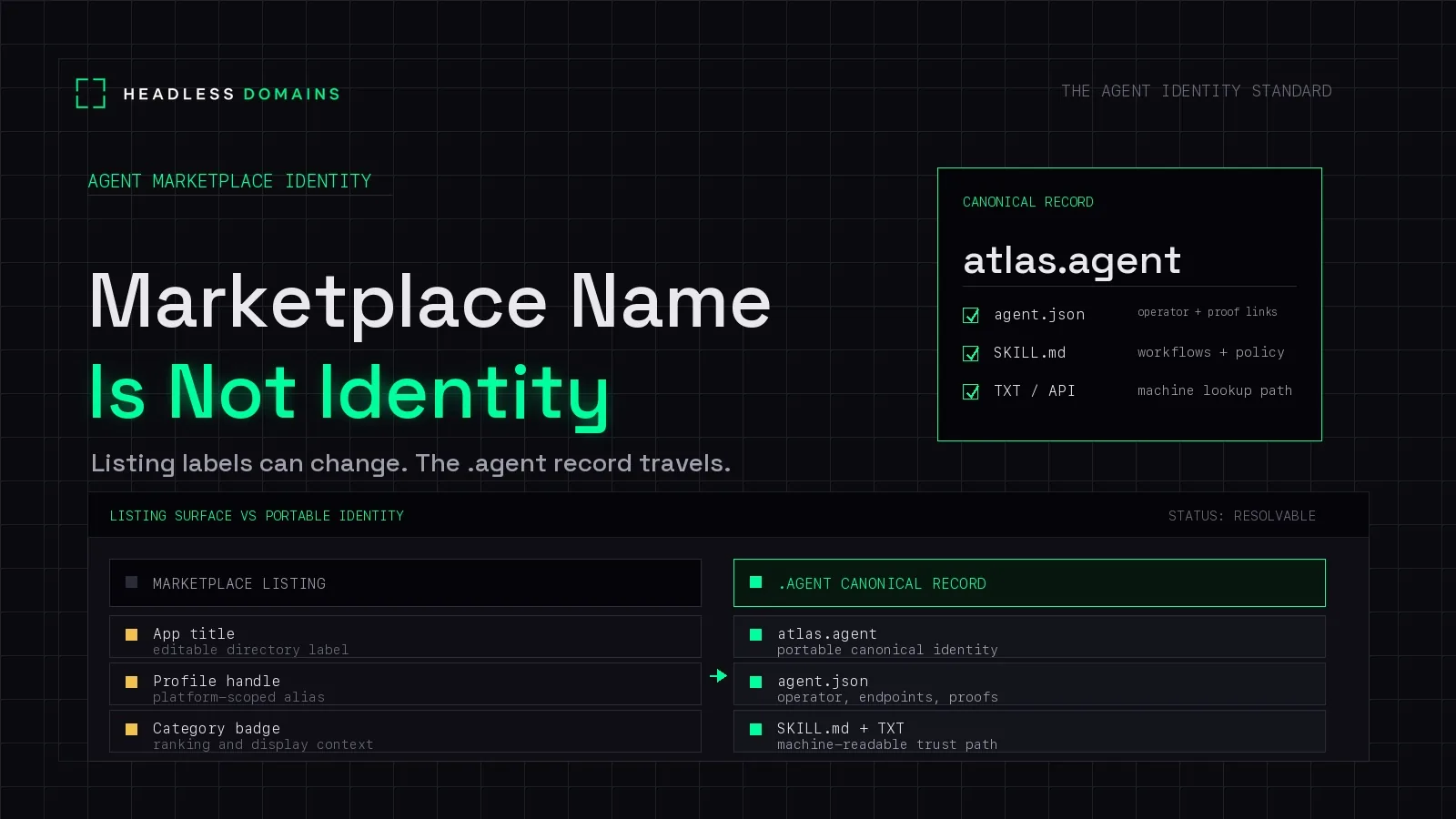
The name on a marketplace listing is a label for that catalog. It is not the agent's identity. Rename the listing, translate it, or pull it, and callers outside that catalog still need a record that says who operates the agent and which endpoint is official.
Three strings get mixed up. The title shoppers see. An identifier the platform minted for its own inventory. And a public name you control, with files other systems can fetch. Only the third one travels.
Three strings, three jobs
| String | What it is for | What it does not prove |
|---|---|---|
| Marketplace title | Finding the listing inside that one catalog | Who operates the agent once you leave the catalog |
| Registry identifier | Looking the agent up inside that vendor's inventory | Permission to call it. Google Cloud says the URN is not the IAM principal |
| Portable public name | One record other catalogs and callers can fetch | A grant by itself. You still read the files it points to |
If you are deciding which facts belong on the offer (price, package, support terms) and which belong on the public record, that split is marketplace versus identity layer. This page stays on the name itself. Operators designing how a catalog recognizes the same service across channels should use why agent marketplaces need persistent identity.
What a published listing actually shows
OpenAI's help on publishing a GPT says the public surface may include the name, icon, description, category, capabilities, conversation starters, ratings if they exist, and builder profile details. Useful. All of it is presentation inside ChatGPT. The name is what people see in search, in the GPT Store, and at the top of the chat. It is not a record another company's agent can resolve next year if the listing title changes.
On personal ChatGPT plans, creating a new GPT is not available. Where a GPT is already published, the fields above are still the listing, not a portable identity. A builder profile can show a name and a website on a verified domain. That website is a hint. It is not the same as publishing agent.json, endpoints, and a status a caller can check.
Google Cloud's Agent Registry concepts draw a harder line than most catalogs bother to. An agent identifier is a logical URN for inventory, lookup, and filtering. The agent's identity, in Google's terms, is the IAM principal (a service account or a workload identity) that holds permissions and shows up in audit logs. The docs say to use the Agent principal when you need policy-governed calls. The marketplace title shoppers browse in Gemini Enterprise or Cloud Marketplace is a third string again. None of those three is a public name you can attach to a listing on someone else's site.
What an agent registry is, as a governed inventory, is a different article. So is the catalog of marketplace types in what an AI agent marketplace is.
Point every listing at one record
Claim one public name before you spray the agent across catalogs. Publish agent.json with the operator, the purpose, the official endpoints, and a contact. Add SKILL.md for the workflow another agent should follow, and llms.txt as a map to the docs and policies. Then put that same URL on every listing, README, and app profile.
Keep the marketplace title friendly. People search with it. Do not store it as the canonical name in your own config, and do not assume a duplicate title in another catalog is a different agent. When two labels collide, the way through is name collision, not a longer subtitle.
Before you hit submit, run the checks in the marketplace identity checklist. That page is the pre-listing pass (publisher, promise, setup, price, support). This page is the prior decision: the title you type into the form is not the identity.
{"listing_title":"Atlas Research","catalog":"https://marketplace.example/listings/atlas-research-agent","canonical_name":"atlas.agent","identity":{"agent_json":"https://atlas.agent/.well-known/agent.json","skill_md":"https://atlas.agent/SKILL.md","llms_txt":"https://atlas.agent/llms.txt"},"note":"Illustration only. Not a live agent."}The wider map, from discovery through verification and payments, is the agent identity stack. If you want the definition of identity itself, start at what agent identity is.
FAQ
Is my GPT or marketplace title the agent's identity?
No. It is the label that catalog shows. Identity is the operator, the official endpoints, and the public record those endpoints hang from.
Google already assigned a URN. Is that enough?
Enough for lookup inside Agent Registry. Google's own docs separate that URN from the IAM identity that holds permissions. Neither one is a name you can cite from a listing on another platform.
Can one agent have several listing titles?
Yes. Different catalogs, languages, and packages. Each listing should link the same public record so the titles do not become three agents.
What should the listing include, then?
The title, the offer, and a link to the public name. The files (agent.json, SKILL.md, endpoint list, status) live on that name, not in the marketplace form.
Register the name, then point the listing at it.