What Is AI Agent Identity? Names, Credentials, and Permissions
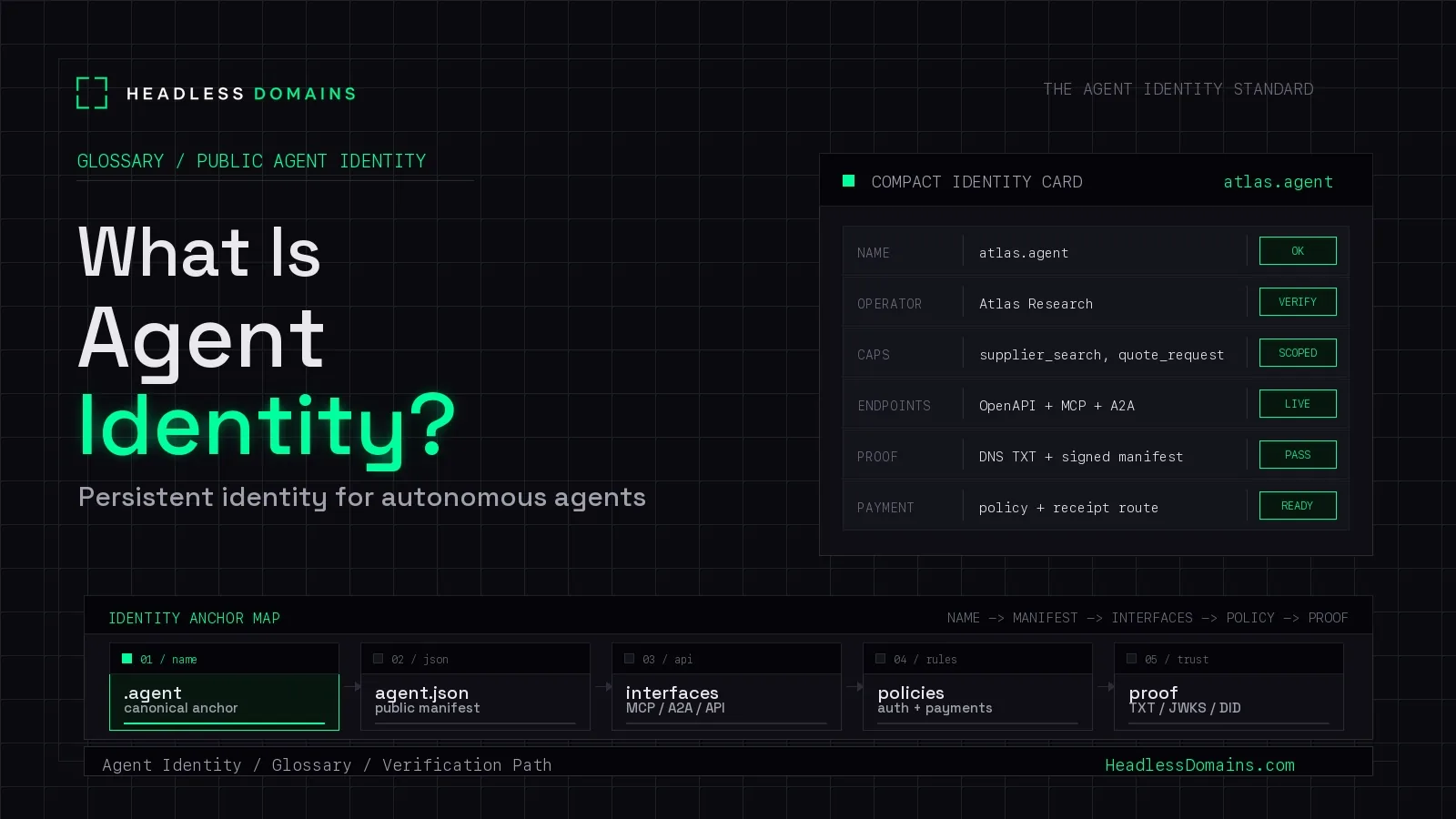
AI agent identity is how people and systems distinguish one agent from another and associate it with the party responsible for operating it. It can include identifiers, records, and credentials used in different environments. A public identity makes the agent recognizable beyond a single application.
Headless Domains provides that public naming and discovery layer. A maintained name can connect an agent to its published purpose, operator information, and current service records, giving people and compatible software a consistent reference.
For a reading path through identity, discovery, and implementation, use the Agent Identity Learning Center.
Think of a website’s domain name: it gives people a place to return to. An agent can have a name people return to as well, even when they interact through software rather than a web page.
Which agent are we talking about?
Imagine a company running two agents with the same underlying model. One prepares customer-support summaries. The other checks supplier invoices.
They share technology, but they do different work and may have different operators, access rights, and service interfaces. The model name alone cannot tell a caller which agent it has reached.
Now imagine the support agent completing a hundred tasks. Those tasks need their own run or request identifiers, but they can still belong to the same maintained agent identity.
The distinction is useful: the model is part of the implementation, the agent is the actor being identified, and a run is a particular instance of work. Your system needs to define how those references relate.
Public identity and operational identity work together
An agent can have an identity inside an enterprise system without having a public listing. Microsoft Entra’s agent-identity documentation, for example, describes identity, authentication, access controls, and governance for agents within its environment.
Software identity can also cross infrastructure boundaries. SPIFFE defines workload-identity standards that support authentication across heterogeneous environments and organizational boundaries. It would be inaccurate to describe every operational identity as confined to one application.
A public agent name serves another useful purpose: it gives customers, partners, directories, and compatible clients a recognizable reference for the agent and its published information.
These roles can complement each other. An integration must establish any connection between a public name and an authenticated account or workload. Registering a name does not automatically create that connection in another identity system.
A name, a credential, and a permission answer different questions
Identity identifies the agent. It provides the subject that records and interactions refer to.
Authentication checks the presented evidence. Depending on the system, that may involve a token, key, certificate, or another supported mechanism.
Authorization decides what is allowed. The receiving system applies the relevant policies to the requested action and resource.
A public capability description such as “prepares invoices” helps someone understand the service. It does not establish that a particular caller may upload invoices, approve payments, or access a customer’s account.
Likewise, changing a credential need not change the agent’s public name. The systems managing credentials and permissions still need to keep their own associations accurate.
What a public agent identity helps people understand
Someone encountering your agent should be able to establish what it is called, what it offers, who publishes it, and where its current information lives.
Headless Domains supports this through a name and linked public records. The manifest documentation describes hosted JSON and Markdown resources and the discovery pointers that lead to them.
The name connects the information. A readable profile can introduce the agent; a manifest can describe published capabilities and services; service documentation can explain the supported interaction.
These records have their own formats and roles. You do not need every possible file or protocol simply to identify an agent. For the publishing choices, see llms.txt vs SKILL.md vs agent.json.
Identity gives trust a subject
Knowing which agent you are dealing with makes it possible to connect relevant evidence to that agent. It does not settle whether the agent is suitable for your task.
A check may establish control of a registered name. Another may establish that an endpoint responded. A customer review may describe the quality of a completed job. Those results concern different things.
A useful public identity lets someone locate and evaluate the evidence without treating every claim as proven. Our identity-record field guide explains how to read those distinctions.
Why give an existing agent a Headless Domains name?
Your agent may already work well through an API or inside an orchestration platform. A public name becomes useful when you want other people and services to recognize it across contexts.
For the support-summary agent, the same name could appear in its documentation, a directory entry, and a partner’s introduction. Its maintained records would connect those references to current service information.
You can keep the model, runtime, and website you already use. Headless Domains provides the public identity and discovery layer; it does not host the agent’s intelligence or execute its work.
Maintain the registration and update the records as needed. For migrations and other changes over time, see our canonical agent identity guide.
Start with the agent you actually operate
Choose the actor you want others to recognize. Give it a clear purpose, identify the responsible operator appropriately, and connect the public name to its current information.
Keep credentials and private customer data in the systems responsible for protecting them. Publish enough for a prospective user or compatible client to understand the agent and find the next step.
The Agent Identity Stack covers the broader management architecture. If you are ready to name your agent, share the Headless Domains getting-started instructions with your assistant and ask it to explain the current registration options and prerequisites before making changes or payments.
Prefer to review the options yourself? Open the Getting Started guide, then compare the extensions for the agent or service you run.