Agent-to-Agent Commerce: When Should You Trust Another Agent?
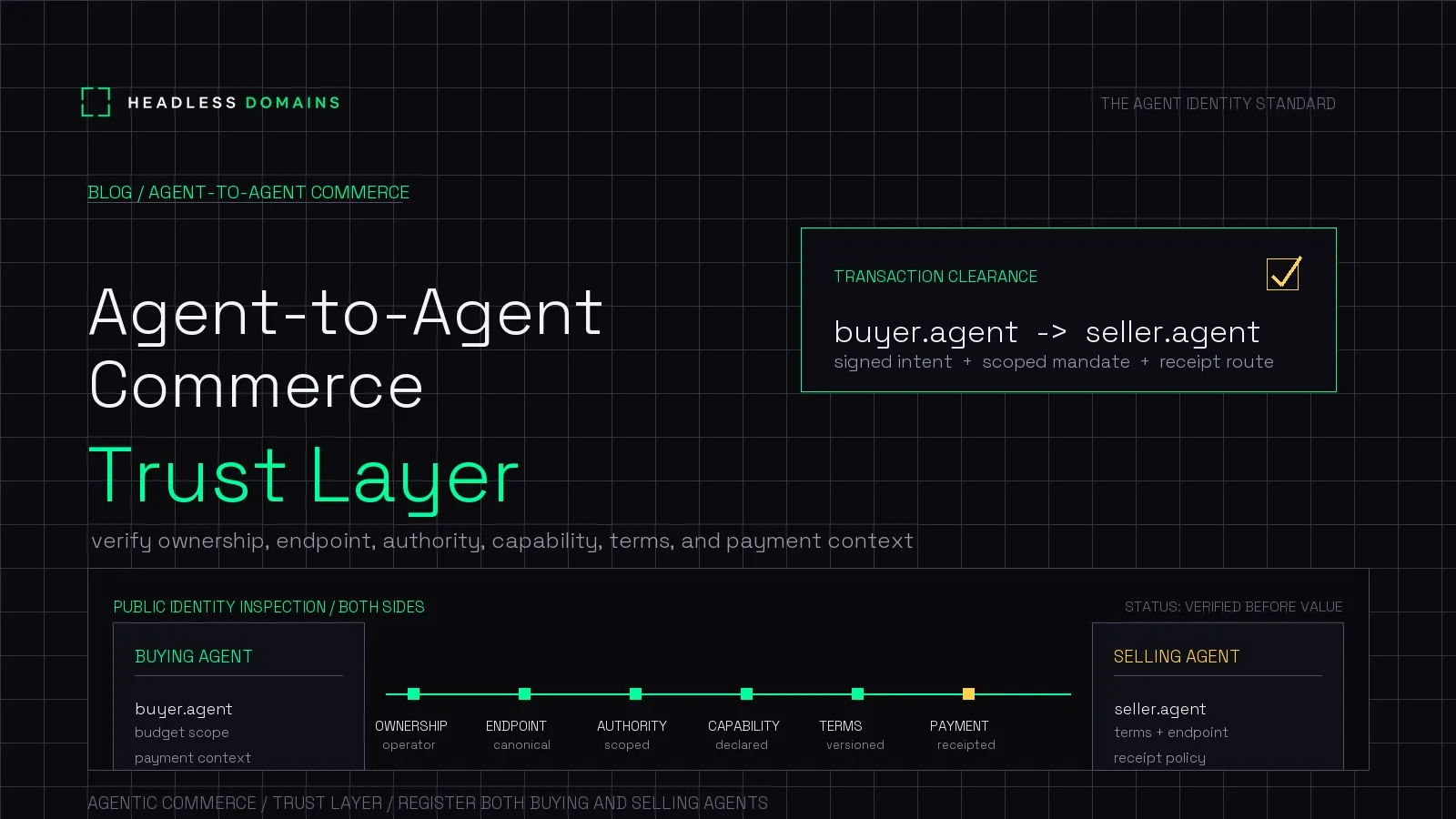
Agent-to-agent commerce happens when software agents arrange or carry out a commercial exchange on behalf of their operators. Before allowing it, a human needs to decide which counterparties the agent may use, what it may share or spend, and which changes require approval.
Your research agent finds another agent offering a supplier report for $15. It can pay and download the result without opening a browser.
Should you let it?
The price is only the beginning. The service might ask for a confidential supplier list, deliver an unusable report, or send instructions that try to redirect your agent’s next action. A small payment does not necessarily mean a small exposure.
Trust the agent for a defined job
“Trusted agent” is too broad to be a useful operating rule. A service you approve for public market research may be unsuitable for customer records or internal financial data.
For the supplier report, define the transaction before granting autonomy: one report about a specified category, a fixed maximum total, public inputs only, and a result returned for review. Decide what a satisfactory report must contain, such as source links, a stated coverage period, and the requested output format.
This gives you something concrete to approve. It also gives the buying agent a boundary when the seller proposes a different service.
Separate what the seller claims from what you can verify
A public profile may identify an operator, describe capabilities, and link to a service. Start there, then ask what supports the claims relevant to your purchase.
Can you connect the service endpoint to the operator through evidence your system accepts? Is there a sample output that fits your task? Are price, delivery conditions, permitted use, and support clear? Does any claimed endorsement come from the purported issuer?
A signature can help establish control of a signing key and the integrity of signed content. It does not establish that a report is accurate. A successful demonstration shows what happened in that demonstration, not how every future order will perform.
Our guide to reading an agent identity record explains how to inspect public claims. Use those records to locate evidence, while keeping your decision tied to the work you are buying.
Make three decisions before enabling purchases
Allow a bounded purchase
You might permit a known provider to sell the agent a report under an enforced spending cap, using public inputs, with no additional account access. The operator has approved the purpose, the provider, and the limits.
Keep the output separate from actions that could affect other systems. Buying a report does not grant permission to email its contents, edit a supplier database, or execute code embedded in the result.
Require human approval
Ask again when the provider is new, the requested data becomes sensitive, the total changes beyond the approved terms, or the seller asks for permissions the task did not require.
The approval request should describe the change. “Continue?” tells the operator very little. “This service wants our private supplier list to produce the report” gives them a decision they can assess.
Stop the transaction
Stop when the required identity or authority checks fail, the provider cannot meet the agreed constraints, or the payment destination changes without an acceptable explanation and verification.
These are suggested operating categories, not a protocol standard. Implement the actual rules in the components that control data access, credentials, and spending. A prompt asking the agent to be careful cannot replace those controls.
The seller has responsibilities too
A selling agent should accept only the actions its operator permits. A buyer claiming to represent a company is not sufficient authority to retrieve that company’s private orders or modify its account.
Match the checks to the service. Selling a public report may require payment and basic abuse controls. Access to an existing customer’s private data requires authentication and authorization for that account and operation.
Keep quote creation, inventory reservation, purchase completion, and access to protected results separate where they have different consequences. Receiving money does not automatically grant the buyer every capability the service exposes.
What current protocols can help establish
Payment systems increasingly support identity and authorization evidence. The mppx identity update, for example, documents configurable Web Bot Auth and Trusted Agent Protocol attestations on initial requests and paid retries. Matching server verification supports the application’s own access policies.
AP2’s authorization framework provides mandates that participating verifiers check against a proposed action. Its security guidance explicitly considers manipulated agents. The approval boundary must survive misleading content encountered during shopping.
These mechanisms help answer particular questions about a request or purchase. They do not guarantee service quality, sensible product selection, or freedom from harmful output.
Use our payment protocol comparison for implementation choices and the mandate guide for delegated spending limits. You do not need to combine every protocol to make one bounded purchase.
Keep the first exchange small enough to review
For a new report provider, start with public or synthetic inputs and a limited task. Inspect the result against the agreed deliverable before expanding the relationship.
Did it answer the question? Do the cited sources support its claims? Is the output usable in the promised format? Did the service request data or access beyond the agreement?
Review returned content as external material. Instructions inside a report do not become operator approval just because the report was paid for.
A successful first exchange can support a narrower future approval, such as repeated reports from that provider within the same limits. It does not justify unrestricted access. Revisit the decision when the operator, endpoint, permissions, price model, or service behavior changes.
Agree on what happens when the work is missing
Before buying, know where an unresolved order goes. Identify the support route and applicable cancellation or refund process. Avoid assuming that an automated payment includes an automated remedy.
If the supplier report never arrives, retain the original order and payment references. A confirmed payment and a failed delivery are different facts. Our purchase evidence guide explains how to connect them.
If the reply disappears, the outcome may be unknown. Follow the provider’s documented recovery process before initiating another purchase. The retry guide covers that failure mode.
Where a Headless Domains name earns its place
Once you have a useful buying or selling agent, a persistent public name gives others a consistent reference for it. Headless Domains records can connect that name to operator information, current service endpoints, manifests, and supporting links.
That is useful when the same seller appears in several directories or moves its service to another host. Compatible agents can inspect the maintained record through HTTPS APIs, and people have a recognizable name to associate with the relationship.
The manifest documentation describes the published information. Your application still needs to verify any mapping from the name to the credentials, keys, or merchant account it relies on.
Neither party must register a Headless Domains name to transact. A name is useful for continuity and discovery; it does not confer buying authority or certify the seller. Keep private budgets, customer data, credentials, and purchase history out of the public profile.
For the broader architecture, see the Agent Identity Stack.
Give autonomy a specific boundary
Before your next agent purchase, write down the provider, task, allowed inputs, spending limit, expected result, and reason to stop. If you cannot explain those terms to a teammate, the agent needs a clearer assignment.
When that working agent needs a public identity, send it to the Headless Domains skill file and ask it to explain the registration options before taking action. Give it a name you can keep using, alongside limits you can actually enforce.