MCP vs A2A: When to Use Each for AI Agents
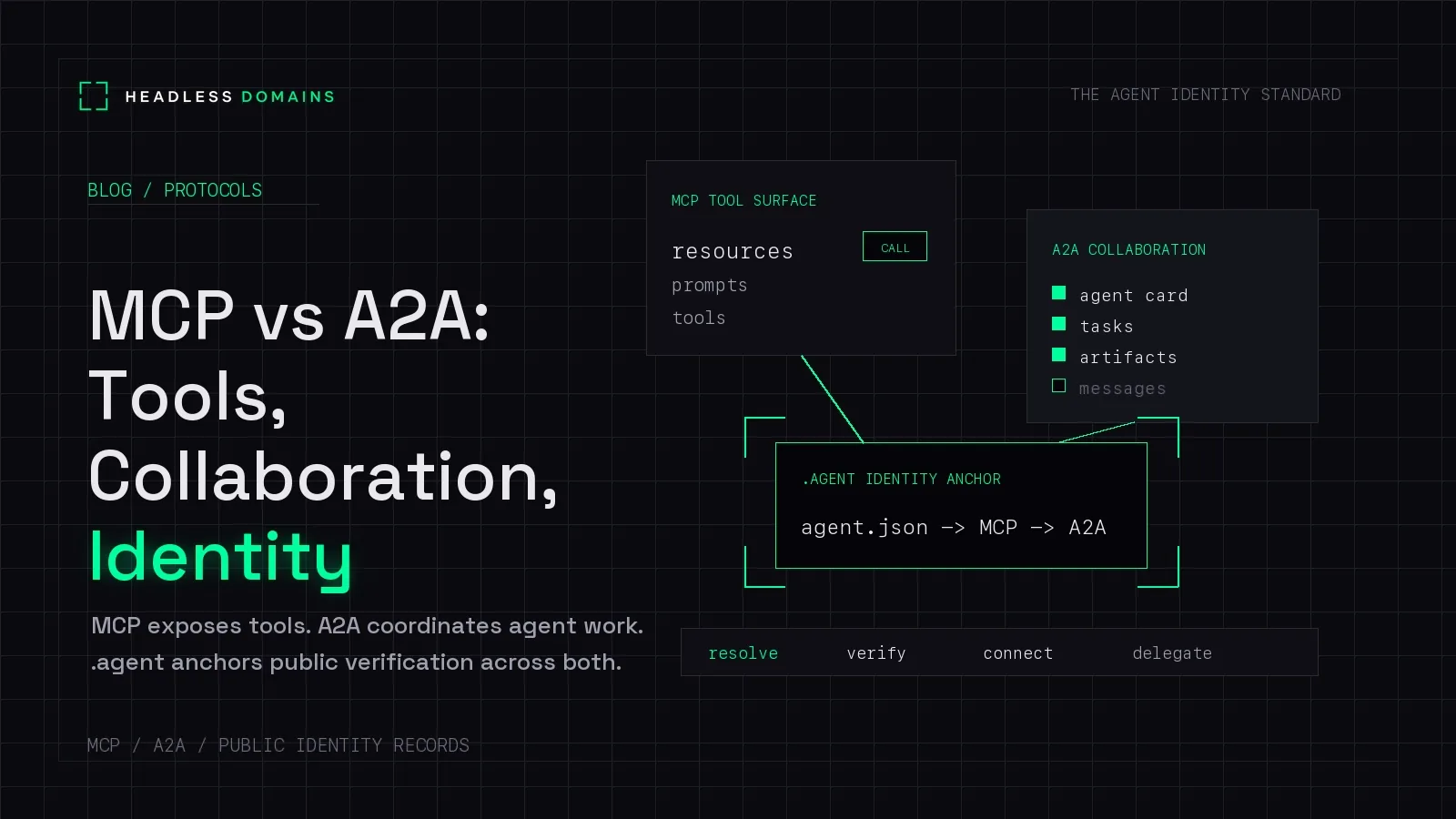
MCP connects AI applications to tools and context. A2A gives applications a standard way to communicate with remote agents through messages, tasks, and results. Use MCP when your caller needs a callable capability. Consider A2A when it needs to hand work to another agent and follow the interaction. One service can use both.
The useful question is what your customer needs to do. Look up a delivery estimate? Request a delivery plan and discuss the options? Those requests may call for different interfaces, even when the same business provides them.
Headless Domains helps connect those interfaces to a maintained public identity. People can remember the service's name while compatible software follows its current records to the connection it needs.
MCP vs A2A at a glance
| Question | MCP | A2A |
|---|---|---|
| Primary focus | Tools and context | Agent interactions |
| Interface description | Server capabilities and schemas | Agent Card |
| Example request | Look up a delivery estimate | Develop a delivery plan |
| Requires a .agent name? | No | No |
These are typical uses, not hard limits. The A2A project's comparison describes the protocols as complementary. Their capabilities overlap, so choose based on the interaction and the clients you need to support.
Choose MCP for a capability your application can call
The Model Context Protocol defines how a host application's clients communicate with servers offering tools, resources, and prompts.
Suppose your assistant needs delivery estimates while building a shortlist of suppliers. An MCP server could expose a tool that accepts a destination and package details, then returns available estimates. Your application can discover the tool's schema and invoke it through the protocol.
The implementation behind that tool could be a database query, an API, a workflow, or another agent. MCP does not restrict tools to simple functions. The tools specification defines the callable interface, rather than how the provider must implement its business logic.
For the distinction between the agent making decisions and the server exposing operations, see MCP Server vs AI Agent vs Tool.
Choose A2A for an interaction with another agent
Now suppose you want a logistics agent to develop a plan for a shipment with several constraints. It may need to ask which deadline matters most, compare alternatives, and return a proposed itinerary.
A2A provides messages and a task model for that exchange. Its task lifecycle guide distinguishes immediate message responses from tracked tasks that can report progress, request input, and produce artifacts such as documents or structured results.
The caller works through the remote agent's published interface. It does not need access to the agent's private prompts, memory, or internal tools.
This is useful when you want the receiving service to handle its part of the work and communicate through a defined task lifecycle. It does not give that service unlimited discretion. The requested work, shared data, and permitted actions still need boundaries.
Don't choose solely on how long the job takes
“MCP is synchronous; A2A is asynchronous” is too crude a rule for an implementation decision.
MCP has a Tasks extension for work that continues beyond an immediate response. It requires support from the participating implementations. A2A, meanwhile, can return an immediate message without starting a long-running task.
Ask what the caller expects to interact with: a tool contract, an agent's message-and-task interface, or both. Then check the exact features and protocol versions its client supports.
How both can work in one service
Consider a fictional service called Dispatch Planner. A merchant's assistant asks it to compare delivery plans for a batch of orders.
- The merchant's application finds Dispatch Planner's A2A Agent Card and selects a compatible interface.
- It sends the planning request with the information it is authorized to share.
- Dispatch Planner uses an MCP-connected rate service to retrieve estimates.
- If a deadline is ambiguous, it requests clarification through A2A.
- It returns a proposed plan for review.
The MCP rate lookup is part of the implementation. A2A is the interface the merchant uses to work with Dispatch Planner. Booking a shipment remains a separate action requiring the appropriate authority.
The provider could also offer an MCP tool that invokes Dispatch Planner directly. That may suit customers whose apps already support MCP. Adding an A2A interface makes sense when customers need its interaction model, not simply because the service contains an agent.
Keep discovery documents distinct
An A2A Agent Card describes the remote agent's interfaces, skills, capabilities, and security requirements. Public discovery can use /.well-known/agent-card.json on the serving host; registries and direct configuration are also supported approaches. The A2A discovery guide explains those options.
Use the interface URLs and versions actually advertised. The current A2A specification describes supported interfaces and protocol version negotiation. Copying an old Agent Card example into a newer implementation can create compatibility problems.
A Headless Domains agent.json manifest is a separate document with its own supported structure. It is not automatically an A2A Agent Card or a universal MCP configuration file. Link the records through supported fields or documentation your client understands.
For the wider file comparison, use llms.txt vs SKILL.md vs agent.json.
Give the service one maintained public identity
Dispatch Planner might appear in a directory, offer an MCP integration, and publish an A2A Agent Card on another host. A Headless Domains name gives its operator a public reference that can connect those locations.
Our manifest documentation describes hosted identity records and pointers to service information. The agent and its protocol servers continue running on the infrastructure you choose.
Use ordinary reachable HTTPS addresses for the hosted documents and endpoints. Don't assume that registering a .agent name makes a browser URL such as https://yourname.agent/.well-known/agent-card.json work. Follow the published records and configure the actual serving host.
If you move the A2A service or add an MCP interface, maintain the same public name and update its records. Clients with saved addresses may still need reconfiguration. The name provides continuity while you maintain the registration; it does not silently migrate connections.
Both protocols already address aspects of discovery and security. Headless Domains adds a public naming layer across those interfaces. It does not replace authentication, verify every operator claim, or authorize a task merely by listing it. Our Agent Identity Stack explains those responsibilities.
What should you implement first?
Start with one real customer workflow and the application they use.
- They need a tool inside an MCP-capable app: build and test that MCP integration.
- They need to exchange messages and manage work with a remote agent: assess an A2A interface.
- They need both: keep the interfaces consistent about the service, operator, and access requirements.
- Your existing API already meets the need: keep it. Add a protocol when it solves a concrete integration problem.
Before production use, review the relevant connection and access controls. Our MCP Security Checklist covers the MCP review; our A2A identity article focuses on inspecting the counterpart.
Common questions
Can an MCP tool call another AI agent?
Yes. The tool's implementation can invoke an agent. Choose A2A when you want its standard agent interaction model, rather than assuming every agent-to-agent handoff requires it.
Do MCP and A2A share credentials automatically?
No. Each receiving service must accept and validate the appropriate credentials and enforce its permissions. A public identity connecting the services does not combine their access grants.
Do I need separate names for MCP and A2A?
Not when they are two interfaces to the same offering. Consider separate public identities when the services have independent users, operators, or purposes.
Name the service your customers use
Your customer may remember Dispatch Planner without remembering which protocol their application used. Give the service a name that connects its current interfaces and explains who operates it.
Send your assistant the Headless Domains getting-started instructions and ask it to help connect your existing service records to a maintained identity. Start with the interface that works today, then add the others as customers need them.