MCP Server vs AI Agent vs Tool: What’s the Difference?
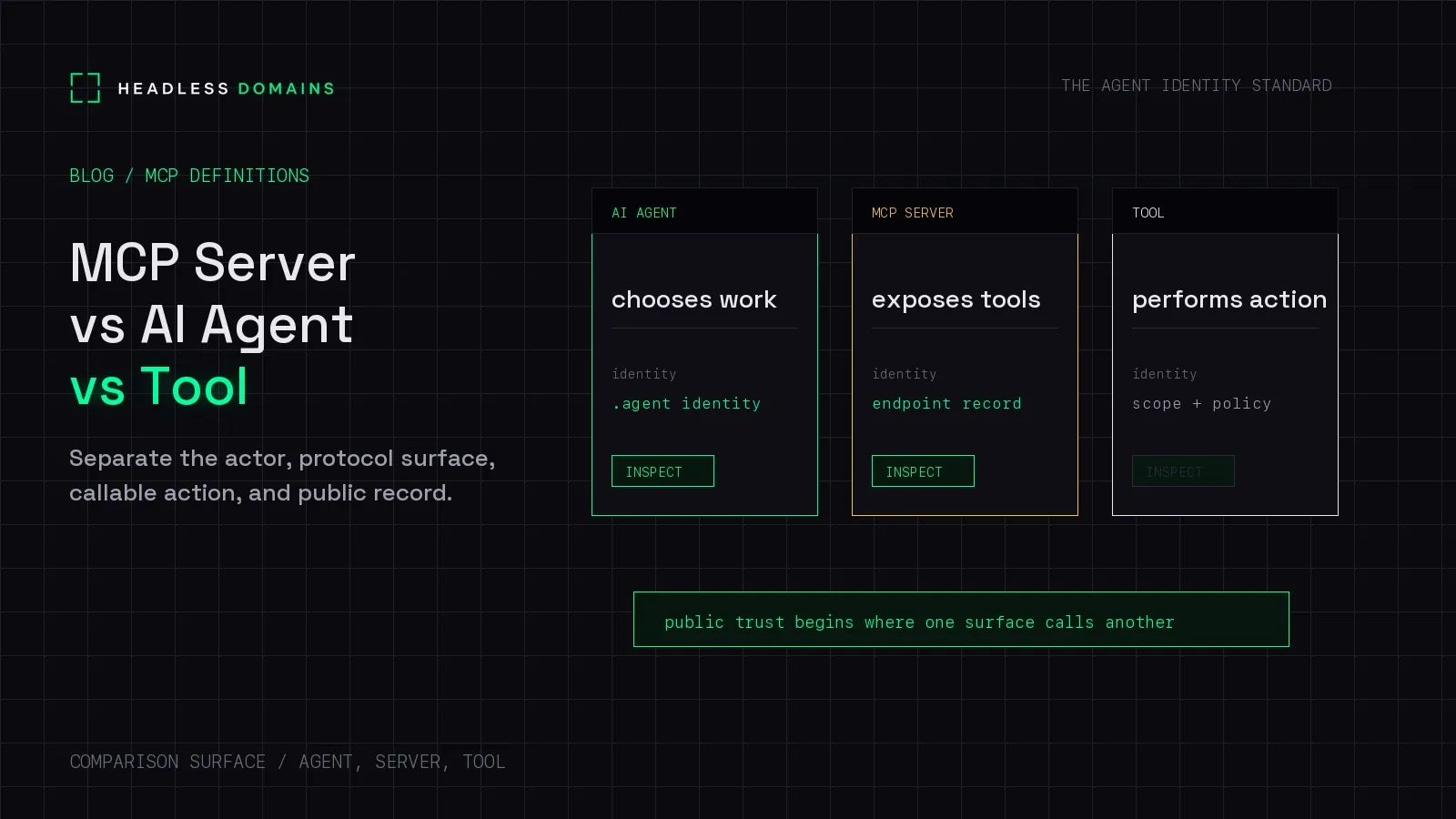
An AI agent decides how to pursue a task. An MCP server exposes capabilities through the Model Context Protocol. A tool is a named operation the client can invoke. They often work together, and one product can contain all three.
That distinction helps you answer a practical question: what are you actually giving a public identity to? The agent doing the research, the service providing its data, or each function the service exposes?
At Headless Domains, our recommendation is to name the agent or service that people need to recognize independently. Keep its tools and connection details attached to that identity unless they have become separate products in their own right.
MCP server vs AI agent vs tool at a glance
| Component | Primary role | Example |
|---|---|---|
| AI agent | Directs work toward a goal | Research assistant |
| MCP server | Exposes capabilities to clients | Documentation service |
| Tool | Provides a callable operation | search_docs |
The agent definition here refers to a system that uses a model to select steps and respond to results. Anthropic's explanation of agent architectures distinguishes that behavior from a workflow following predefined code paths. A product called an “agent” may combine both approaches.
The MCP specification defines the interface for exchanging capabilities and context. Implementing that interface does not, by itself, give software goals or independent decision-making.
Follow one research task
Suppose you ask a research agent to compare two product manuals and identify differences in their installation requirements. This is a fictional example.
The agent chooses what to search for. Its host application uses an MCP client to communicate with a documentation server. The server exposes a tool called search_docs, which accepts a query and returns matching material.
The agent reads the results and decides whether it has enough evidence. It might search again, ask you which product revision matters, or write the comparison.
The same documentation server could support several different agents. The research agent could also use several servers. There is no requirement for a one-agent-to-one-server relationship.
The client is the connector inside the host application, not necessarily the agent itself. The official MCP architecture guide explains these roles. A server can run locally or remotely; “server” describes what the program does, not a requirement to rent a cloud machine.
A tool can do more than one small action
A tool has a name and an input schema. Its implementation might query a database, call an API, run a workflow, or hand work to another agent. The caller sees the operation exposed by the server, even when the software behind it is complex.
So an agent can be offered through an MCP tool. A hypothetical research_topic tool might invoke a specialist research agent and return its result. The tool is the callable interface; the agent is part of the implementation behind it.
According to the MCP tools specification, tool names are scoped to a server. Two servers may both offer search. Integrations combining them need to distinguish those operations, and a server's display name is not guaranteed to be globally unique.
For your own records, keep the selected server connection alongside the tool name. “The agent called search” leaves out which service received the request.
Choose what deserves a public name
Give a separate public identity to something people need to find, evaluate, or use independently. That is our naming recommendation, not an MCP protocol requirement.
For the research example, the assistant may deserve a maintained name because customers hire it, ask it questions, and follow its work across platforms. Its public record can explain its purpose, identify the operator, and link to its official service information.
The documentation service may deserve a separate name if it has its own users, operator, support arrangements, or commercial offer. Its identity should describe that service rather than pretending it is the research agent using it.
The internal search_docs function probably needs a clear tool identifier and documentation, rather than another domain registration. If it later becomes an independently offered search product, reconsider the naming decision then.
This also keeps you from creating a new public identity for every agent run. An enduring agent or service can have one maintained public name while its executions use distinct internal run IDs.
Our Agent Identity Stack covers the wider relationship between public naming, verification, access, and governance.
Public identity and access have different jobs
A public name helps someone recognize the agent or service. Credentials identify the caller to the receiving system, and authorization determines which requests it may perform.
A tool does not automatically inherit a safe permission boundary because it belongs to a named server. The implementation still needs appropriate access checks. A description that says “read-only” does not enforce read-only behavior.
For protected HTTP MCP services, the authorization specification defines discovery and token requirements, including validating that tokens are intended for the receiving resource. Public metadata can describe access requirements; publishing it does not grant those permissions.
The authenticated caller may also be a shared connector rather than the individual agent. If you need to trace a result back to the initiating agent, our API call attribution exercise helps you inspect that mapping.
Connect the service to its Headless Domains identity
Once you know what you are naming, make its public record useful. Describe the job, publish appropriate operator information, and link to the current service and documentation.
Headless Domains supports hosted manifests and pointers to machine-readable records. Its manifest documentation explains how MCP service references fit into that information. Your agent and MCP server continue running on the infrastructure you choose.
The name can stay consistent while you maintain the records behind it. If you replace the documentation server in our example, the research agent can retain its public identity. Review the changed connection and its permissions as part of that replacement.
For connection addresses and transports, use What Is an MCP Endpoint? If a policy gateway sits between clients and servers, the MCP gateway guide covers that additional role.
Common questions
Is an MCP server an AI agent?
Not inherently. An MCP server implements a protocol interface. It may expose ordinary functions, an agent-backed service, or a mixture. Whether it contains an agent depends on the software behind that interface.
Does an AI agent need MCP?
No. An agent can use direct API integrations or other supported tools. MCP provides a common interface when the client and server support it.
Does every MCP tool need a .agent domain?
No. Keep ordinary tool operations associated with their server or service. Consider a separate public name when the offering needs to be discovered and evaluated independently.
Name the thing someone will come back to
Ask a customer what they would recommend to a colleague: the research assistant, the documentation service, or a separately sold tool? Their answer is a useful starting point for your public identity.
Give your assistant the Headless Domains getting-started instructions. Ask it to help name that agent or service and connect its official records. If you already have a name, make sure its profile describes the work people will return for.