When AI Agents Shop, Who Gets the Sale?
An AI assistant recommends the headphones you sell. The shopper likes them. Then the assistant presents three stores, and somebody else gets the order.
When AI agents shop, the sale depends on which seller fits the buyer’s priorities and can complete the purchase. Product recommendations, merchant rankings, and checkout each play a different role. Price matters, alongside availability, delivery, seller quality, and the customer’s instructions.
For a retailer selling the same item as several competitors, the recommendation opens a contest over delivery promises, return postage, and the amount on the final bill. If you operate a commerce agent or service behind the store, HeadlessDomains.com gives it a public name connecting people and agents to its current information and destinations.
Start with the question closest to the money: why buy the item from you?
How AI shopping agents choose a seller after choosing a product
Choosing between headphones and earbuds settles what to buy. Comparing stores selling the same headphones settles where to buy it. For a manufacturer selling direct alongside retail partners, either result moves a product, but only one brings the order into its own store.
OpenAI separates product selection from merchant selection. ChatGPT considers the shopping request and context when surfacing products. After a shopper selects an item, it can present several merchants. OpenAI names availability, price, quality, and maker or primary-seller status among the factors informing merchant rankings.
OpenAI also explains an easily missed detail: the price in an initial response commonly comes from the first listed merchant. Another seller may offer a lower price. For the competing stores, the product result starts another round of comparison.
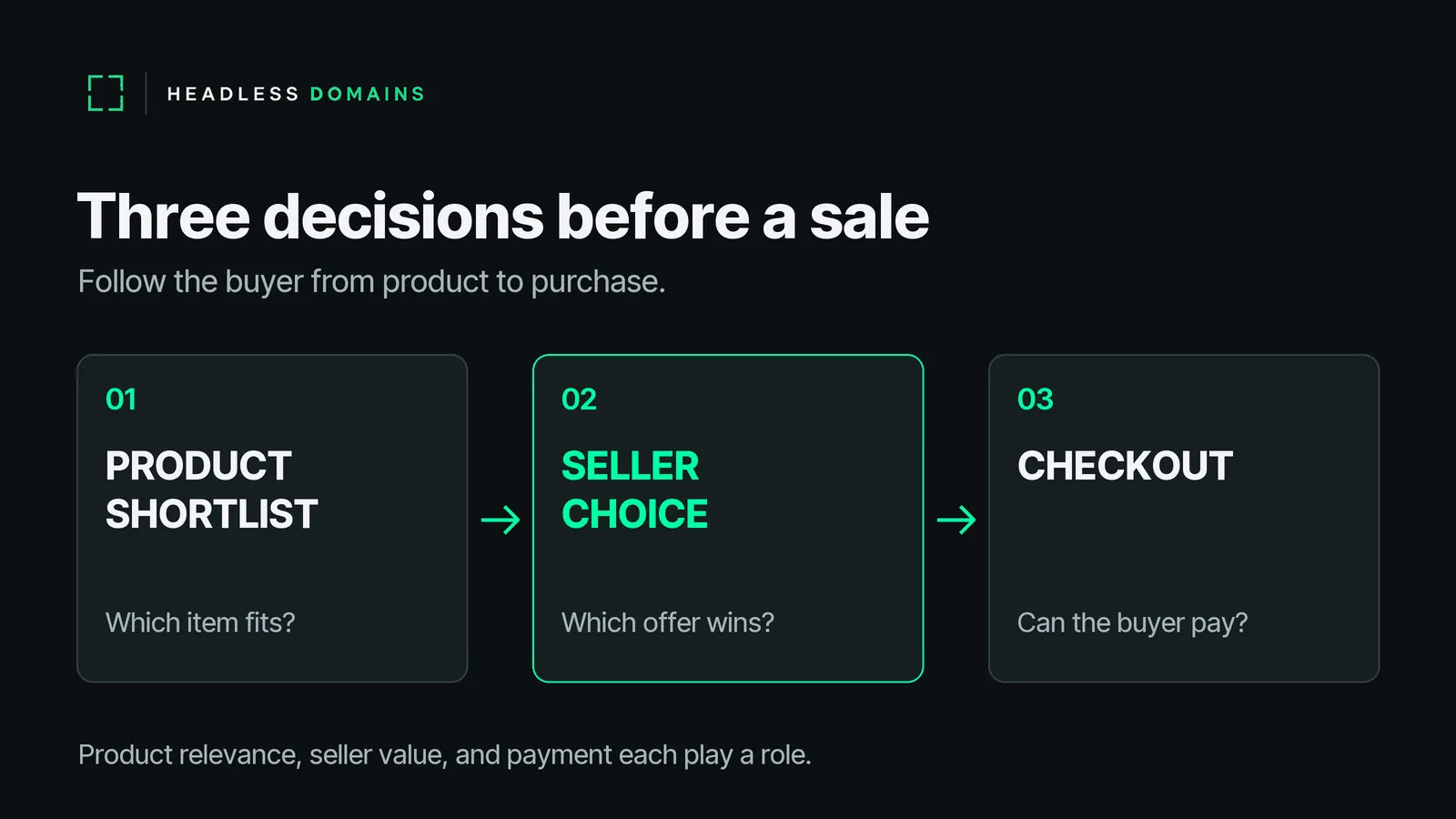
The seller-selection question assumes the item already matches the request. For the earlier problem of preserving size, color, or pack identity, read how AI shopping agents match the exact product variant.
Same headphones, three sellers: the cheapest sticker loses
Imagine a shopper comparing one identical headphone model across three sellers. Every offer has stock. The shopper wants delivery tomorrow and can spend up to $100 before tax. Put three hypothetical offers side by side, with the same tax treatment across sellers.
| Offer detail | Seller A | Seller B | Brand’s own store |
|---|---|---|---|
| Item price | $79 | $86 | $89 |
| Shipping | $14 | Free | Free |
| Total before tax | $93 | $86 | $89 |
| Arrival estimate | 3–4 days | Tomorrow | 2 days |
| Return terms | 14 days; buyer pays postage | 14 days; buyer pays postage | 30 days; free return postage |
| Fit for the original request | Misses the deadline | Meets budget and deadline | Misses the deadline |
Seller B satisfies the stated request. Seller A advertises the smallest number, then shipping raises its total above both competitors. The brand’s store offers a longer return window, but its parcel arrives after the shopper’s deadline.
Change the request to “delivery within a week, free returns, and at least 30 days to decide,” and the brand’s offer becomes the fit. The headphones haven’t changed. The buyer’s priorities have.
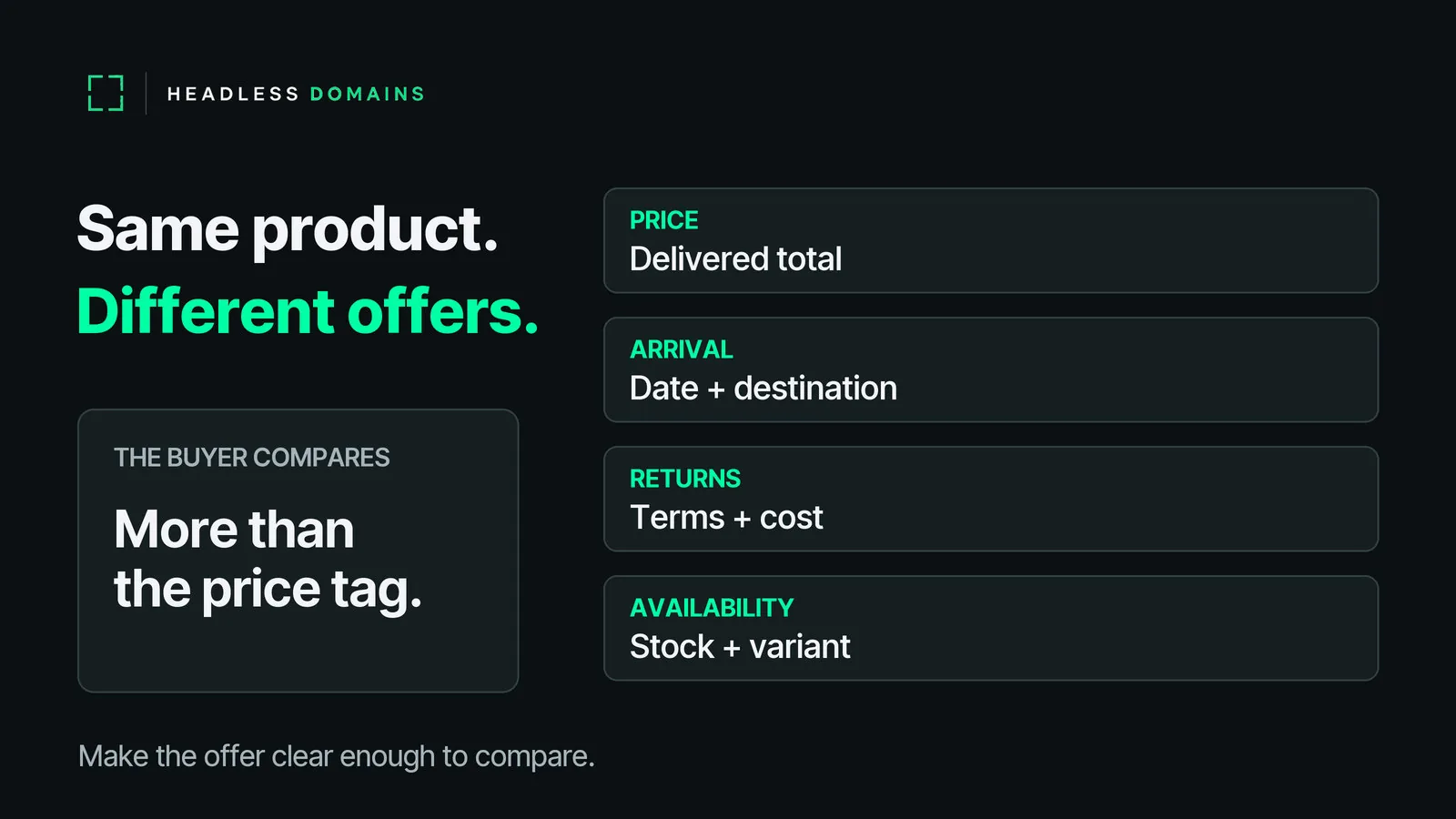
Use the example to compare offers against a customer’s request, rather than to predict a platform ranking. For your own offer, include the actual destination, full payable total, applicable discounts, return postage, and expected arrival date.
A competitive offer sometimes starts in the warehouse. Faster dispatch or a clearer return policy can give the buyer a reason to choose your store. Make the terms easy to find and keep them accurate wherever your offer appears.
Google’s merchant-listing documentation provides fields for shipping costs, destinations, delivery times, and return terms. Publish the terms your store actually offers so shoppers can compare the complete deal.
ChatGPT, Google, and Shopify offer different paths to the order
After an assistant recommends your offer, the buyer still has to reach your checkout. Google, ChatGPT, and Shopify connect those steps in different ways.
ChatGPT connects product discovery to merchant experiences
In its March 2026 product-discovery update, OpenAI expanded ACP’s role in sharing catalog information and described a greater focus on merchants’ own checkout experiences. It also explained how Shopify Catalog supplies product data to ChatGPT.
Keep the seller’s name, offer, and purchase destination clear through the handoff. A shopper comparing your store with another retailer has to recognize where the purchase will happen and whose terms apply.
Google keeps the retailer in the purchase relationship
Google’s October 15 Universal Cart launch lets U.S. shoppers save products across retailers in Search and Gemini. Shoppers can use Google Pay with participating stores or transfer items to a merchant’s cart. The retailer remains the seller of record and provides confirmations and customer support.
An assistant may organize the shopping, but your store still carries the relationship after purchase. Delivery, refunds, and support remain part of the offer you sell.
Shopify separates catalog inclusion from native checkout
Shopify’s October 27 Catalog API beta update allows developers to include products from external brands for U.S. shoppers. Those external offers link to the brand’s product page for purchase; they cannot use Shopify’s native checkout through the catalog.
For supported Shopify shopping flows, the October 13 Shop MCP release connects search, carts, and checkout. A signed-in shopper can use saved Shop Pay details, with purchase completion following confirmation of the total and payment method.
Both routes can introduce a seller to a buyer. They deliver different purchase experiences. Evaluate the route your customers actually encounter, including the point where they approve the order.
AI merchant ranking has no single winning formula
A retailer can act on a published ranking factor. Turning several factors into a guaranteed recipe for orders goes further than the evidence allows, especially when different assistants evaluate the same offers.
Researchers behind the ACES shopping-agent study tested product choices in a controlled marketplace. Their December 2025 paper found substantial differences across models and model versions, including responses to listing position, prices, ratings, and platform labels. Position effects also appeared in their text-only interface experiments.
The experiments concern product choice in a sandbox, rather than a live merchant-ranking system. For merchants, the useful lesson is to examine several answers and the conditions behind them. Customer instructions and the shopping environment deserve attention alongside the model.
For a useful seller comparison, hold the product constant and vary one buyer priority. Ask for the lowest total, then the earliest arrival, then free returns. Record which seller the assistant recommends, the offer facts it cites, and whether those facts agree with the store. Repeat enough times to distinguish a recurring issue from a one-off answer. Track completed orders separately from recommendations.
An old price in the answer points to an information problem. An accurate comparison favoring a rival’s faster delivery sends you back to the offer itself. Fix the problem the comparison exposes.
Give your commerce service a name buyers can return to
After the order, a customer may return to ask about delivery, buy again, or contact support through an agent. Give the shopping or support service a recognizable name people can share and software can look up.
With HeadlessDomains.com’s public naming and lookup infrastructure, agents can inspect a name’s public identity, service information, and advertised actions through API and command-line workflows. You can update the destinations behind the name as your service changes.
For a store operating its own shopping or support agent, a name ending in .agent or .chatbot gives the service a recognizable address to share with customers and connect to its public records. Each shopping platform controls its own admission and ranking; the name supplies the maintained reference for your service.
Keep the catalog and purchase terms behind the name accurate. For the broader channel setup, use the store discoverability guide. For implementation across catalog, cart, and support, follow the merchant guide to agentic commerce.
Give AI shoppers a reason to choose your store
Choose a product you sell alongside other retailers. Put your delivered price, arrival date, and return terms beside theirs. Then write the customer request your offer serves particularly well.
Your advantage might be tomorrow’s delivery, a generous return window, or direct support from the people who make the product. Name the advantage, publish the details an assistant can compare, and give the shopper a clear path to buy.
For the commerce agent or service you operate, choose a public name at HeadlessDomains.com and connect its current records. Make your business easy to return to after the first order.
Connect your name to useful information with What to Do After Registering a Headless Domain: 7 Next Steps.