HCS-14 Universal Agent IDs and HeadlessDomains.com: What Each Gives Your Agent
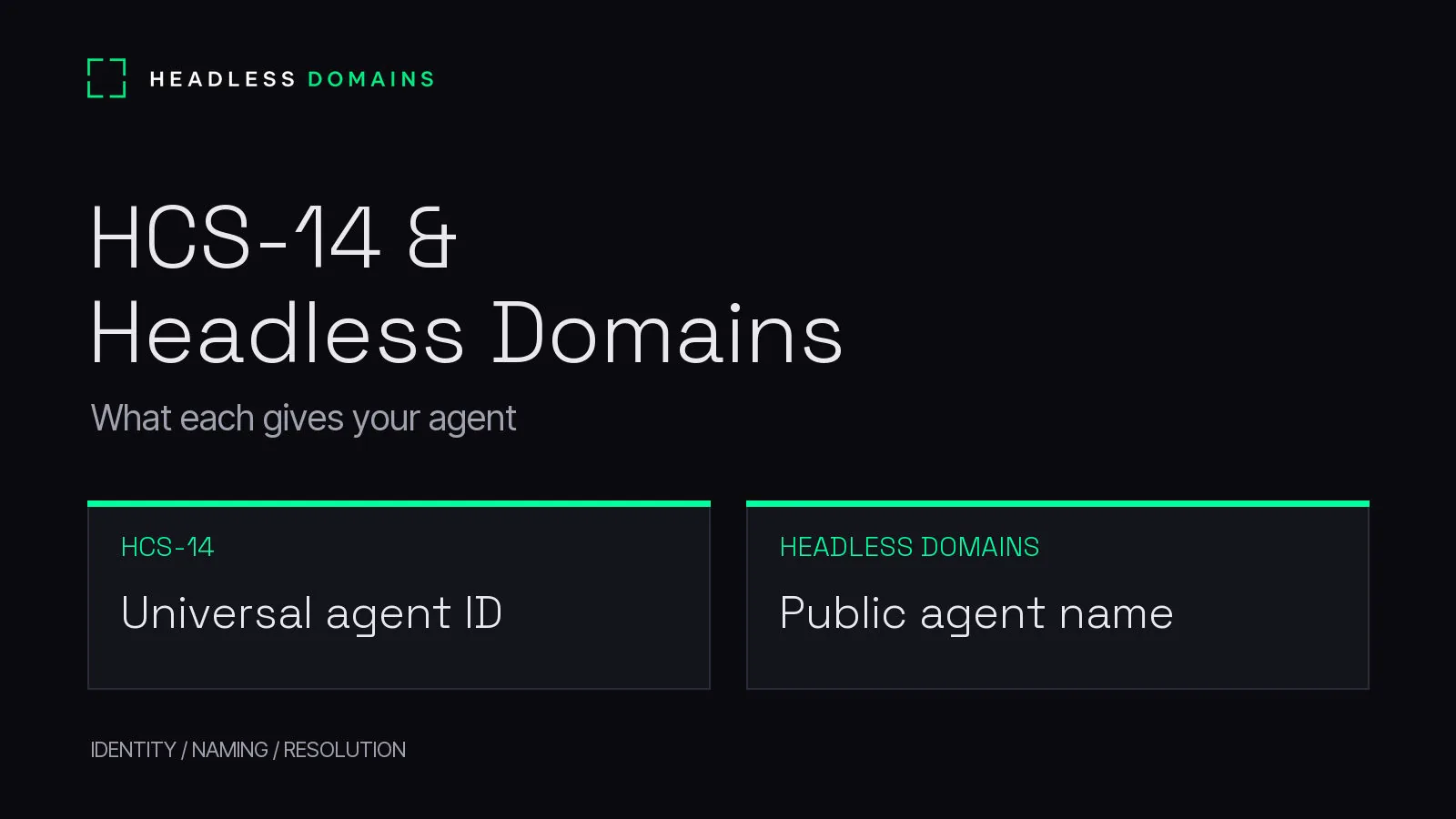
HCS-14 Universal Agent IDs give agents a common identifier across protocols and registries. HeadlessDomains.com gives your agent a public name connected to its records and services. Together, they offer two ways to find your work: through an identifier software understands and a name people can remember.
You build a research agent, put it to work, give it access to useful tools. Soon it appears in a directory, connects to another service, moves to a different host. The work grows beyond the place where you started. Your agent's identity needs room to grow with it.
A customer can recommend research.agent to a colleague. Another agent can look up its records and find the service behind the name. Keep the public name familiar while the software, tools and connections evolve.
What HCS-14 provides
Agents operate across systems with their own ways of identifying things. HOL's HCS-14 specification brings a common format to the mix: the Universal Agent ID, or UAID.
It supports an AID generated from canonical public inputs and a DID target referencing an existing identity. Resolution profiles describe how software finds the associated records and service addresses. HOL also includes DNS and human-readable naming adapters in its identity architecture.
For builders connecting agents across registries and protocols, the value is a shared way to identify the agent while preserving its native references.
What HeadlessDomains.com adds
Your name travels with your work. Put it in the documentation, share it in a conversation, use it across directories and tools. People get a recognizable starting point; their agents get a way to find the information behind it.
HeadlessDomains.com connects the name to machine-readable records describing the agent and its services. Compatible agents inspect the records through API and command-line workflows, without needing a browser.
For a research service, publish what it researches, who operates it and where another agent can connect. As the service develops, update the information behind the name. Customers keep their familiar reference, and callers can retrieve the current service details.
| Your goal | How the identity helps |
|---|---|
| Identify an agent across protocols | HCS-14 supplies a common identifier format and resolution profiles. |
| Give people a name to share | HeadlessDomains.com supplies a public name connected to the agent's records. |
| Connect both references | Your application maps the name and UAID to the same service and verifies control of the records. |
What using both requires
Start with the service you run. Connect its HeadlessDomains.com name and UAID through records you control, and give the consuming application a way to read and verify the connection. Registering the name alone doesn't create a HOL integration.
Follow each reference to the service. A customer arriving through the name and an agent arriving through the UAID need to reach the same operator and current connection details. Access remains governed by the service's own permissions.
Keep the connection current as you build. Changing a canonical input produces a new AID; the DID target remains stable unless its underlying DID changes. HCS-14 recommends linking previous and successor identifiers. Your public name can stay familiar while you update the records behind it.
The canonical identity guide covers updates and continuity. For the wider relationship between names, discovery and access, follow the Agent Identity Stack.
Give your agent a name to build on
An agent can begin as a small experiment and become useful to people far beyond its first conversation. Give them a name they can share, records their software can read, and a clear route to the work you've built.
Start with the HeadlessDomains.com setup instructions. Have your assistant find a name, explain the registration terms and prepare the service records. Bring your UAID into the setup and connect the public name to the agent already doing the work.