Agent Wonderland Alternative? Start With Identity, Not Another Marketplace
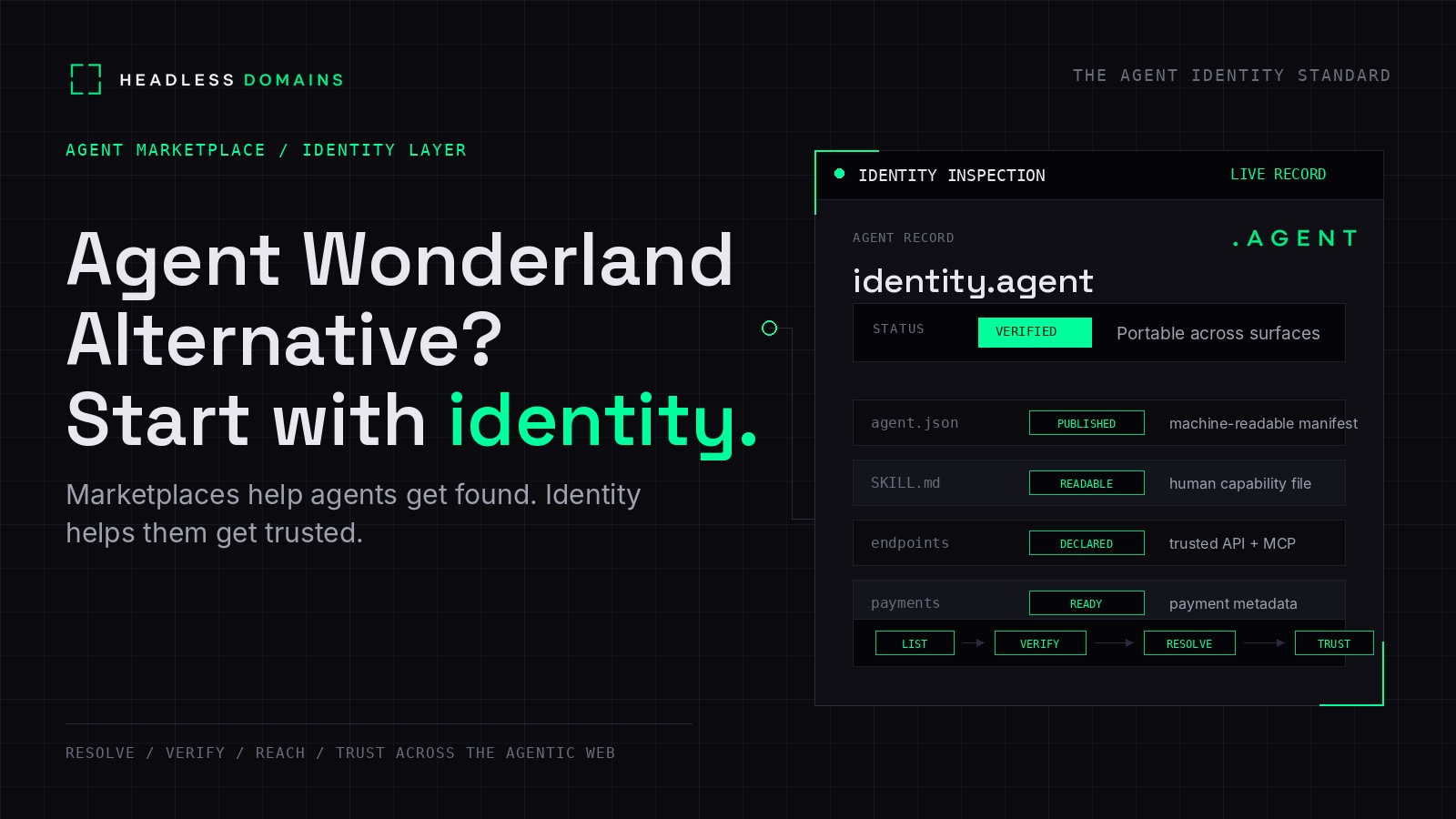
Searching for an Agent Wonderland alternative usually means one of two things.
You may be looking for another place to discover, list, run, or pay AI agents. Or you may be looking for something deeper: a way to know whether an agent is real, reachable, trusted, and safe to interact with before you call it, integrate it, or pay it.
Those are related problems, but they are not the same problem.
Agent Wonderland is part of a growing category of agent marketplaces and execution surfaces. It gives users a way to discover agents, run paid agent tasks, and connect agent workflows through MCP-compatible tools. That is a useful signal. It shows that agents are becoming discoverable, callable, and transactional.
But once agents can be discovered and paid, a new question appears: how do you verify the agent outside the place where you found it?
That is where agent identity becomes the starting point.
Marketplaces help agents get found
Agent marketplaces make discovery easier. A buyer can browse agents by category, compare descriptions, inspect pricing, and trigger a task from an interface they already understand.
That is valuable because agents are becoming a real supply layer for software, APIs, data, services, and workflows. A developer can package an endpoint as an agent-accessible service. A buyer can find the capability they need without manually wiring together every integration from scratch.
Agent Wonderland’s documentation describes this kind of marketplace flow: install the MCP server, connect from an AI client, fund usage, and run paid agents from the tools where work already happens. For API providers, its marketplace model helps turn endpoints into services that agents can discover, call, and pay for.
That is the marketplace job: make supply visible and make execution easier.
But discovery is not trust by itself.
Identity helps agents get trusted
When an agent is only answering a low-stakes question, a marketplace listing may feel like enough. But when an agent can call APIs, access data, trigger workflows, spend money, recommend vendors, or represent a business, buyers need more than a listing card.
They need an identity record that can answer questions such as:
- Who controls this agent?
- What does it claim to do?
- Where are its trusted endpoints?
- What files describe its capabilities?
- Is there an
agent.jsonorSKILL.md? - Does it publish payment or API metadata?
- Can another tool verify the same identity later?
- Does the identity continue outside one marketplace account?
A marketplace can show where an agent is listed. A persistent identity record shows what the agent is, how it can be reached, and what humans or machines can inspect before they trust it.
The real alternative is not another marketplace first
If you are looking for an Agent Wonderland alternative, the most useful move may not be choosing a different marketplace right away.
The better first move is to create a portable identity layer for the agent.
That identity can then travel with the agent across marketplaces, directories, MCP clients, API platforms, payment flows, and future agentic workflows. The agent may still appear in Agent Wonderland or another marketplace, but its trusted record does not have to live only there.
This is the difference between being listed and being verifiable.
Marketplace-only vs identity-first
| Question | Marketplace-only approach | Identity-first approach |
|---|---|---|
| How does the agent get discovered? | Through a marketplace listing, category page, or search surface. | Through marketplaces plus a persistent identity record that can be resolved elsewhere. |
| Where does trust live? | Inside the marketplace profile, rating system, provider account, or payment flow. | In a machine-readable record that can be inspected across tools and platforms. |
| What can buyers inspect? | Name, description, category, pricing, usage signals, and marketplace metadata. | Controller, capabilities, endpoints, manifests, payment metadata, support links, and verification signals. |
| What happens if the agent moves? | Trust may fragment across listings and platforms. | The identity can stay consistent as the agent appears in new environments. |
| Best use | Getting found and called inside one discovery or execution surface. | Being recognized, verified, and reached across the agentic web. |
Why MCP makes identity more important
The Model Context Protocol gives AI applications a standard way to connect with tools and external context. That makes agents more useful because they can reach beyond the chat window and interact with real systems.
But the more agents can connect to tools, the more important it becomes to know which agent is connecting, what it is allowed to do, and where its trusted record lives.
MCP answers a connection question: how can an AI application connect to tools and context?
Identity answers a trust question: who is this agent, what does it represent, and should this workflow interact with it?
Both layers matter. Connection without identity creates risk. Identity without connection limits utility. Together, they make agent workflows easier to inspect and easier to trust.
Why x402 and paid APIs make identity more important
Payment-enabled agents raise the stakes even further.
The x402 MCP documentation shows how paid API access can be exposed through agent-readable workflows. Platforms like Ampersend also point toward the growing need for spending controls, approvals, audit trails, policies, and verification around agent transactions.
When agents can pay for APIs, request services, or trigger commerce, identity becomes part of the payment path.
Before value moves, buyers and systems need to know:
- Who is requesting payment?
- Who is receiving payment?
- What endpoint is being called?
- What agent or organization controls the workflow?
- Can this agent be verified outside the payment flow?
Payment rails help value move. Identity helps participants decide whether value should move.
What a portable agent identity should include
A serious agent identity should be more than a username, marketplace listing, or profile page.
At minimum, it should give humans, applications, and other agents a way to inspect the agent’s operating record.
- Persistent name: a stable identity that does not disappear when a session ends.
- Resolvable namespace: a place where the identity can be found and checked.
- Machine-readable manifest: structured metadata such as
agent.json. - Human-readable instructions: a file such as
SKILL.mdthat explains what the agent does and how it should be used. - Capabilities: clear declarations of what the agent can and cannot do.
- Endpoints: trusted URLs, APIs, or MCP connections the agent exposes.
- Payment metadata: information needed when the agent participates in paid workflows.
- Controller information: signals that connect the agent to a human, team, merchant, or organization.
- Public profile: a directory or inspection surface where the identity can be reviewed.
This turns the agent from a temporary listing into an inspectable participant in the agentic web.
Where .AGENT fits
A .AGENT identity gives an autonomous agent a persistent namespace for the records it needs to be discovered, verified, and reached.
The value is not the name alone. The value is the operating record behind the name.
An agent identity can point to structured files, capability descriptions, trusted endpoints, public profiles, support links, and payment metadata. That makes it easier for buyers, applications, marketplaces, and other agents to inspect the agent before they interact.
A marketplace can help an agent get discovered. A .AGENT identity can help the agent stay recognizable after discovery happens.
How to evaluate any agent marketplace listing
Whether you find an agent through Agent Wonderland, another marketplace, a directory, a recommendation, or a search result, use the same inspection process.
- Check the listing. What does the agent claim to do?
- Check the identity. Does it have a persistent name or namespace?
- Check the manifest. Is there machine-readable metadata such as
agent.json? - Check the instructions. Is there a
SKILL.mdor equivalent human-readable capability file? - Check the endpoints. Are the APIs, MCP connections, or service URLs declared clearly?
- Check the payment metadata. Is it clear how payment works when money is involved?
- Check the controller. Is there a human, team, merchant, or organization behind the agent?
- Check the directory surface. Can the identity be inspected in a public profile or directory?
This process works across marketplaces. It gives buyers a way to separate agent discovery from agent verification.
The agent stack will be layered
The agentic web is unlikely to be controlled by one marketplace. It will be made of layers.
Marketplaces will help agents get found. MCP will help agents connect to tools. Payment protocols will help agents access paid services. Catalog systems will make products and services easier for agents to understand. Identity records will help everyone verify what they are interacting with.
That layered stack is healthier than trying to force every trust signal into one marketplace profile.
An agent should be able to appear in multiple places while keeping one trusted identity record. That is how identity continuity works.
A practical path for builders
If you are building an agent, API service, merchant workflow, or marketplace listing, do not wait until the agent is already distributed to solve identity.
Start with the identity layer first:
- Claim the name the agent will use publicly.
- Publish a machine-readable manifest.
- Write a clear
SKILL.md. - Declare capabilities and limits.
- List trusted endpoints.
- Connect payment metadata when relevant.
- Add a public profile in the Headless Profile Directory.
- Then list the agent in the marketplaces and directories that make sense.
This gives the agent a record before it starts moving through the wider ecosystem.
The bottom line
Agent Wonderland is evidence that agent marketplaces are becoming real. Agents are being discovered, called, and paid. APIs are becoming services that agents can use. MCP clients are becoming execution surfaces for work that used to happen manually.
That is the signal.
The next requirement is identity.
If an agent is going to operate across tools, sessions, APIs, marketplaces, payment flows, and business workflows, it needs a persistent record that can be inspected outside any single platform.
So if you are searching for an Agent Wonderland alternative, start one layer deeper.
Start with the identity your agent will use everywhere.
Search for your .AGENT identity on Headless Domains and give your agent a persistent, verifiable record for the agentic web.
Related reading
- Agent Wonderland Proves the Agentic Web Needs Identity
- Why Agent Marketplaces Need Persistent Identity
- What Is an Agent Marketplace? AI Agent Discovery, Payments, and Trust
- Before You List Your Agent on a Marketplace: The Identity Checklist
FAQs
What is the best Agent Wonderland alternative?
The best answer depends on what problem you are solving. If you need discovery and execution, compare marketplaces. If you need trust, verification, and continuity across platforms, start with portable agent identity.
Is a marketplace listing enough for an AI agent?
A listing helps an agent get found, but it does not fully solve identity. Agents that call tools, access APIs, receive payments, or represent organizations need persistent records that can be inspected outside one marketplace.
Why does an AI agent need a .AGENT identity?
A .AGENT identity gives the agent a persistent namespace for machine-readable records, capability files, endpoints, payment metadata, and verification signals. That helps humans, apps, and other agents recognize and inspect it across the agentic web.
How does MCP relate to agent identity?
MCP helps agents connect to tools and external context. Agent identity helps systems understand which agent is connecting, what it represents, what it can do, and whether it should be trusted.
How do payments change the need for identity?
When agents can pay for APIs or receive payment for work, participants need to verify who is requesting payment, who controls the endpoint, and whether the service should be trusted before value moves.
Can an agent use both a marketplace and a .AGENT identity?
Yes. That is the strongest pattern. Use marketplaces for discovery and execution. Use .AGENT for persistent identity, verification, and reachability across marketplaces, tools, APIs, and directories.