Will ChatGPT Recommend Your Store? A Merchant Guide to Agentic Commerce
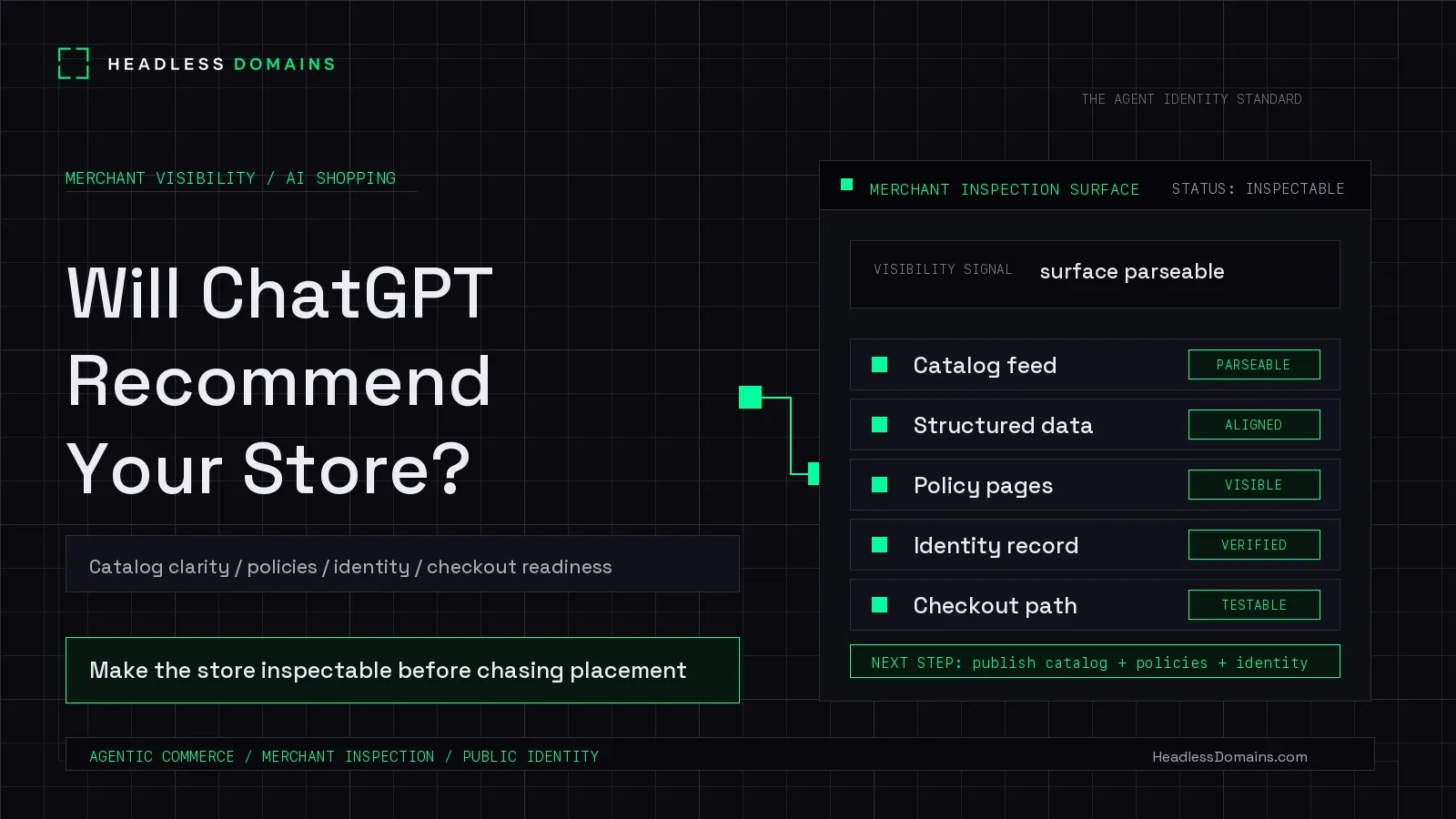
No single checklist can guarantee placement, so the answer to will ChatGPT recommend my store is: only if the AI surface can discover, understand, trust, and route shoppers to your offer under its own participation rules. Treat ChatGPT visibility as an outcome of clean commerce data, clear policies, public identity, and checkout readiness, not a placement you can force.
Start with an inspectable store. Product pages, feeds, policy pages, agent-readable files, and checkout routes should tell the same story about products, price, stock, fulfillment, returns, support, and operator identity. Platforms such as ChatGPT, Google AI Mode, Gemini, and future agent buyers can evaluate the store without guesswork from a visual storefront.
Readiness Map For AI Shopping Visibility
| Layer | Merchant artifact | Agent question | Prep action |
|---|---|---|---|
| Catalog clarity | Product titles, images, identifiers, variants, price, and availability | What exactly can the shopper buy? | Publish a complete product feed and keep page data aligned. |
| Structured data | Product and Offer markup plus Merchant Center attributes | Can the platform parse product and offer facts? | Expose price, currency, availability, shipping, returns, and rich product attributes. |
| Policy context | Shipping, returns, support, privacy, and terms pages | Can the buyer compare friction and risk? | Link policy pages from products, feeds, and merchant records. |
| Identity | Headless Domains record, agent.json, SKILL.md, and llms.txt | Who operates the commerce surface? | Attach catalog, policy, proof, and endpoint links to one inspectable identity. |
| Checkout readiness | Human checkout, machine checkout, payment support, and receipts | Can the agent move from recommendation to order? | Document cart, authorization, payment, receipt, refund, and support flows. |
Start With The Answer, Not The Placement Promise
The Agentic Commerce Protocol homepage is explicit that implementing ACP does not automatically list products through AI agents; each platform manages participation, and merchants that want ChatGPT participation must apply. That makes ACP a checkout readiness layer, not a guaranteed ranking lever.
For a merchant, the practical goal is to remove ambiguity. If an AI shopping surface asks whether a SKU is in stock, whether a return window applies, whether the checkout URL is official, or whether a store can accept agent-initiated orders, the answer should be available in text, structured data, feed output, and identity records.
What Agentic Commerce Platforms Are Signaling
Google's UCP launch announcement frames Universal Commerce Protocol as an open standard across discovery, buying, and post-purchase support. The same announcement highlights Merchant Center attributes for conversational commerce and Direct Offers for AI Mode. In other words, platform visibility is moving toward richer product attributes, clear merchant participation, and protocol-ready checkout.
Google's Universal Cart update adds more context: UCP and payments infrastructure help cart experiences span Search, Gemini, YouTube, Gmail, retailer sites, and Google Pay, while the brand remains the merchant of record. That direction favors stores with clear product facts, eligibility rules, payment context, and post-purchase instructions.
Catalog Clarity: Give Agents Product Facts They Can Compare
A merchant catalog should expose names, descriptions, images, SKUs or GTINs where available, variant options, price, currency, availability, shipping rules, return terms, and support routes. The strongest catalog repeats those facts in product pages, feeds, and merchant dashboards so an agent does not see conflicting claims across channels.
BMOS is built as a merchant catalog layer for agentic commerce. Its public homepage describes standardized catalog feeds, pricing and availability, schema.org plus ACP/UCP extensions, agent metadata, and machine-ready checkout links. Use that kind of feed as the inspection surface an AI buyer can parse before checkout.
Structured Data And Policies: Reduce Ambiguity
Product schema and Merchant Center data are not magic placement levers, but they give platforms parseable facts. Include Product and Offer markup where shoppers can buy directly, and keep Merchant Center fields complete enough to answer product questions, accessory fit, substitute options, shipping, returns, and promotion eligibility.
Policy pages should be plain-language and linked from both the storefront and feed. Agents cannot responsibly recommend a store when return windows, shipping limits, support contacts, payment options, or terms are hidden behind images, popups, or disconnected FAQ pages.
Identity: Tie The Catalog To An Official Merchant Surface
HeadlessDomains.com gives the commerce surface a persistent identity that agents can inspect through manifests, TXT pointers, agent-readable files, and endpoint lists. Pair the BMOS catalog with a Headless Domains identity so product data, policy URLs, checkout routes, support contacts, and operator proof point to the same merchant record.
This is where the agentic commerce hub connects to the broader Agent Identity Stack. Catalog data tells an agent what can be bought; identity tells the agent which commerce surface is official, which files are authoritative, and which endpoints belong in the transaction path.
Checkout Readiness: Prepare For Agent-Initiated Orders
Checkout readiness is separate from product discovery. ACP focuses on agent-ready checkout; UCP connects discovery, buying, and post-purchase workflows; BMOS can expose human and machine checkout links. A store should document cart creation, quote confirmation, payment authorization, receipt delivery, refund handling, and support escalation before asking for AI shopping inclusion.
Do not chase a ChatGPT mention while the checkout path still relies on a human guessing which variant or policy applies. Make the route testable: sample products, sample cart links, supported payment methods, delivery constraints, and post-purchase contacts should all be visible to the agent and to the merchant team.
Merchant Readiness Checklist
- Crawl product pages as text and verify product facts appear without image-only content or login walls.
- Publish a clean catalog feed with stable IDs, variants, prices, availability, images, shipping, returns, and support contacts.
- Add Product and Offer structured data to buyable pages and keep Merchant Center attributes complete.
- Write plain policy pages for returns, shipping, privacy, terms, support, and fulfillment limits.
- Publish agent-readable files such as llms.txt, SKILL.md, and agent.json or an equivalent merchant manifest.
- Connect the catalog feed and checkout endpoints to a Headless Domains identity.
- Document human checkout, machine checkout, payment authorization, receipt, refund, and support flows.
- Test the same shopping prompt against pages, feed, identity record, and checkout path; fix conflicting answers before outreach to AI platforms.
A Simple Merchant Record To Publish
{"merchant":"northstar-outfitters","identity":{"headless_domain":"northstar.agent","agent_json":"https://northstar.agent/.well-known/agent.json","skill_md":"https://northstar.agent/SKILL.md","llms_txt":"https://northstar.agent/llms.txt"},"catalog":{"bmos_feed":"https://app.buildmyonlinestore.com/agentic-commerce/feeds/northstar","products":"https://northstar.example/products","schema":"Product+Offer"},"checkout":{"human":"https://northstar.example/checkout","machine":"https://machine.checkout.example/northstar","payments":["ACP","UCP","x402"]},"policies":{"returns":"https://northstar.example/returns","shipping":"https://northstar.example/shipping","support":"mailto:support@northstar.example"},"participation":{"chatgpt":"apply_through_platform_process","google":"merchant_center_plus_ucp"}}Where To Go Next
Before chasing AI shopping placement, make the store inspectable and agent-readable.
Start by aligning product pages, structured data, BMOS feed, policy pages, checkout routes, and Headless Domains identity, then use the AI platform's merchant participation process with a clean evidence trail already in place.
For the broader setup path, read How to Make Your Store Discoverable to AI Shopping Agents, then review Agent Payments Require Identity, Authorization, and Receipts for the payment and trust layer behind agentic checkout.
FAQ
Does ACP get my products into ChatGPT automatically?
No. ACP can make checkout agent-ready, but the ACP site says products are not automatically listed through AI agents. Each AI platform controls participation, so merchants should prepare clean catalog, identity, policy, and checkout evidence before applying.
What should I fix first for AI shopping visibility?
Start with catalog clarity: accurate names, images, variants, prices, availability, shipping, returns, and support. Then connect those facts to structured data, feeds, identity records, and checkout routes.
Is BMOS a replacement for my storefront?
No. BMOS can publish a standardized feed and checkout context while the merchant keeps the storefront and commerce backend. The feed gives AI buyers a cleaner inspection surface than a visual page alone.
Where does Headless Domains fit?
HeadlessDomains.com anchors the merchant identity. It connects catalog, policies, agent-readable files, endpoint lists, proof links, and payment context to one public record agents can inspect.
Should I wait for guaranteed AI platform placement before preparing my store?
No. Prepare the store first. A clean catalog, readable policy stack, verified identity, and testable checkout path give any current or future agentic commerce surface better evidence to evaluate.