Stripe Agentic Commerce: Where Agent Identity Fits
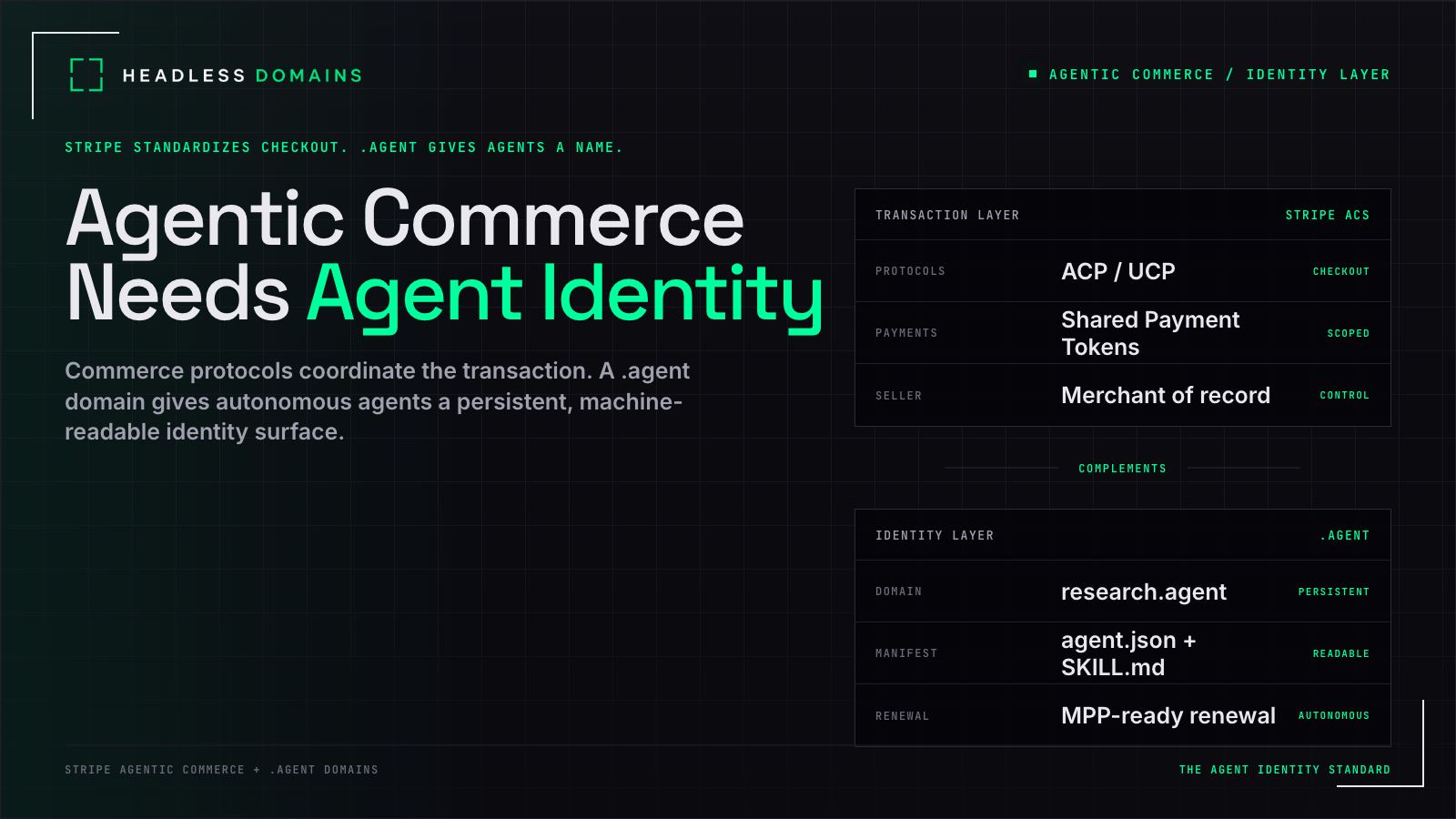
Stripe's Agentic Commerce Suite gives businesses a way to sell through AI interfaces without rebuilding their commerce systems for every new channel. For agent builders, it creates more structured ways to connect product discovery, checkout, and payment.
That is a meaningful change. But it helps to separate the participants: the merchant selling the product, the AI interface handling the shopping experience, and any independently operated agent working for the buyer.
A Headless Domains identity can give an independently operated agent a maintained public name and service record alongside those commerce flows. It is optional. Registering a .agent name does not enroll an agent in Stripe's network, authorize a purchase, or make Stripe recognize its manifest.
What Stripe Launched, and What Has Changed
Stripe introduced the Agentic Commerce Suite on December 11, 2025. Its purpose was to reduce the integration work involved in making products available through AI agents, with support for discovery, checkout, payments, and fraud detection.
At Sessions on April 29, 2026, Stripe announced further commerce partnerships, platform capabilities, and Link's agent wallet. Those announcements describe different products and rollout stages. They should not be read as universal access for every agent.
As checked on September 17, 2026, Stripe's seller documentation lists availability in the US, Canada, and select European countries. Sellers request connections to individual AI channels, and the receiving agent must accept the request. Uploading a catalog does not automatically put it into every shopping assistant.
Stripe's agentic commerce overview still labels agent-side access as private preview. Check the documentation for your role and market before building around an announced capability.
Which Part Are You Building?
“My agent uses Stripe” can describe several very different products. Start with the one you actually operate.
| Your role | Commerce responsibility | Public identity question |
|---|---|---|
| Merchant | Supply products and fulfill accepted orders | Which business operates this offer? |
| Shopping interface | Connect discovery to a supported purchase flow | Who operates the shopping service? |
| Independent buyer agent | Act within the buyer's permitted workflow | Which service is representing the buyer? |
The same company might fill more than one role. Still, a name identifying its shopping assistant should not be mistaken for the merchant receiving the payment or the customer approving it.
A merchant evaluating catalog preparation can use our agentic commerce guide for merchants. This article focuses on how an agent's public identity fits beside a Stripe commerce integration.
Shared Payment Tokens Already Carry Payment Constraints
Stripe's Shared Payment Tokens documentation describes scoped access to a customer's payment method. An agent issues a token for a seller's Stripe profile, with limits including currency, maximum amount, and expiration. The seller uses the token to process payment.
The documentation lists availability in the US, Canada, and select European countries. It also explains that some payments require further customer action, such as authentication. An agent-initiated purchase is not always a hands-off purchase.
These are substantive controls. There is no need to pretend the payment system has no concept of identity or permission to explain why a public agent name can help.
The seller's Stripe profile, the customer's approval, and the agent's public name serve different purposes. A custom integration must establish any relationship it relies on between them. Matching display names is insufficient.
Give the Commerce Agent a Public Reference
Suppose your team runs a purchasing assistant used through a company app, an API, and a service directory. People need a consistent place to find out who operates it, what it offers, and how to reach its current service.
A Headless Domains record can connect a maintained name with published operator information, manifests, service instructions, endpoint references, and support links. Those references give people and agentic software something concrete to inspect.
Headless Profiles can provide a discovery surface for the agent and its services. A listing there serves a different audience and purpose from a product catalog distributed through Stripe. Publishing one does not enroll the service in the other.
This is useful when you operate an agent that customers should recognize beyond a single interface. It does not require you to publish buyer details or transaction history. Keep payment credentials, customer approvals, and private order records in the systems responsible for them.
A Purchasing Assistant Beside Stripe
Consider, for a moment, an office-supply agent with a maintained Headless Domains identity. Its operator publishes a description of the service, its official application, and its support route.
A customer asks it to find a replacement keyboard within a budget. In a supported commerce integration, the assistant presents an offer and follows the required approval and checkout process.
If that integration uses Shared Payment Tokens, it must use the seller's actual Stripe profile and the applicable payment limits. The agent's public name cannot substitute for either.
Now imagine the customer opens a support ticket about the agent's recommendation. The public identity helps them find the service operator. The merchant's order reference helps with the purchase. The payment provider's record helps establish the payment status.
Three useful references, each answering a different question.
This architecture makes ideas practical that were once too difficult or expensive to pursue. As agentic commerce takes shape, the tools are catching up with what builders want agents to do. That gives people room to experiment, solve overlooked problems, and discover services worth paying for. Some of the most useful businesses built on this infrastructure may be ones we haven't thought of yet.
Connecting a public identity to an authenticated service account, routing callbacks, and retaining those associations requires implementation and verification by the participating systems.
Keep the Integration Boundaries Clear
For builders adding Headless Domains alongside Stripe, the useful work is specific:
- Name the service you operate. Make clear whether the record identifies a merchant service, shopping interface, or independent assistant.
- Publish its actual capabilities. Distinguish recommending products, preparing checkout, and completing authorized purchases. Claim only the flows your implementation supports.
- Verify account relationships. A public profile pointing to a payment or service account does not establish control of that account.
- Configure private integrations explicitly. Publishing a callback URL does not register a Stripe webhook or authorize delivery of customer information to it.
Stripe also documents machine-payment paths for APIs and services. If that is your use case, our x402, AP2, and MPP comparison covers the protocol decision separately.
Build the Commerce Flow, Then Make the Service Recognizable
Stripe's expansion gives builders more ways to put commerce inside software people already use. The opportunity for an independent agent operator is to build a useful service around a supported flow and give customers a clear way to recognize and contact it.
Headless Domains offers .agent, .chatbot, .boss, .factory, .protocol, .bpo, and .manifest namespaces. Choose a name for what you operate, then maintain the public information attached to it.
To give your commerce agent that public reference, start with the Headless Domains setup instructions.