The B2A Economy Moves the Sale Inside the Task
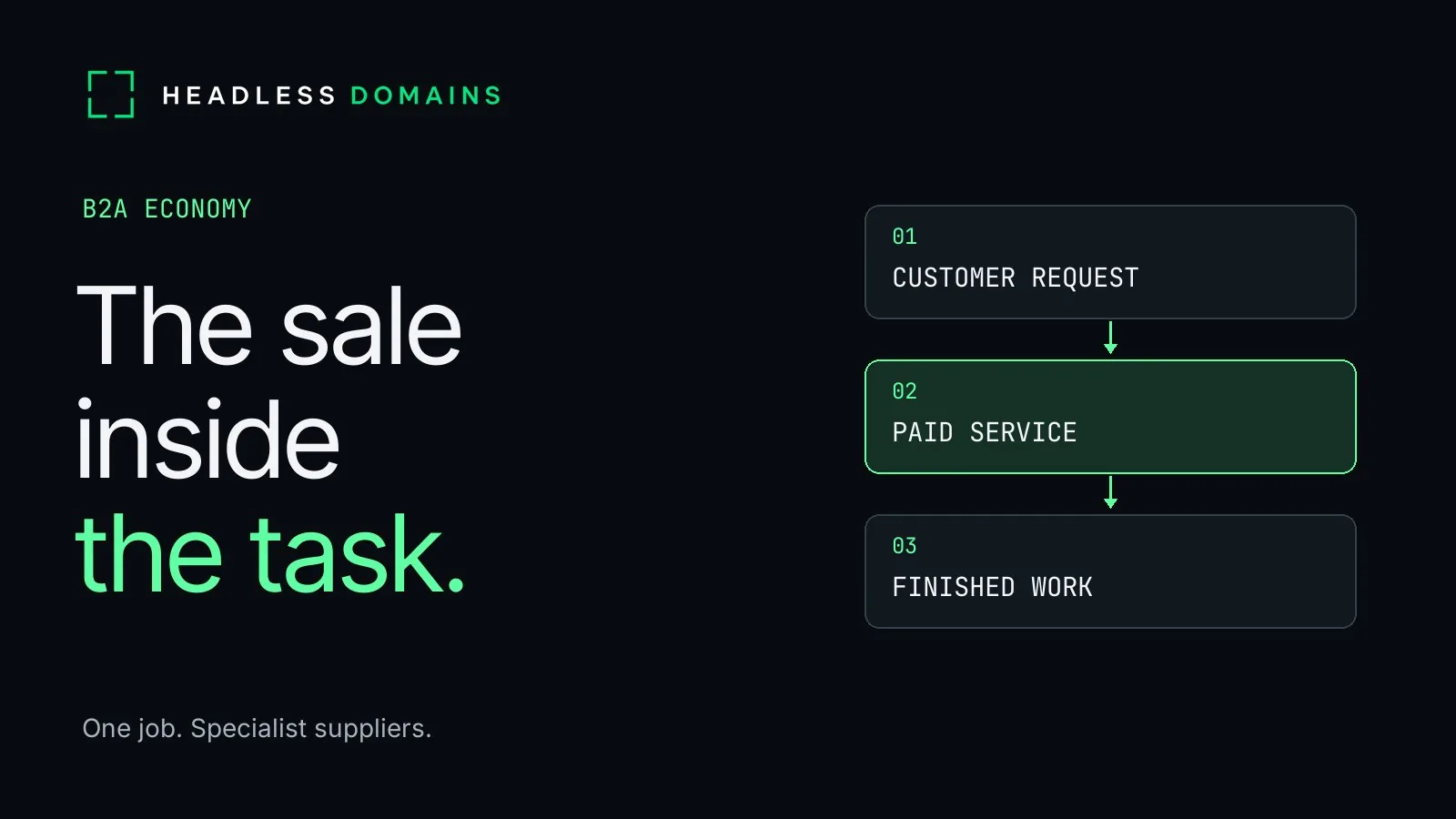
An agent can finish a report by buying a PDF.
The customer asked for the report. Somewhere between the research and the finished attachment, a specialist gets the document job. Its bill fits comfortably inside a dollar.
API2PDF opened the purchase route on September 25. Its v2 API accepts x402 payments in USDC on Base without a service account or API key. The service publishes a maximum charge of five cents per request and returns the generated file through a download URL. The customer’s agent brings the payment tooling; API2PDF supplies the document operation.
A five-cent sale rarely gets a strategy meeting. The change behind it deserves one.
On November 11, Olivia Moore and Justine Moore published a16z’s Welcome to the B2A Economy. Their argument puts agents in the path of distribution and spending: software increasingly chooses products, connects services, and completes work for people. Business-to-agent commerce includes the purchases an agent makes while carrying out a larger assignment.
Your service can earn a place inside the job, even when the person requesting the work never visits your homepage.
B2A brings the buying decision into the work
A person asking for a finished report usually cares about the report. Search tools, document conversion, data sources, and formatting utilities sit somewhere behind the result, alongside all the other machinery people prefer to stop thinking about.
An agent assembling the work encounters those choices as it goes. It can use an existing tool, write code, or buy a specialist operation through a supported service. Each paid choice creates a small commercial encounter inside the larger assignment.
The a16z authors give a familiar example: they asked ChatGPT to create and edit a video advertisement using Krea, Descript, and ElevenLabs plug-ins. The workflow included an upsell to a paid Descript plan. The request concerned an advertisement; the work created a reason to buy software.
HeadlessDomains.com covered an earlier version of the same behavior in the October 28 Space recap. The host recounted using Codex with a connected wallet for email checks and company research, buying individual API calls from services outside his subscriptions. Some calls cost cents. Those purchases supplied information for the task already in progress.
Timing changes the sale. A supplier gets a chance to sell when the work presents a problem its service can solve. The customer has already decided to do the job.
Human budgets, permissions, and provider restrictions still govern those purchases. Within an authorized workflow, an agent can handle more of the supplier coordination people previously carried between tabs.
One agent task can pay several businesses
Cloudflare’s September Monetization Gateway announcement brings several suppliers into view: Ceramic.ai for search, Stocktwits for market signals, API2PDF for document work, and Cloudflare AI Gateway for inference. The gateway entered closed beta for eligible U.S. sellers and buyers, with the announcement highlighting production customer examples.
Each supplier sells a particular input at the point of use. Search can feed research. Research can feed a presentation. Document conversion can finish the handoff. An agent can purchase an input without turning every supplier into another subscription someone manages.
| Larger job | Paid input | Business earning the sale | Evidence |
|---|---|---|---|
| Prepare information for outreach | Email checks and company research | Specialist data providers | The host’s reported workflow in the October 28 Space |
| Produce a finished document | Document generation or conversion | API2PDF | The provider’s published x402 service |
| Plan a protein-bar campaign | Social research and eight campaign images | AIsa and Cloudflare AI Gateway | Mastercard’s campaign-payment pilot |
In Mastercard’s October 20 pilot, agency Hype approved a campaign task and budget. An agent bought research from AIsa and eight images through Cloudflare AI Gateway: nine payments across two merchants. Mastercard opened early access alongside the demonstration.
The demonstration puts the supplier relationship on screen. Each merchant contributes part of the campaign, and the agent carries the work between them.
The full campaign walkthrough covers the budget and payment mechanics. The business opportunity reaches the suppliers on the other side: someone else’s agent can buy their work while completing a customer’s assignment.
Selling to AI agents starts with a useful result
A working payment route gets a service into the transaction. The service still has to earn the purchase.
Document conversion offers a useful example because the result has an obvious job. A returned file must open, preserve the content, and fit the recipient’s purpose. A successful payment followed by a broken file leaves the customer with a charge and the original problem.
For a data service, freshness and coverage may carry the value. For translation, terminology and formatting may matter more. A buyer evaluating either service benefits from a clear account of the accepted input, returned work, price, and handling of incomplete requests. “AI-powered” leaves an awful lot for the buyer to discover after paying.
Pricing also follows the actual job. Charging per call suits some operations; a maintained feed, ongoing review, or managed workflow may justify a recurring agreement. Price the service around the work you deliver, including the calls, retries, and operator time behind each result.
The September first-customer article explores a retailer paying for maintained competitor observations. The valuable work includes matching products, collecting fresh information, and resolving failures. Returning a tidy response is the visible end of an operation someone has to run.
For your service, identify the part a buyer already spends time or money handling. Then make the result easy to evaluate before purchase and easy to use afterward. A sample output often says more than another paragraph about intelligence.
Agent platforms bring distribution; your service carries the promise
On November 10, OpenAI launched Businesses in ChatGPT in beta. Businesses can claim their organization, manage information, and view aggregated engagement insights. Eligible U.S. ecommerce and online-service businesses can also launch Business Agents.
A platform presence gives a business another place to meet a customer. It also makes the information behind the conversation commercially important. The price, service description, and purchase destination influence what the customer understands before any work begins.
Other efforts address the customer’s journey across channels. Sierra’s Personal Agent Protocol draft, known as Poppy, connects discovery and customer-authorized access across a company’s website, APIs, and agent. The customer chooses access; the company defines the available actions.
Distribution and delivery meet at an ordinary promise: someone asks for work, and a business agrees to provide it. A platform can introduce the parties. Your service carries the consequences of the offer.
Keep the description close to the result. A customer comparing document services can understand supported formats, sample files, and delivery terms. Grand claims about transforming work become less persuasive when the attachment won’t open.
A public agent name gives the next purchase a destination
After a useful purchase, the next request has somewhere familiar to go. A colleague can recommend the service. A customer can return with another file. An agent can inspect the current instructions behind a name it already knows.
HeadlessDomains.com’s public naming and lookup infrastructure connects a service name to published information and destinations through API and command-line workflows. The operator maintains the records as the service changes.
For an independent supplier, the name belongs alongside the offer: what the service does, who runs it, where the buyer sends work, and how to reach the operator afterward. You can move an endpoint or replace a worker while keeping the customer’s familiar introduction current.
The guide to selling agent services connects a named offering to a paid operation. The Agent Identity Stack covers the relationship between public identity, runtime credentials, and application permissions. Those details support the service people came to use.
A second purchase gives you better evidence than applause for the first demonstration. The buyer received something useful, remembered the supplier, and had a reason to return. Measure the work behind the sale, including retries and operator time, so repeat business earns money as well as attention.
The five-cent document operation makes the opportunity small enough to picture. Somewhere inside a larger assignment, another business has a useful job to do. Your service can be the one the agent hires.
Give your service a public name at HeadlessDomains.com, connect its offer and working destination, and make the next introduction easier.
The onboarding walkthrough covers the first steps after registration.