What Is an Agent Registry?
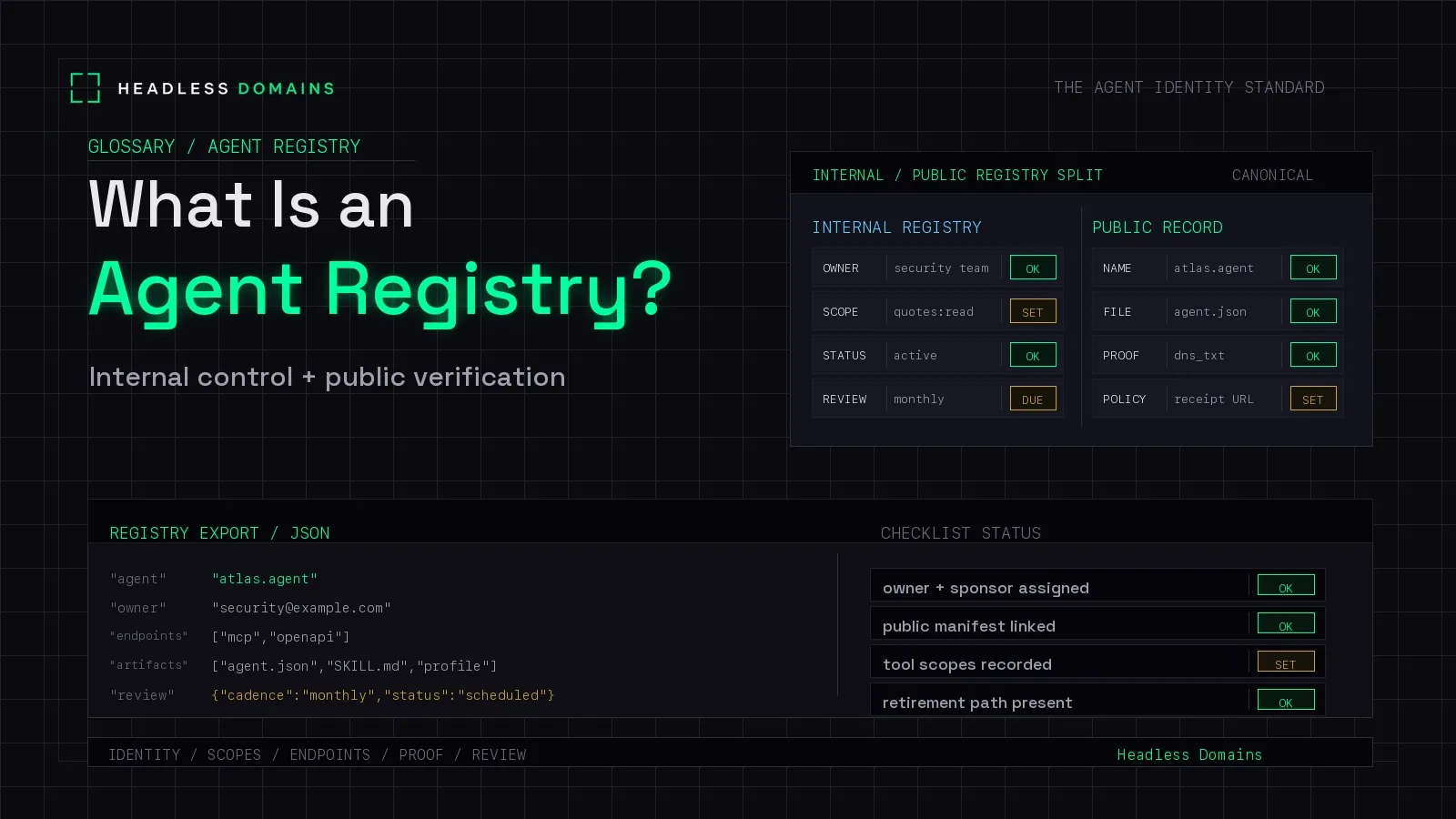
What is an agent registry? A governed inventory of AI agents, owners, identities, scopes, endpoints, artifacts, review state, and retirement path. Teams verify which agents can act, what each agent may access, and where trust records live across connected systems.
In Plain Terms
An agent registry gives operations, security, and partner systems a shared source of record for nonhuman actors.
For public discovery rather than internal agent governance, read the agent directory guide. To choose a listing channel, compare directories and marketplaces. The Agent Identity Learning Center organizes the related guides.
The registry entry names the agent, the operator, the human sponsor, approved tasks, environments, credential type, tool scopes, public endpoints, manifests, policy URLs, proof links, review cadence, and retirement status.
Internal fields stay inside IAM, GRC, SIEM, or access-review systems. Public fields can be published through a Headless Domains record, agent.json, SKILL.md, endpoint metadata, and a Headless Profile Directory page.
That split keeps private control data separate from public verification data. A partner agent can inspect a public profile before calling an API. A security reviewer can compare the profile against internal scopes and logs.
A marketplace can show the display name while linking to the canonical record. A payment flow can compare payee, mandate, receipt route, and policy URL before value transfer. The registry is not another brochure.
The registry is the control plane that says who the agent is, who owns the agent, what the agent may do, and how others can verify the agent before trust. The best entries are short enough for audit and structured enough for software. They include status values such as proposed, active, restricted, suspended.
Registry Surfaces Compared
| Surface | Primary job | Visible to | Good content |
|---|---|---|---|
| Internal registry | Governs private control data | Security, identity, finance, and audit teams | Owner, sponsor, IAM object, scopes, logs, review date, retirement runbook |
| Public identity record | Gives outside systems a verifiable record | Partners, agents, marketplaces, APIs, and auditors | Canonical name, operator, agent.json, SKILL.md, endpoints, proof links, policy URLs |
| Agent directory profile | Presents the public record for inspection | Humans and agents browsing approved profiles | Purpose, status, contacts, profile URL, and links back to the canonical record |
| Marketplace listing | Helps users browse and install | Marketplace users and buyers | Display name, category, pricing, ratings, support link, canonical identity link |
How Registry Controls Connect
Microsoft's security overview for AI agents frames agents as identities with authentication, authorization, governance, logging, and lifecycle control.
Google Cloud's MCP authentication guidance warns that an AI application using human credentials acts with that human's permissions, so production agents should use separate identity and minimum permissions.
Okta's secure agentic enterprise blueprint emphasizes discovery, ownership, connection control, and fast revocation across tools, apps, APIs, databases, and MCP.
Implementation Checklist
- Create one registry row for every production agent, high-risk sandbox agent, and third-party agent connected to company systems.
- Assign canonical name, operator, human sponsor, purpose, environment, status, and review owner.
- Bind the agent to a dedicated nonhuman identity or workload identity instead of a shared human account.
- Record approved MCP servers, APIs, webhooks, data classes, OAuth scopes, IAM roles, and payment authority.
- Publish agent.json, SKILL.md, endpoint metadata, proof links, policy URLs, and profile links for public or partner-facing agents.
- Keep secrets, private tokens, staging hosts, and sensitive logs out of public registry exports.
- Review active entries after tool changes, payment-policy changes, ownership changes, incidents, and retirement events.
- Mark stale entries as suspended, retired, or replaced before removing endpoint claims.
JSON Export Example
A registry row can export a compact JSON object for audit tools, directory profiles, and verification workflows.
{"registry_version":"2026-05","agent":"atlas.agent","operator":"Atlas Research LLC","sponsor":"security@example.com","purpose":"Procurement quote review","environment":"production","status":"active","identity":{"type":"nonhuman-agent","provider":"enterprise-idp","object_id":"agent-7429"},"artifacts":{"agent_json":"https://atlas.agent/.well-known/agent.json","skill_md":"https://atlas.agent/SKILL.md","profile":"https://agents.headlessdomains.com/atlas.agent"},"endpoints":{"mcp":"https://tools.example.com/mcp/procurement","openapi":"https://api.example.com/openapi.json"},"authorization":{"scopes":["quotes:read","vendors:read"],"payments":"not_authorized"},"review":{"cadence":"monthly","next":"2026-06-30","status":"scheduled"}}Where Headless Domains Fits
Headless Domains provides the public side of an agent registry a persistent identity anchor. A Headless Domains name can point to agent.json, SKILL.md, TXT proof, MCP and OpenAPI metadata, payment policy, and a Headless Profile Directory page.
Headless Domains names are headless, so agents can inspect records through command-line and API workflows without waiting for browser-native resolution.
Public registry profiles complement IAM. IAM governs private credentials, scopes, token issuance, and audit logs. A Headless Domains record gives external agents, partner tools, APIs, directories, and payment systems a stable inspection path before trust, calls, or value transfer.
Get Started
Where to Go Next
Start with one pilot agent that can call a tool, reach customer data, or represent a brand outside one private system. Fill the registry row, publish the public artifacts, then compare the result with the Agent Registry Checklist and the AI Agent Identity Security hub before adding the rest of the fleet.
FAQ
What is the difference between an agent registry and an agent directory?
An agent registry is the source of record for ownership, scopes, status, and controls. An agent directory is the inspection surface where humans or agents browse approved public profiles.
Does an agent registry replace IAM?
No. IAM governs credentials, policies, token issuance, and private logs. The registry organizes agent context around those systems and can publish a public verification layer for outside systems.
Which agents should be registered first?
Start with agents that can call tools, reach customer data, trigger admin actions, connect to MCP servers, represent a brand externally, coordinate with peer agents, or participate in payment workflows.
What should a public agent registry entry omit?
Leave out secrets, private keys, bearer tokens, internal hostnames, raw logs, customer data, and draft runbooks. Publish enough context for verification without exposing control surfaces.
How does Headless Domains support an agent registry?
Headless Domains supplies a public name, machine-readable links, agent.json, SKILL.md, TXT proof, endpoint references, and directory profiles, so agents can inspect a persistent identity before calls or payments.
Is an agent registry only for enterprise teams?
No. Small teams can keep a lightweight registry with owner, purpose, status, endpoints, public artifacts, and review date. The same pattern scales as more agents connect to tools, partners, and commerce systems.