What Is Agentic Commerce?
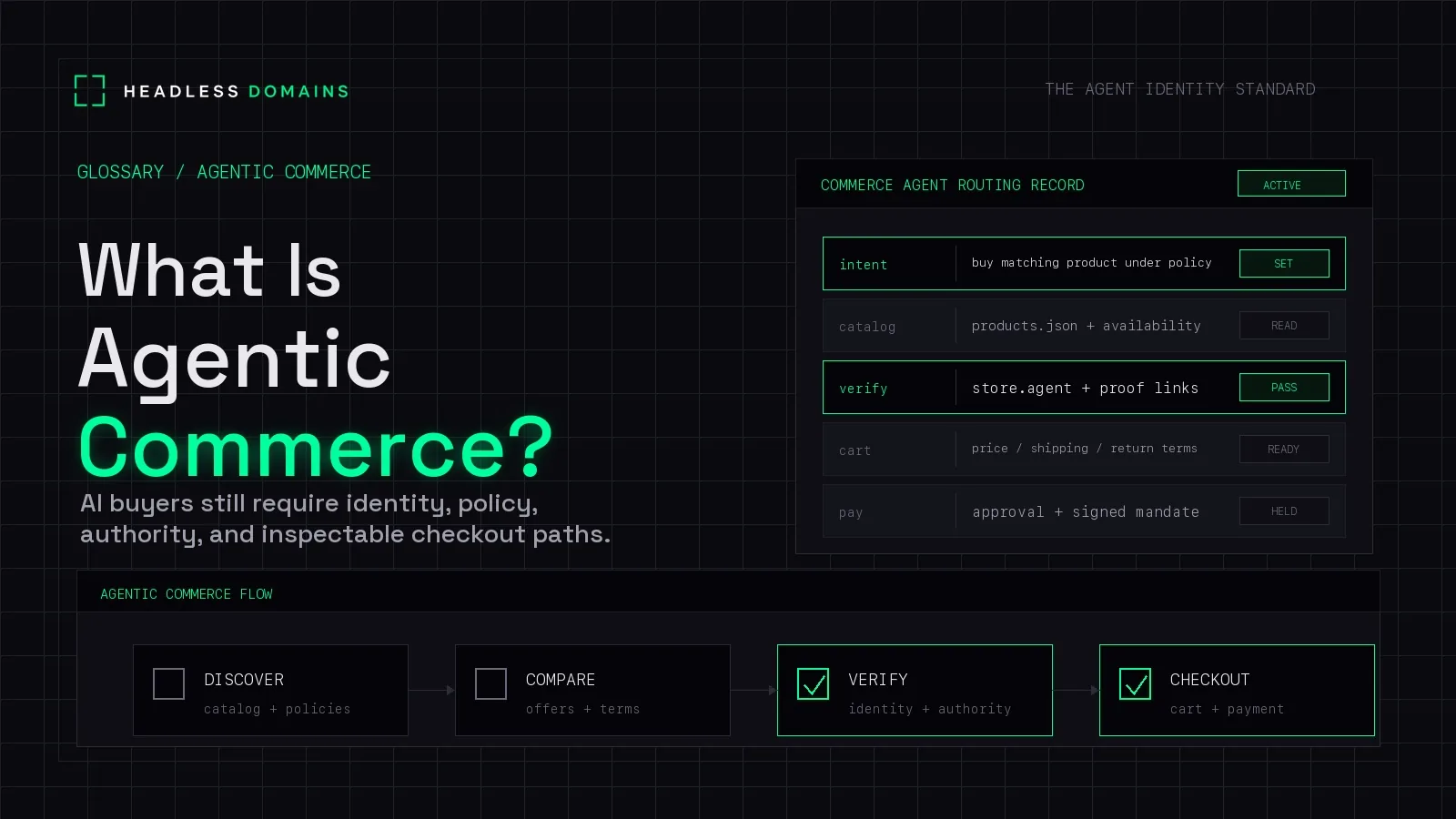
Agentic commerce is shopping a person delegates to an AI agent. The agent can discover products, compare offers, build a cart, and sometimes pay, inside rules that person set. Ordinary ecommerce is still a person clicking through a store. A chat that only recommends a product and sends you to a normal checkout is not this either.
People do not leave the picture. Someone still sets the budget, the merchants that are allowed, and the point where a human has to say yes. The agent is doing steps in that box, not inventing a new kind of store from scratch.
Three ways software shows up in a purchase
| Pattern | Who does the buying work | What you still decide |
|---|---|---|
| Ordinary ecommerce | A person, in a browser | The store, the price, and the policy, same as now |
| Chat that recommends | A chat suggests items, then hands the person a link | Checkout still happens on a page a person completes |
| Agentic commerce | An agent searches, compares, and may check out inside a limit | The budget, the merchants, and when a person has to approve |
When software agents sit on both sides of the exchange, buyer and seller, that is agent-to-agent commerce. Keep that page for the bilateral case. This page is the broader pattern: an agent shopping for a person, usually from a merchant.
Names you will hear at checkout
Protocols specify a checkout or a request. They are not the definition.
The Agentic Commerce Protocol, maintained by OpenAI and Stripe, is an open model for buyers, their agents, and businesses to complete a purchase. Google's Universal Commerce Protocol is the open standard it describes for agents and merchant systems to work across discovery, buying, and support after the sale. Merchant Center documents a UCP-powered checkout button on eligible listings in AI Mode and the Gemini app for participating merchants, and Google's UCP FAQ says the merchant remains the merchant of record. The same FAQ describes AP2 as a payment layer that can sit inside UCP, not as a replacement for the rest of the flow. UCP REST checkout is advertised from a business profile at /.well-known/ucp, and calls carry a UCP-Agent header pointing at that profile.
Visa's Trusted Agent Protocol is how a merchant can check a signed request from a recognized agent, bound to that merchant and that purpose. It answers "which agent traffic is this?" It does not define the shopping pattern.
Which of ACP, UCP, and a BMOS catalog feed to use is ACP vs UCP vs BMOS. What belongs in a product feed versus an agent-readable catalog is product feed vs agent-readable catalog. How a store gets found on the channels agents already use is making a store discoverable to AI shopping agents. Stripe's product suite for selling through AI interfaces is where agent identity fits in Stripe agentic commerce.
What the merchant still has to publish
You can delegate research and cart prep without joining any of those protocols. The agent still needs product facts it can read, a policy it can quote, and a way to tell the official store from a lookalike. That is a public record for the store: who operates it, which domain and checkout are official, and where support goes.
The build steps for a merchant (catalog, feed, checkout route, identity) live in agentic commerce for merchants. This page stops at the definition so that guide can own the implementation.
{"store":"example-store.agent","canonical_store":"https://store.example.com","catalog":"https://store.example.com/products.json","policies":{"returns":"https://store.example.com/returns"},"checkout":{"human_approval_over":"250 USD"},"note":"Illustration only. Not a live store."}FAQ
Is agentic commerce the same as ecommerce?
No. Ecommerce is online buying in general. Agentic commerce is the slice where an AI agent does discovery, comparison, or checkout under rules a person set.
Do I need ACP or UCP before any of this works?
No. Those specs matter when a merchant wants checkout on a particular agent surface, such as ChatGPT or Google AI Mode. An agent can already research products and assemble a cart for a person to approve without them.
Is this the same as agent-to-agent commerce?
Not quite. Agent-to-agent commerce is both sides represented by agents. Agentic commerce includes a person's agent buying from a merchant that may still be an ordinary store.
Does the agent have to pay by itself?
No. A useful version stops at a cart and an explanation, and a person confirms payment. If the agent may pay, cap the amount and name the merchants before you turn that on.
Give the store a name agents can check.