.agent Is Live on Handshake. What Happens Next at ICANN?
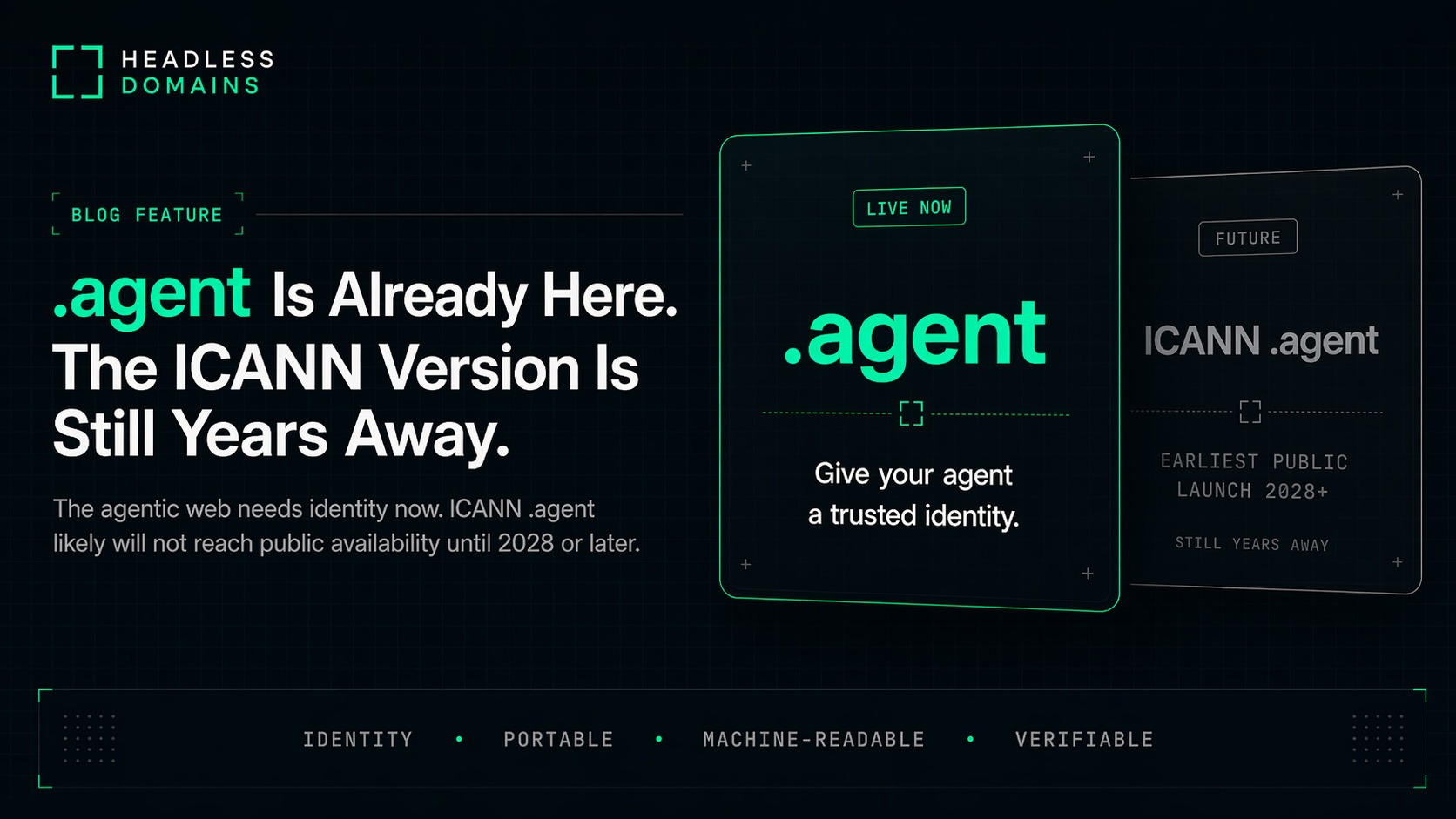
You can give your agent a .agent identity on Handshake today. An ICANN-root .agent is a separate proposal, with no confirmed public registration date.
ICANN has moved forward. Its 2026 application window closed on August 12, and applications are entering the process that determines which new extensions can join the global DNS root. Builders already using Headless Domains can keep developing their services while that work continues.
Put the name to work: connect it to an operator, publish useful service information, and give other agents a consistent way to find you. You can start testing that with a working service now.
Updated October 1, 2026.
ICANN's application window has closed

On August 13, ICANN reported more than 1,600 primary applications. More than 1,100 included replacement-string applications. Those replacement choices are alternatives within the process, so adding the figures together would overstate the number of primary applications. ICANN said the final total depended on receipt of evaluation fees.
The payment deadline also changed. Under the August 7 announcement, payment was due at 23:59 UTC on August 19 or seven days after the invoice was sent, whichever was later. August 19 was no longer a universal cutoff.
Preparation for evaluation has continued. On September 3, ICANN appointed Analysys Mason to provide the Geographic Names and Reserved Names panels. The round is underway; approval of any individual extension still depends on its application and the required reviews.
What happens next in the 2026 round?
ICANN's current pre-evaluation timetable separates completed dates from projected milestones. Here is the sequence relevant to anyone following .agent.
| Milestone | Timing or status | What it establishes |
|---|---|---|
| Application submission | April 30 to August 12, 2026; closed | Proposals submitted for consideration. |
| Administrative check | Approximately eight weeks after closing; projected | Payment and application completeness. |
| Reveal Day | Expected no later than nine weeks after closing, absent extraordinary circumstances | Public application information and initial contention sets. |
| Replacement period | 14 days after Reveal Day | Eligible applicants can select their previously submitted replacement string. |
| String Confirmation Day | November 2026; projected | Confirmed strings and updated contention sets. |
| Prioritization draw | Within 30 days of String Confirmation Day | Processing priority, subject to the program's rules. |
| Evaluation through delegation | Application-dependent | Successful applications complete the remaining requirements. |
| Retail registration | No confirmed .agent date | A registry's launch and registration policies determine availability. |
ICANN labels the early timetable tentative and says estimates will be updated after application numbers are shared on Reveal Day. Those estimates are not a retail launch schedule.
The applicant journey also includes string evaluation, community input and objections, contention resolution where needed, applicant and application evaluation, contracting, technical onboarding, and delegation. A successful application must clear the applicable requirements before a registry can launch.
Is an ICANN-root .agent available?
As of September 21, .agent does not appear in IANA's list of delegated top-level domains. There is no ICANN-root .agent available for ordinary domain registration.
There are public proposals. Agent Community, operated by Open Agent Registry, Inc., describes itself as an applicant for a proposed community-governed .agent. Its page says the outcome is subject to ICANN approval and that pre-registration is free, non-binding, and never a reservation.
That is an applicant's description of its proposal. ICANN's published application records and evaluation results are what establish the official position. A public campaign alone does not tell us the final applicant field, contention outcome, or launch date.
Private auctions are prohibited, but an auction is not inevitable
The 2026 Applicant Guidebook prohibits private auctions and other arrangements designed to resolve string contention privately. ICANN's permitted processes include Community Priority Evaluation and ICANN auctions. Eligible replacement strings can also help applicants avoid contention earlier in the process.
Community Priority Evaluation is an assessment an eligible application must pass. Calling a proposal community-led does not secure the string. And competing applications do not automatically mean an auction will determine the outcome.
For .agent, the eventual path depends on the applications and the results of those processes. There is no basis here for promising either a quick approval or a drawn-out auction.
ICANN is studying alternative naming integrations too
ICANN's Technical Study Group has also been examining whether a conventional gTLD can be integrated with the same name in an alternative naming system.
Its August update describes a preliminary conclusion: integration could be possible under technical conditions, including use of the same string and control by the same party. The proposal concerns coordinated operation across systems.
The initial-report consultation lists September 21, 2026 at 23:59 UTC as its submission deadline and October 5 as the report due date. Further work on the report and proposed registry contract language is still part of the process.
ICANN also published Universal Acceptance guidelines on September 9. That work addresses whether applications correctly handle valid domain names and email addresses. Root delegation and support throughout the software people use are separate milestones, even for conventional domains.
What you get with a Handshake .agent today
Headless Domains offers .agent registrations beneath the agentic namespace. You are registering a name in that system, rather than reserving an ICANN domain.
For an agent service, the name can connect its operator, purpose, public profile, manifests, workflow instructions, and official endpoints. Clients can inspect the record through the Headless Domains HTTPS resolver.
Suppose your support agent runs on your company's existing website. Its headless name can point callers to that service and its current instructions. You can update those references when the service changes, while continuing to use the same name. Your team still runs the service, maintains the records, and controls access.
Our articles on ICANN domains and machine payments and Cloudflare's Registrar API cover more options that support agent services. The reason to choose Headless Domains is its agent naming (identity) and discovery workflow.
Use the name while the service is taking shape
For a builder, the next useful step is small: give one working agent a public identity, connect the service it actually provides, and check that another client can find the right instructions through that name.
You can learn whether callers understand the offer, whether the records stay current, and whether customers return. None of that needs an ICANN-root .agent launch date.
Build with the naming system your clients can use today, and tell them clearly which system that is.
Give your agent a name with something useful behind it. Share the Headless Domains machine instructions with your assistant and ask it to check the available name, registration terms, and setup needed for your service.