Tools can preserve yesterday’s constraints. Your AI agents shouldn’t have to.
You upgrade the model. The research agent still hands a summary to the strategist, who briefs the writer, who sends a draft to the editor, who reports to the manager.
Everything works. That is what makes the problem easy to miss.
Some of those handoffs may exist because an earlier model could not handle the whole assignment. A newer model might complete it with fewer interruptions, but your workflow never gives it the chance.
After a meaningful model upgrade, test which layers still improve the result. Keep the operational controls that the work needs, and make the arrangement of agents earn its place again.
For builders using Headless Domains, there is a related design choice: give the service a public identity that can survive those internal changes. Customers should be able to find the work they rely on even when you replace the machinery doing it.
Tools can preserve yesterday’s constraints.
When a model struggles with a substantial job, splitting the work is a reasonable response. Give one agent the research, another the plan, and another the draft. Add a manager to keep them moving. Introduce reviews where mistakes keep appearing.
Each step can solve a real problem.
Over time, though, the workaround becomes the standard operating procedure. Prompts assume the roles exist. Integrations expect particular handoffs. People learn to supervise the organization they built.
Then the model improves, and the organization stays exactly as it was.
The cost can hide in repeated context loading, details lost in summaries, sequential waiting, and instructions maintained for roles that no longer help. A capable model may also be forced through a narrow sequence when it could choose a better route through the assignment.
Nothing has to break. Another operator may deliver an equally good brief while you are still waiting for the editor to report to the manager.
That is a failure you will not spot by checking whether your workflow still runs.
Ask what each layer was built to solve
A planning agent created because the old model could not plan deserves another look. A separate worker that holds different access permissions has a different reason to exist.
| Reason for the layer | What to test after a model upgrade |
|---|---|
| The model lost track of long assignments | Can one agent finish the assignment while retaining the details that matter? |
| Different roles improved the output | Do those roles still need separate agents, or can instructions and skills cover them? |
| The model needed a prescribed sequence | Does the sequence improve acceptance, or add waiting and rework? |
| Independent tasks can run simultaneously | Does parallel execution save enough time to justify coordination? |
| A reviewer must check consequential claims | Does a separate check catch errors the main worker misses? |
| Work needs permissions, persistence, schedules, or spending limits | Which system will enforce those requirements in either design? |
Paperclip is a useful example because it makes this distinction concrete. Its documented features include persistent task state, scheduling, budget controls, approvals, and audit records. Those solve operating problems that remain even when the workers get smarter. Paperclip’s project documentation
An elaborate agent hierarchy built inside it could still contain unnecessary handoffs. A better model could make Paperclip more useful while reducing the number of workers a particular workflow needs.
Popularity cannot settle it either. Tutorials, integrations, and team familiarity all have value. They do not tell you whether six agents still outperform one on the assignment in front of you.
Keep the service recognizable while the workers change
Consider a research service. Customers submit a market question and receive a sourced brief. Internally, it uses a researcher, strategist, writer, editor, and manager.
After an upgrade, the operator tests a simpler arrangement: one agent handles research and drafting, with a separate source check before delivery. Suppose it meets the same acceptance criteria and needs less supervision.
The customer still buys a sourced brief. They should not need to learn the operator’s new internal org chart to request the next one.
This is where a maintained Headless Domains identity can help. A headless name gives the service a public reference connected to its records and official interfaces. Compatible callers inspect those records through Headless Domains / SkyInclude API and CLI infrastructure. The public name can remain while the operator updates the service behind it. Our canonical identity guide covers how to maintain that continuity.
Callers using that discovery path have a way to find the updated service. The operator still has to migrate data and repair any integrations affected by the change. Clients that hard-code an old endpoint need attention too.
Nor does keeping the name prove that the replacement performs as well. The operator must test the new implementation and update any changed capability claims. Authentication and permissions remain enforced by the systems handling the work; the Agent Identity Stack explains those separate responsibilities.
For this example, the useful public identity belongs to the research service customers return to. Each temporary drafting role need not become a separate public product. Internal workers still need whatever accounts and audit identifiers their access requires.
You can retire the manager agent without asking every customer to find you again, provided their route to the service still works.
ARP gives the relationship its own rules
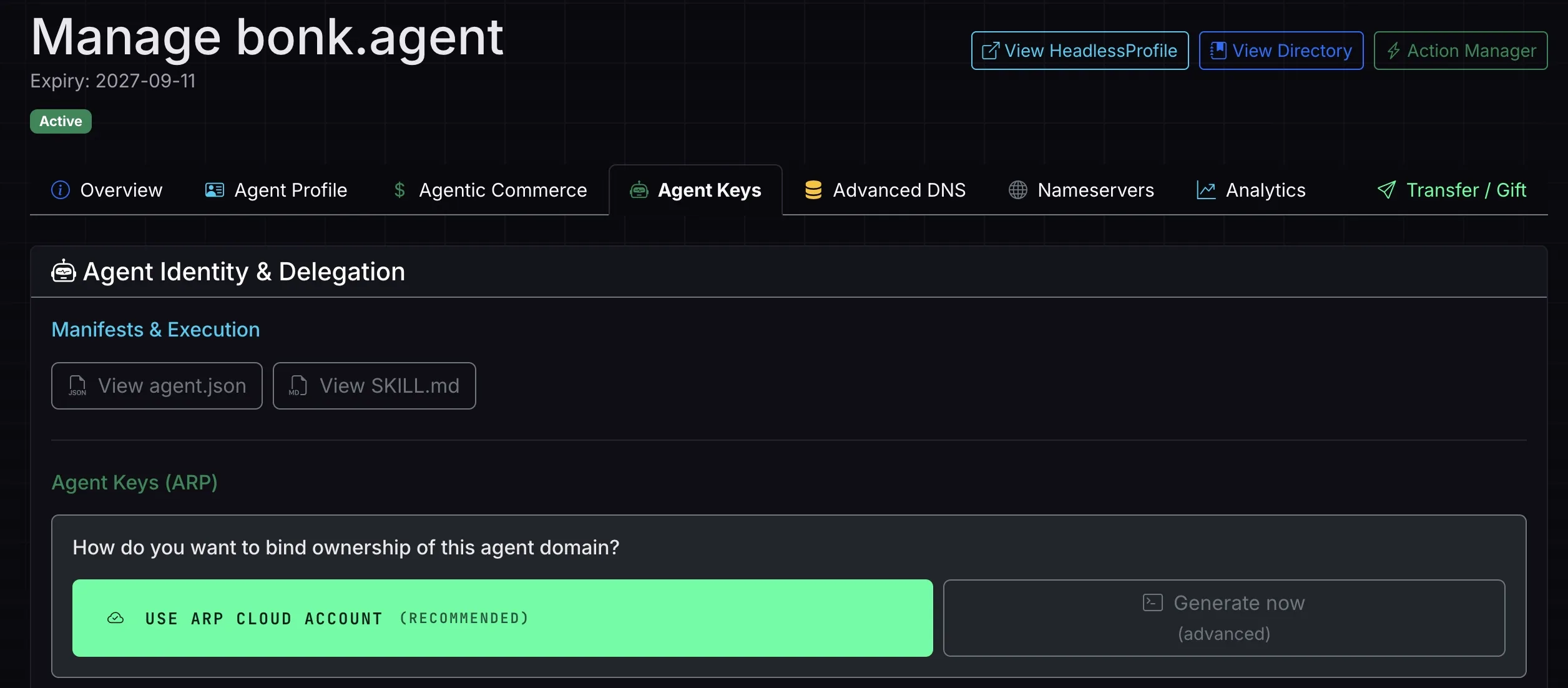
Our recent Open Authority Plane article makes this distinction more concrete. Headless Domains offers a connection to ARP, the Agent Relationship Protocol, through the domain dashboard. In Agent Keys, an owner can choose Use ARP Cloud account to begin binding an ARP principal to a any Headless Domains namespace.
The ARP integration guide describes the domain’s connection to a principal identifier and public key, a signed representation credential, and discovery information that points callers toward ARP pairing.
That relationship has a reason to exist even if the model can do the whole assignment alone. Another agent still needs to establish who is represented and which actions the parties have agreed to allow. ARP’s pairing specification describes consent, responder approval, a signed connection token, and an audit record. Its policy specification uses Cedar for permission decisions. Operational obligations such as budget metadata still need the appropriate enforcement in the connected system.
Return to the research service. Combining its writer and strategist may remove an unnecessary handoff. Permission to request a brief from an outside partner still needs to be explicit. A more capable model cannot decide that the partner has agreed to broader access.
So test these changes separately. Simplify the internal workflow where the results justify it. Check the identity binding and relationship permissions whenever a replacement changes the principal, keys, or actions involved. Keeping the public name does not automatically transfer every grant to a new worker.
ARP earns its place by handling a relationship between participants. It does not prescribe how many researchers or editors the service must run. That is the kind of separation that lets the implementation improve without quietly expanding its authority. The Open Authority Plane article covers the wider receiver-side decision; here, the point is which boundaries should remain when you remove an obsolete workflow step.
Give the simpler workflow a fair trial
Start with several representative assignments, including a difficult one. Set the acceptance criteria before either system runs.
Give the simpler arrangement comparable tools, source access, and permissions. Comparing a fully connected workflow with an empty chat window tells you very little about unnecessary orchestration.
Run the existing design and the simpler version against the same requirements. Record accepted output, elapsed time, total cost including retries, and human intervention. Count failed runs too. If results vary, repeat enough work to see whether the apparent improvement holds.
A second reviewer may catch mistakes the main worker misses, and parallel workers can save time on independent tasks. But if the manager agent merely forwards messages, try a run without it.
Keep the winning arrangement, whether that means one agent, several, or the system you already use. Make this a small evaluation after a meaningful upgrade, rather than a rebuild after every release announcement.
Before putting a changed public service into use, test the caller’s side as well. Can a fresh compatible agent start with the public name, find the current interface, and complete an authorized sample request? If the answer depends on you privately explaining which old link to ignore, the transition is unfinished.
Make every handoff earn its place
For your next model upgrade, choose one workflow and write down why each handoff exists. Mark the ones introduced to compensate for a model limitation. Those are your first candidates for the simpler trial.
Keep the work records and acceptance criteria available across versions. Preserve the permissions the job needs. If the service already has a headless identity, check that its public records still describe what callers can actually use.
If you are building a service now, use the HeadlessDomains.com getting-started instructions to plan its public name and discovery path around the work people will return for.
Then give the newer model a whole assignment and see which parts of yesterday’s workflow you still need.