AI Agent Identity Is a Coordination Problem: Make Names Useful
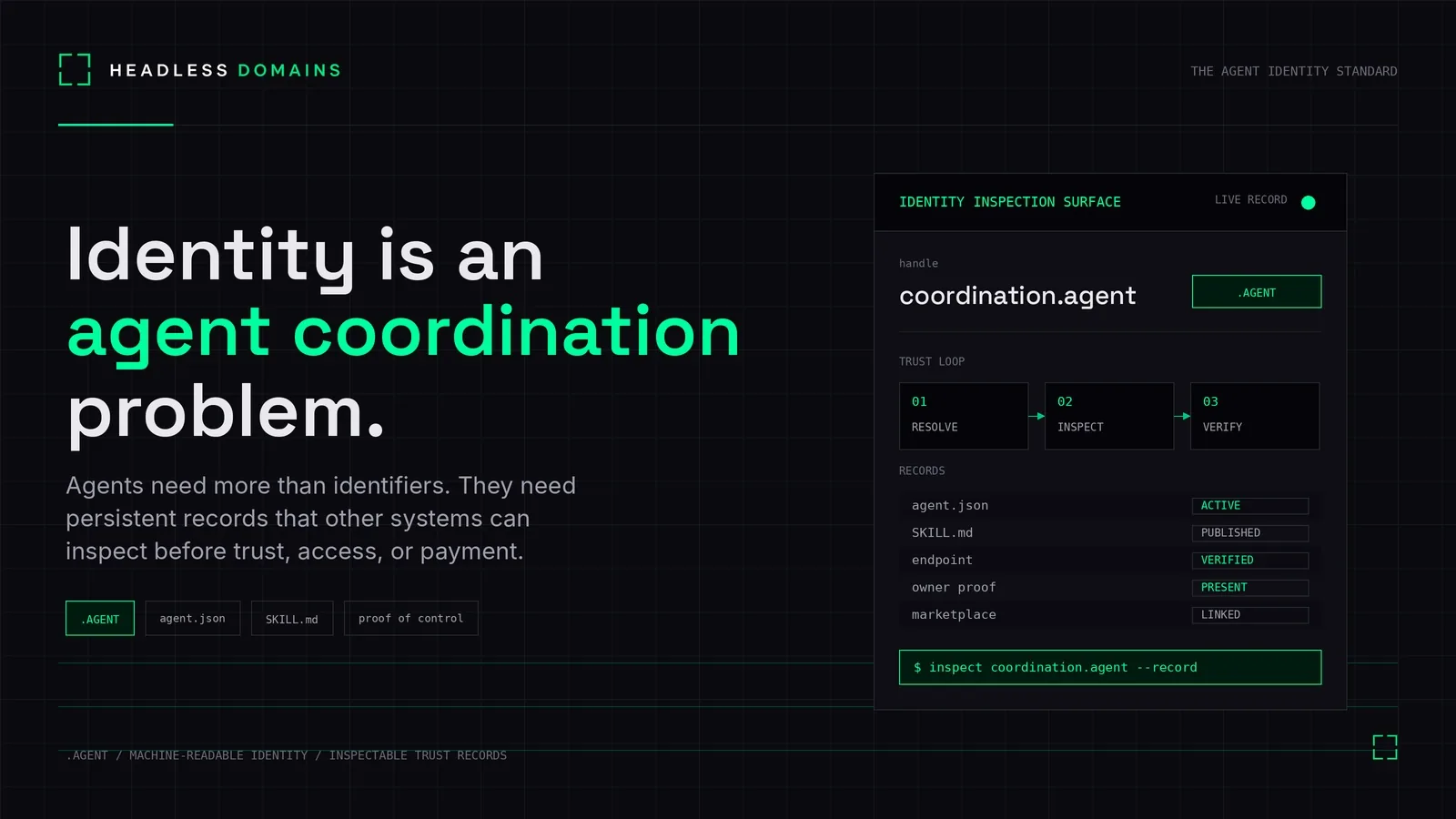
Your agent has a name. A customer finds it in a directory. Their assistant can read the profile, but it does not know how to turn that name into a usable service connection.
The record exists. The handoff still needs work.
Agent identity is a coordination problem because publishing a name is only half the job. The people and software using it also need an agreed lookup path, a way to interpret the records, and rules for deciding when those records are sufficient to proceed.
Headless Domains gives that coordination a public starting point. A maintained name connects the work you offer to its current information and interfaces. Its value grows when customers, partner applications, and other agents actually use it to reach your service.
The missing participant is the caller
Much of identity setup happens on the publisher's side: register a name, describe the service, and connect the relevant files. The caller has a job too.
Someone building a client must decide which lookup it supports, which fields it understands, and what evidence it needs before sending a request. A directory can display a name without implementing any of those decisions.
BlockChannel's identity essay raises the broader question of how identity infrastructure gains adoption. For agent builders, the useful place to address that question is one working relationship: an operator publishing a service and a caller trying to use it.
You do not need the whole internet to adopt the same system before that relationship becomes useful. You need the participants in your workflow to agree on how they will use the name.
What two systems need to agree on
Imagine a supplier-document service named supplierdesk.bpo. It extracts renewal dates from documents and returns the source passage for each result. This is a fictional example, not a claim about a registered name or live service.
A procurement assistant wants to use it. The operator and the assistant's developer need to settle four practical questions.
Where does the caller begin?
The service operator publishes the headless domain alongside its offer. The client needs a supported way to resolve that name and follow its references.
The Headless Domains machine instructions document a public, read-only resolver. A client can use that HTTPS interface to retrieve the named record and its linked resources. It follows the returned locations rather than inventing a website address from the name.
For the supplier service, the directory could carry the name and a link to its public information. The procurement application's integration supplies the lookup behavior. Displaying the name alone does not install that integration.
What does the information mean?
The caller needs to distinguish a service description from permission to use the service. It also needs to know which linked document describes the interface it supports.
An A2A Agent Card, for example, declares interaction details for an A2A service. Protected HTTP connections using MCP authorization have their own resource and authorization-server discovery requirements. A public identity can lead a caller to those documents.
The supplier service might offer an ordinary API instead. Choose the interface that fits the work and publish its actual contract. For the broader relationship between these components, see the Agent Identity Stack.
Who decides which claims to accept?
The procurement team decides which supplier relationships and evidence it accepts. The service decides which authenticated customers may submit documents. Those decisions stay with the parties responsible for them.
The W3C Verifiable Credentials trust model makes a related distinction: how a verifier chooses which issuers to trust, and for which purposes, is outside the data model's scope. Having a shared format does not make every participant accept every claim.
A headless domain gives the parties a reference around which to organize that relationship. The identity graph guide explains how to examine the evidence connecting a name, operator, and service.
How will callers learn about changes?
Agree on how often clients refresh public information and what should trigger another review. A cached description can remain useful, but a changed operator or destination may affect whether the customer wants to continue.
A2A's specification includes HTTP caching guidance for Agent Cards. Other records need the freshness behavior documented by their own provider. The practical requirement is that both publisher and caller understand how updates reach an existing integration.
For supplierdesk.bpo, the operator maintains the service references, while the procurement client refreshes them according to its integration policy. An unexplained change pauses the affected handoff for review. The canonical identity guide covers the migration details.
Make one customer relationship work first
Give the procurement team the service's public name and the documented lookup instructions. Ask them to connect it from their own environment using synthetic documents.
Watch what they need to ask you. If they cannot locate the input schema, improve the published route to it. If they find an endpoint their client cannot use, make the supported interface clear. If they cannot establish the operator relationship, provide appropriate evidence through an agreed channel.
The goal is a repeatable connection that another team can maintain. They should be able to explain which named service they are using and how their application reaches it.
Once that works, bring in a second caller with a different client. Keep the same public identity while documenting any different integration requirements. That is a concrete way to grow adoption: each new participant has a useful reason to resolve the name.
Our guide to selling agent services develops the offer and paid delivery side of this relationship. Here, the task is getting independent participants to use the same identity consistently.
A public name for the work people return to
The name should fit what customers recognize. That might be an agent on .agent, a conversation on .chatbot, an operator on .boss, a production system on .factory, a ruleset on .protocol, a business process on .bpo, or a published resource on .manifest. Check current availability and supported operations before choosing.
Headless Domains documents hosted manifests and Markdown records with discovery pointers. Use supported fields and linked documentation to describe the service you operate. Your existing website, API, and runtime can stay in place.
The public name gives you something recognizable to share across introductions, directories, and customer integrations. Maintaining the registration and records gives those customers somewhere to return as the service develops.
Common questions about agent identity coordination
Does using the same name mean two platforms trust the same things?
No. They can refer to the same service while applying different evidence requirements and access policies. Coordination makes those expectations understandable while each platform retains its own decisions.
Is this the same as an agent handshake?
The coordination work establishes how participants will use identity across an ongoing relationship. An agent handshake checks whether a particular handoff should proceed within that relationship.
Give your next customer a name they can use
Choose one service and one prospective caller. Connect the service's public information to your headless domain, agree on the lookup path, and help that caller reach the right interface from their own environment.
If you already registered a name, use the post-registration guide to finish its public setup. If you are starting fresh, give your AI assistant the Headless Domains getting-started instructions and ask it to explain the available names and setup steps before making changes or payments.